

17.4 Transformations of Rotation and Reflection
251
˜ 1 =
3
2
(ε x − ε 0 ); ˜ 3 =
1
√
2
γ xy .
Consequently, the strain trajectory will be a plane curve.
Transformation of the trajectory rotation Э = Э(t) is another trajectory Э
=
Э
(t) obtained from the first one by rotating it as a rigid whole relative to the
reference point.
In the considered case, this transformation is done using the formulas
˜
1 = ˜ 1 cos α + ˜ 3 sin α,
˜
3 = −˜ 1 sin α + ? 3 cos α,
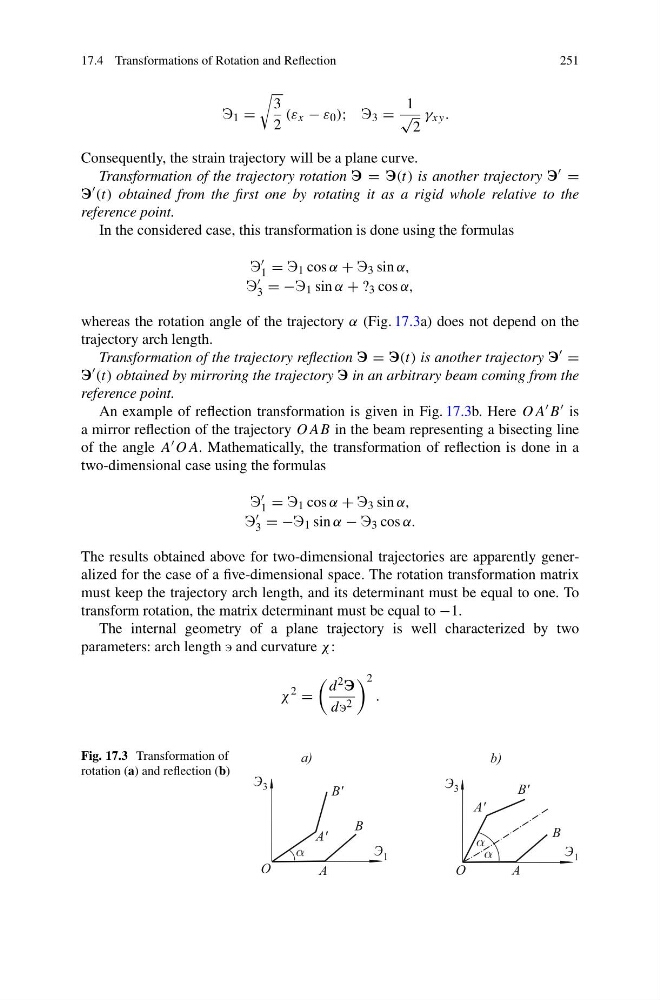
whereas the rotation angle of the trajectory α (Fig. 17.3a) does not depend on the
trajectory arch length.
Transformation of the trajectory reflection Э = Э(t) is another trajectory Э
=
Э
(t) obtained by mirroring the trajectory Э in an arbitrary beam coming from the
reference point.
An example of reflection transformation is given in Fig. 17.3b. Here OA B is
a mirror reflection of the trajectory OAB in the beam representing a bisecting line
of the angle A OA. Mathematically, the transformation of reflection is done in a
two-dimensional case using the formulas
˜
1 = ˜ 1 cos α + ˜ 3 sin α,
˜
3 = −˜ 1 sin α − ˜ 3 cos α.
The results obtained above for two-dimensional trajectories are apparently generalized for the case of a five-dimensional space. The rotation transformation matrix
must keep the trajectory arch length, and its determinant must be equal to one. To
transform rotation, the matrix determinant must be equal to −1.
The internal geometry of a plane trajectory is well characterized by two
parameters: arch length ¸ and curvature χ :
χ
2
=
d 2 Э
d¸ 2
2
.
Fig. 17.3 Transformation of
rotation (a) and reflection (b)
O
A
B
A'
B'
Э 1
Э 3
а)
α
α
α
O
A
B
A'
B'
Э 1
Э 3
b)
251
˜ 1 =
3
2
(ε x − ε 0 ); ˜ 3 =
1
√
2
γ xy .
Consequently, the strain trajectory will be a plane curve.
Transformation of the trajectory rotation Э = Э(t) is another trajectory Э
=
Э
(t) obtained from the first one by rotating it as a rigid whole relative to the
reference point.
In the considered case, this transformation is done using the formulas
˜
1 = ˜ 1 cos α + ˜ 3 sin α,
˜
3 = −˜ 1 sin α + ? 3 cos α,
whereas the rotation angle of the trajectory α (Fig. 17.3a) does not depend on the
trajectory arch length.
Transformation of the trajectory reflection Э = Э(t) is another trajectory Э
=
Э
(t) obtained by mirroring the trajectory Э in an arbitrary beam coming from the
reference point.
An example of reflection transformation is given in Fig. 17.3b. Here OA B is
a mirror reflection of the trajectory OAB in the beam representing a bisecting line
of the angle A OA. Mathematically, the transformation of reflection is done in a
two-dimensional case using the formulas
˜
1 = ˜ 1 cos α + ˜ 3 sin α,
˜
3 = −˜ 1 sin α − ˜ 3 cos α.
The results obtained above for two-dimensional trajectories are apparently generalized for the case of a five-dimensional space. The rotation transformation matrix
must keep the trajectory arch length, and its determinant must be equal to one. To
transform rotation, the matrix determinant must be equal to −1.
The internal geometry of a plane trajectory is well characterized by two
parameters: arch length ¸ and curvature χ :
χ
2
=
d 2 Э
d¸ 2
2
.
Fig. 17.3 Transformation of
rotation (a) and reflection (b)
O
A
B
A'
B'
Э 1
Э 3
а)
α
α
α
O
A
B
A'
B'
Э 1
Э 3
b)