

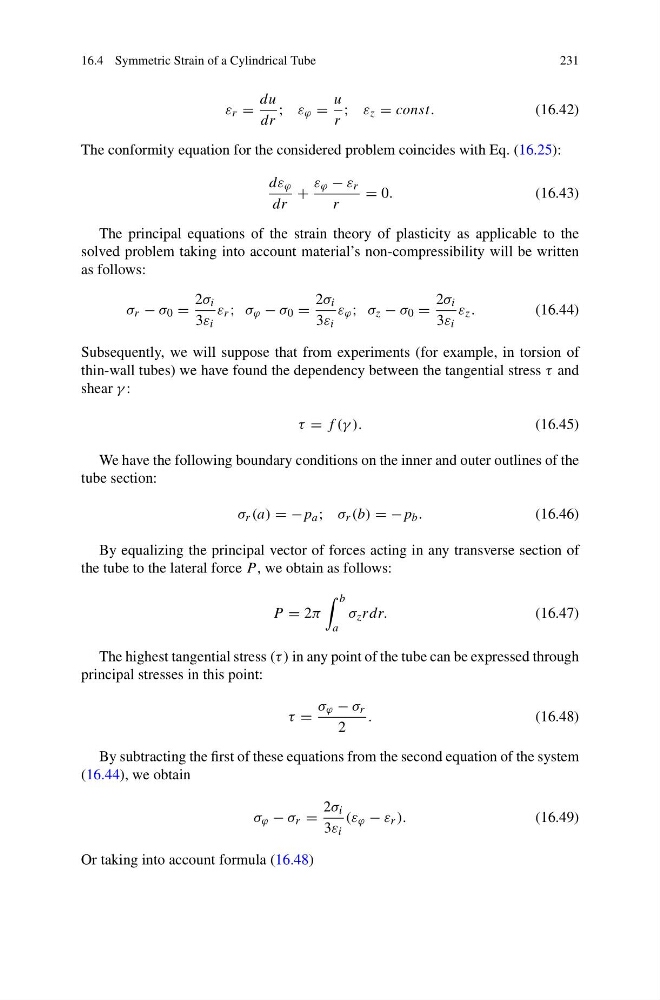
16.4 Symmetric Strain of a Cylindrical Tube
231
ε r =
du
dr
; ε ϕ =
u
r
; ε z = const.
(16.42)
The conformity equation for the considered problem coincides with Eq. (16.25):
dε ϕ
dr
+
ε ϕ − ε r
r
= 0.
(16.43)
The principal equations of the strain theory of plasticity as applicable to the
solved problem taking into account material’s non-compressibility will be written
as follows:
σ r − σ 0 =
2σ i
3ε i
ε r ; σ ϕ − σ 0 =
2σ i
3ε i
ε ϕ ; σ z − σ 0 =
2σ i
3ε i
ε z .
(16.44)
Subsequently, we will suppose that from experiments (for example, in torsion of
thin-wall tubes) we have found the dependency between the tangential stress τ and
shear γ :
τ = f (γ ).
(16.45)
We have the following boundary conditions on the inner and outer outlines of the
tube section:
σ r (a) = −p a ; σ r (b) = −p b .
(16.46)
By equalizing the principal vector of forces acting in any transverse section of
the tube to the lateral force P , we obtain as follows:
P = 2π
b
a
σ z rdr.
(16.47)
The highest tangential stress (τ ) in any point of the tube can be expressed through
principal stresses in this point:
τ =
σ ϕ − σ r
2
.
(16.48)
By subtracting the first of these equations from the second equation of the system
(16.44), we obtain
σ ϕ − σ r =
2σ i
3ε i
(ε ϕ − ε r ).
(16.49)
Or taking into account formula (16.48)
231
ε r =
du
dr
; ε ϕ =
u
r
; ε z = const.
(16.42)
The conformity equation for the considered problem coincides with Eq. (16.25):
dε ϕ
dr
+
ε ϕ − ε r
r
= 0.
(16.43)
The principal equations of the strain theory of plasticity as applicable to the
solved problem taking into account material’s non-compressibility will be written
as follows:
σ r − σ 0 =
2σ i
3ε i
ε r ; σ ϕ − σ 0 =
2σ i
3ε i
ε ϕ ; σ z − σ 0 =
2σ i
3ε i
ε z .
(16.44)
Subsequently, we will suppose that from experiments (for example, in torsion of
thin-wall tubes) we have found the dependency between the tangential stress τ and
shear γ :
τ = f (γ ).
(16.45)
We have the following boundary conditions on the inner and outer outlines of the
tube section:
σ r (a) = −p a ; σ r (b) = −p b .
(16.46)
By equalizing the principal vector of forces acting in any transverse section of
the tube to the lateral force P , we obtain as follows:
P = 2π
b
a
σ z rdr.
(16.47)
The highest tangential stress (τ ) in any point of the tube can be expressed through
principal stresses in this point:
τ =
σ ϕ − σ r
2
.
(16.48)
By subtracting the first of these equations from the second equation of the system
(16.44), we obtain
σ ϕ − σ r =
2σ i
3ε i
(ε ϕ − ε r ).
(16.49)
Or taking into account formula (16.48)