

182
14 On the Plasticity Conditions of an Isotropic Body
f (σ 1 , σ 2 , σ 3 ) = 0,
(14.3)
whereas f is a symmetric function of stress invariants. Condition (14.3) can also be
written as follows:
f (J 1 , J 2 , J 3 ) = 0,
(14.4)
where J i are stress tensor invariants.
If we neglect the effect of hydrostatic stress on the plasticity condition, arguments
of the function f in the ratio (14.4) will be deemed the second and third invariants
of the stress deviator, e.g. assume that
f (J
2 , J
3 ) = 0.
(14.5)
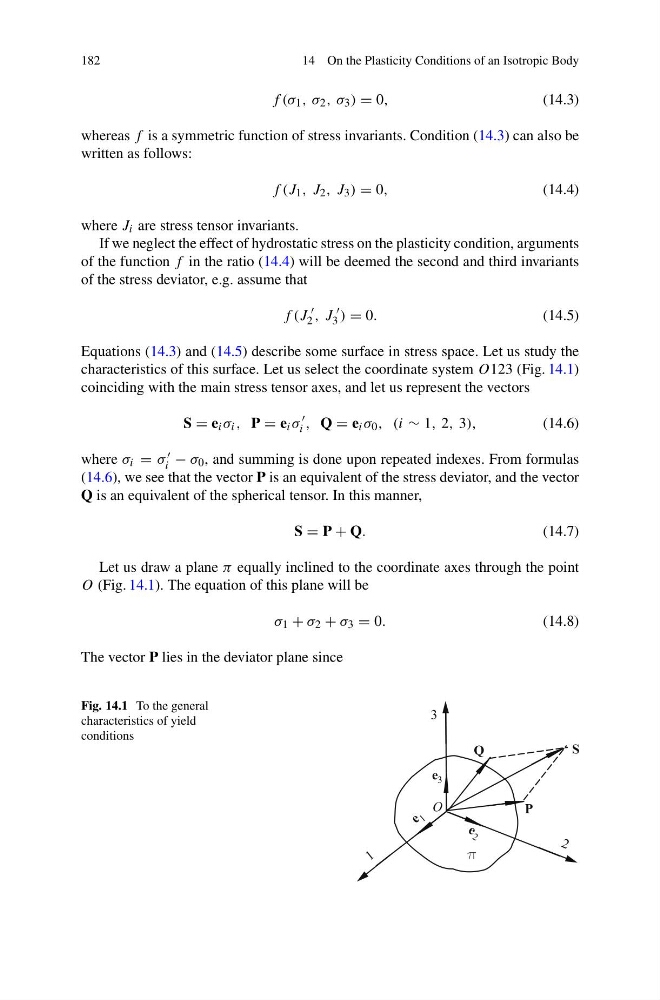
Equations (14.3) and (14.5) describe some surface in stress space. Let us study the
characteristics of this surface. Let us select the coordinate system O123 (Fig. 14.1)
coinciding with the main stress tensor axes, and let us represent the vectors
S = e i σ i , P = e i σ
i , Q = e i σ 0 , (i ∼ 1, 2, 3),
(14.6)
where σ i = σ
i − σ 0 , and summing is done upon repeated indexes. From formulas
(14.6), we see that the vector P is an equivalent of the stress deviator, and the vector
Q is an equivalent of the spherical tensor. In this manner,
S = P + Q.
(14.7)
Let us draw a plane π equally inclined to the coordinate axes through the point
O (Fig. 14.1). The equation of this plane will be
σ 1 + σ 2 + σ 3 = 0.
(14.8)
The vector P lies in the deviator plane since
Fig. 14.1 To the general
characteristics of yield
conditions
14 On the Plasticity Conditions of an Isotropic Body
f (σ 1 , σ 2 , σ 3 ) = 0,
(14.3)
whereas f is a symmetric function of stress invariants. Condition (14.3) can also be
written as follows:
f (J 1 , J 2 , J 3 ) = 0,
(14.4)
where J i are stress tensor invariants.
If we neglect the effect of hydrostatic stress on the plasticity condition, arguments
of the function f in the ratio (14.4) will be deemed the second and third invariants
of the stress deviator, e.g. assume that
f (J
2 , J
3 ) = 0.
(14.5)
Equations (14.3) and (14.5) describe some surface in stress space. Let us study the
characteristics of this surface. Let us select the coordinate system O123 (Fig. 14.1)
coinciding with the main stress tensor axes, and let us represent the vectors
S = e i σ i , P = e i σ
i , Q = e i σ 0 , (i ∼ 1, 2, 3),
(14.6)
where σ i = σ
i − σ 0 , and summing is done upon repeated indexes. From formulas
(14.6), we see that the vector P is an equivalent of the stress deviator, and the vector
Q is an equivalent of the spherical tensor. In this manner,
S = P + Q.
(14.7)
Let us draw a plane π equally inclined to the coordinate axes through the point
O (Fig. 14.1). The equation of this plane will be
σ 1 + σ 2 + σ 3 = 0.
(14.8)
The vector P lies in the deviator plane since
Fig. 14.1 To the general
characteristics of yield
conditions