

174
13 Initial Concepts of Plasticity Theory
β 1 =
σ 2 − σ 3
(σ 1 − σ 2 ) 2 + (σ 2 − σ 3 ) 2 + (σ 3 − σ 1 ) 2
,
β 2 =
σ 3 − σ 1
(σ 1 − σ 2 ) 2 + (σ 2 − σ 3 ) 2 + (σ 3 − σ 1 ) 2
,
β 3 =
σ 1 − σ 2
(σ 1 − σ 2 ) 2 + (σ 2 − σ 3 ) 2 + (σ 3 − σ 1 ) 2
.
(13.32)
Similarly to the strain tensor, we introduce the concept of octahedral shift (γ 0 ) that
is defined through principal deformations ε 1 , ε 2 , ε 3 using the formula
γ 0 =
2
3
(ε 1 − ε 2 ) 2 + (ε 2 − ε 3 ) 2 + (ε 3 − ε 1 ) 2 .
(13.33)
Along with the octahedral tangential stress and octahedral shift, the theory of nonelastic deformations also uses values proportional to them: stress intensity σ i and
strain intensity ε i :
σ i =
3
√
2
τ 0 =
1
√
2
(σ 1 − σ 2 ) 2 + (σ 2 − σ 3 ) 2 + (σ 3 − σ 1 ) 2 ,
ε i =
1
√
2
γ 0 =
√
2
3
(ε 1 − ε 2 ) 2 + (ε 2 − ε 3 ) 2 + (ε 3 − ε 1 ) 2 .
(13.34)
The multiplier 3/
√
2 in front of τ 0 in formula (13.30) is selected so that in the case
of uniaxial elongation of a rod with the stress σ , the stress intensity σ ? coincides
with σ . In a similar way, the multiplier 1/
√
2 in front of γ 0 is selected such that in
the case of uniaxial elongation (ν = 0, 5), the strain intensity ε ? coincides with the
relative linear deformation in the direction of the rod axis.
13.5 On the Criterion of Similarity of Stress and Strain
Deviators
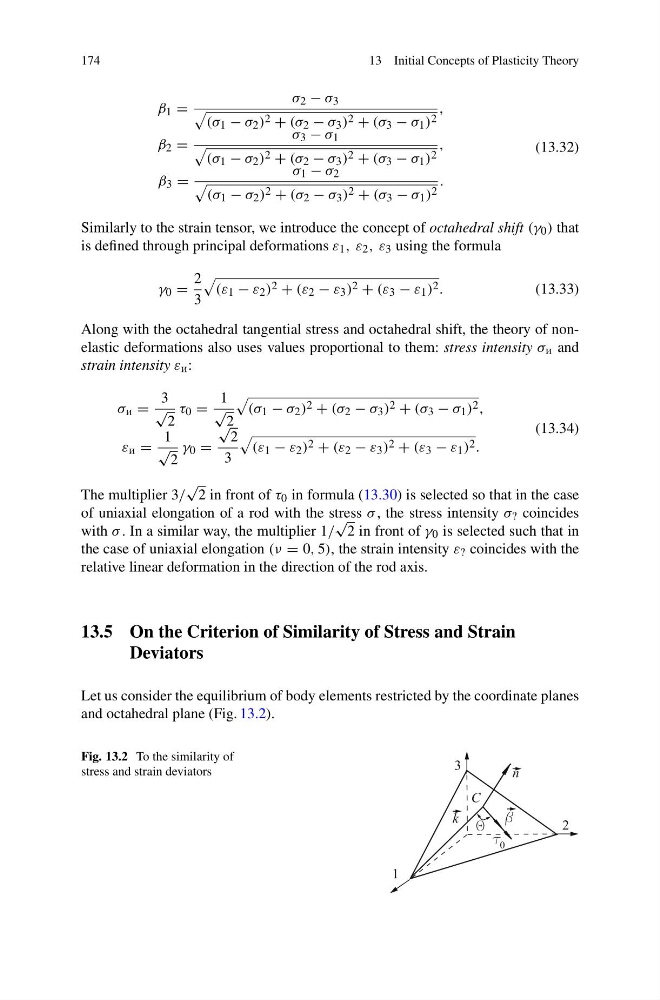
Let us consider the equilibrium of body elements restricted by the coordinate planes
and octahedral plane (Fig. 13.2).
Fig. 13.2 To the similarity of
stress and strain deviators
13 Initial Concepts of Plasticity Theory
β 1 =
σ 2 − σ 3
(σ 1 − σ 2 ) 2 + (σ 2 − σ 3 ) 2 + (σ 3 − σ 1 ) 2
,
β 2 =
σ 3 − σ 1
(σ 1 − σ 2 ) 2 + (σ 2 − σ 3 ) 2 + (σ 3 − σ 1 ) 2
,
β 3 =
σ 1 − σ 2
(σ 1 − σ 2 ) 2 + (σ 2 − σ 3 ) 2 + (σ 3 − σ 1 ) 2
.
(13.32)
Similarly to the strain tensor, we introduce the concept of octahedral shift (γ 0 ) that
is defined through principal deformations ε 1 , ε 2 , ε 3 using the formula
γ 0 =
2
3
(ε 1 − ε 2 ) 2 + (ε 2 − ε 3 ) 2 + (ε 3 − ε 1 ) 2 .
(13.33)
Along with the octahedral tangential stress and octahedral shift, the theory of nonelastic deformations also uses values proportional to them: stress intensity σ i and
strain intensity ε i :
σ i =
3
√
2
τ 0 =
1
√
2
(σ 1 − σ 2 ) 2 + (σ 2 − σ 3 ) 2 + (σ 3 − σ 1 ) 2 ,
ε i =
1
√
2
γ 0 =
√
2
3
(ε 1 − ε 2 ) 2 + (ε 2 − ε 3 ) 2 + (ε 3 − ε 1 ) 2 .
(13.34)
The multiplier 3/
√
2 in front of τ 0 in formula (13.30) is selected so that in the case
of uniaxial elongation of a rod with the stress σ , the stress intensity σ ? coincides
with σ . In a similar way, the multiplier 1/
√
2 in front of γ 0 is selected such that in
the case of uniaxial elongation (ν = 0, 5), the strain intensity ε ? coincides with the
relative linear deformation in the direction of the rod axis.
13.5 On the Criterion of Similarity of Stress and Strain
Deviators
Let us consider the equilibrium of body elements restricted by the coordinate planes
and octahedral plane (Fig. 13.2).
Fig. 13.2 To the similarity of
stress and strain deviators