

172
13 Initial Concepts of Plasticity Theory
=
1
3
(σ 1 − σ 2 ) + (σ 2 − σ 3 ) + (σ 3 − σ 1 )
;
J
3 = (σ
3
1 + σ
3
2 + σ
3
3 )
=
1
9
(2σ 1 − σ 2 − σ 3 )(2σ 2 − σ 3 − σ 1 )(2σ 3 − σ 2 − σ 1 ).
(13.24)
Similar ratios between invariants can be written for the strain tensor and its deviator,
as well as their expanded expression through the components ε ij . These expressions
are obtained from the respective expressions of the tensor invariants and stress
deviator by substituting (σ x , σ y , σ z ) with (ε x , ε y , ε z ) and (τ xy , τ yz , τ zx ) with
1
2
γ xy ,
1
2
γ yz ,
1
2
γ zx
.
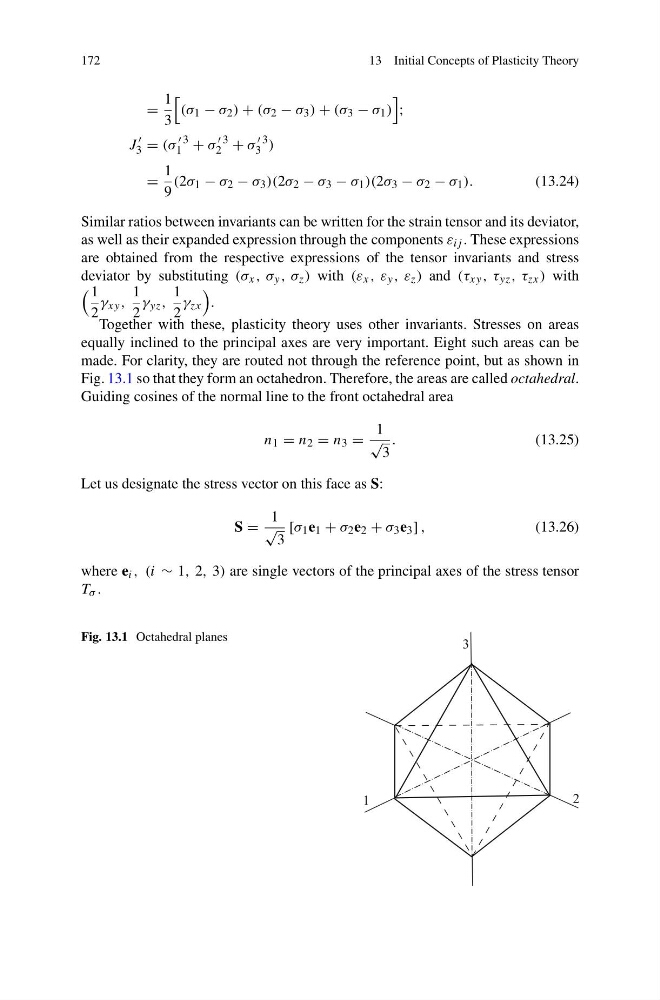
Together with these, plasticity theory uses other invariants. Stresses on areas
equally inclined to the principal axes are very important. Eight such areas can be
made. For clarity, they are routed not through the reference point, but as shown in
Fig. 13.1 so that they form an octahedron. Therefore, the areas are called octahedral.
Guiding cosines of the normal line to the front octahedral area
n 1 = n 2 = n 3 =
1
√
3
.
(13.25)
Let us designate the stress vector on this face as S:
S =
1
√
3
[σ 1 e 1 + σ 2 e 2 + σ 3 e 3 ] ,
(13.26)
where e i , (i ∼ 1, 2, 3) are single vectors of the principal axes of the stress tensor
T σ .
Fig. 13.1 Octahedral planes
13 Initial Concepts of Plasticity Theory
=
1
3
(σ 1 − σ 2 ) + (σ 2 − σ 3 ) + (σ 3 − σ 1 )
;
J
3 = (σ
3
1 + σ
3
2 + σ
3
3 )
=
1
9
(2σ 1 − σ 2 − σ 3 )(2σ 2 − σ 3 − σ 1 )(2σ 3 − σ 2 − σ 1 ).
(13.24)
Similar ratios between invariants can be written for the strain tensor and its deviator,
as well as their expanded expression through the components ε ij . These expressions
are obtained from the respective expressions of the tensor invariants and stress
deviator by substituting (σ x , σ y , σ z ) with (ε x , ε y , ε z ) and (τ xy , τ yz , τ zx ) with
1
2
γ xy ,
1
2
γ yz ,
1
2
γ zx
.
Together with these, plasticity theory uses other invariants. Stresses on areas
equally inclined to the principal axes are very important. Eight such areas can be
made. For clarity, they are routed not through the reference point, but as shown in
Fig. 13.1 so that they form an octahedron. Therefore, the areas are called octahedral.
Guiding cosines of the normal line to the front octahedral area
n 1 = n 2 = n 3 =
1
√
3
.
(13.25)
Let us designate the stress vector on this face as S:
S =
1
√
3
[σ 1 e 1 + σ 2 e 2 + σ 3 e 3 ] ,
(13.26)
where e i , (i ∼ 1, 2, 3) are single vectors of the principal axes of the stress tensor
T σ .
Fig. 13.1 Octahedral planes