

13.3 Decomposition of Stress and Strain Tensors
169
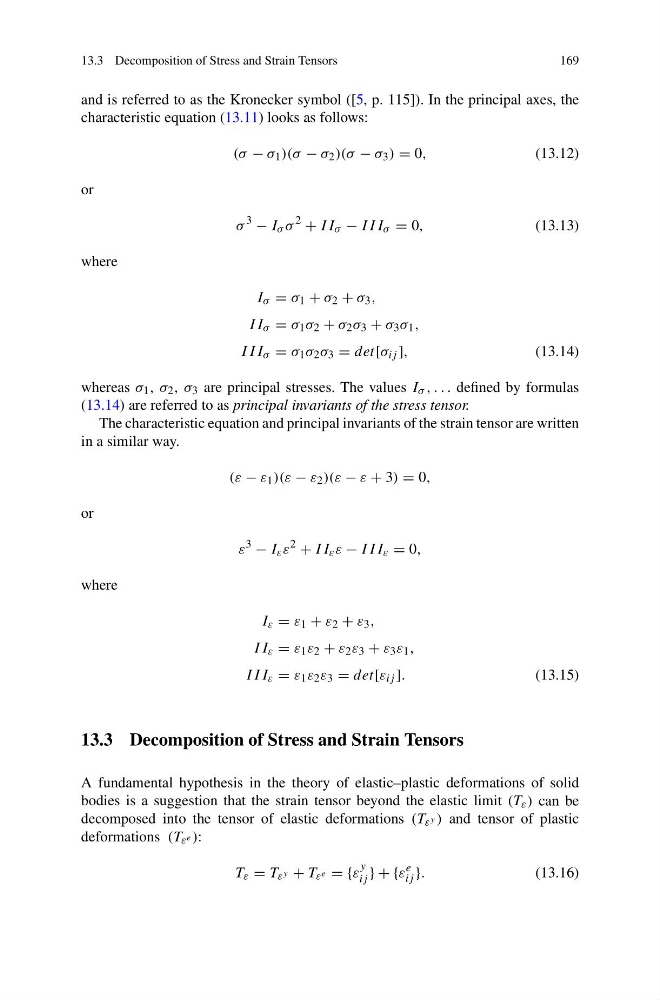
and is referred to as the Kronecker symbol ([5, p. 115]). In the principal axes, the
characteristic equation (13.11) looks as follows:
(σ − σ 1 )(σ − σ 2 )(σ − σ 3 ) = 0,
(13.12)
or
σ
3
− I σ σ
2
+ I I σ − I I I σ = 0,
(13.13)
where
I σ = σ 1 + σ 2 + σ 3 ,
I I σ = σ 1 σ 2 + σ 2 σ 3 + σ 3 σ 1 ,
I I I σ = σ 1 σ 2 σ 3 = det[σ ij ],
(13.14)
whereas σ 1 , σ 2 , σ 3 are principal stresses. The values I σ , . . . defined by formulas
(13.14) are referred to as principal invariants of the stress tensor.
The characteristic equation and principal invariants of the strain tensor are written
in a similar way.
(ε − ε 1 )(ε − ε 2 )(ε − ε + 3) = 0,
or
ε
3
− I ε ε
2
+ I I ε ε − I I I ε = 0,
where
I ε = ε 1 + ε 2 + ε 3 ,
I I ε = ε 1 ε 2 + ε 2 ε 3 + ε 3 ε 1 ,
I I I ε = ε 1 ε 2 ε 3 = det[ε ij ].
(13.15)
13.3 Decomposition of Stress and Strain Tensors
A fundamental hypothesis in the theory of elastic–plastic deformations of solid
bodies is a suggestion that the strain tensor beyond the elastic limit (T ε ) can be
decomposed into the tensor of elastic deformations (T ε y ) and tensor of plastic
deformations (T ε e ):
T ε = T ε y + T ε e = {ε
y
ij } + {ε
e
ij }.
(13.16)
169
and is referred to as the Kronecker symbol ([5, p. 115]). In the principal axes, the
characteristic equation (13.11) looks as follows:
(σ − σ 1 )(σ − σ 2 )(σ − σ 3 ) = 0,
(13.12)
or
σ
3
− I σ σ
2
+ I I σ − I I I σ = 0,
(13.13)
where
I σ = σ 1 + σ 2 + σ 3 ,
I I σ = σ 1 σ 2 + σ 2 σ 3 + σ 3 σ 1 ,
I I I σ = σ 1 σ 2 σ 3 = det[σ ij ],
(13.14)
whereas σ 1 , σ 2 , σ 3 are principal stresses. The values I σ , . . . defined by formulas
(13.14) are referred to as principal invariants of the stress tensor.
The characteristic equation and principal invariants of the strain tensor are written
in a similar way.
(ε − ε 1 )(ε − ε 2 )(ε − ε + 3) = 0,
or
ε
3
− I ε ε
2
+ I I ε ε − I I I ε = 0,
where
I ε = ε 1 + ε 2 + ε 3 ,
I I ε = ε 1 ε 2 + ε 2 ε 3 + ε 3 ε 1 ,
I I I ε = ε 1 ε 2 ε 3 = det[ε ij ].
(13.15)
13.3 Decomposition of Stress and Strain Tensors
A fundamental hypothesis in the theory of elastic–plastic deformations of solid
bodies is a suggestion that the strain tensor beyond the elastic limit (T ε ) can be
decomposed into the tensor of elastic deformations (T ε y ) and tensor of plastic
deformations (T ε e ):
T ε = T ε y + T ε e = {ε
y
ij } + {ε
e
ij }.
(13.16)