

12.4 Development of Plasticity Theory in the Twentieth Century
149
Together with this, other authors (see, for example, [26]) note that the solutions
obtained under the scheme of full plasticity can be interesting.
In 1913, Richard Edler von Mises generalized and partially simplified the SaintVenant–Levy ratios. The theory was based on [50, 65] the following ideas.
1. Any body is elastic if stresses are sufficiently low.
2. When reaching the elasticity limit, the body shows the properties of a noncompressible viscous liquid.
Bringing this idea to a mathematical form, Mises comes to the Levi equations.
3. During plastic deformations, stresses remain the same as at the elastic limit. The
concept of the elastic limit is defined as follows by Mises.
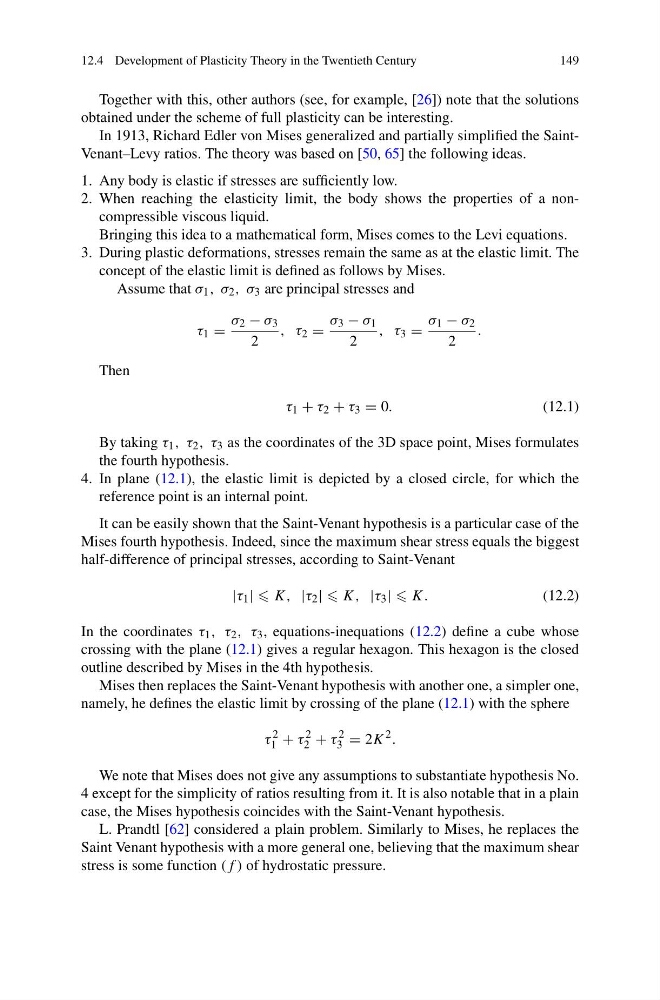
Assume that σ 1 , σ 2 , σ 3 are principal stresses and
τ 1 =
σ 2 − σ 3
2
, τ 2 =
σ 3 − σ 1
2
, τ 3 =
σ 1 − σ 2
2
.
Then
τ 1 + τ 2 + τ 3 = 0.
(12.1)
By taking τ 1 , τ 2 , τ 3 as the coordinates of the 3D space point, Mises formulates
the fourth hypothesis.
4. In plane (12.1), the elastic limit is depicted by a closed circle, for which the
reference point is an internal point.
It can be easily shown that the Saint-Venant hypothesis is a particular case of the
Mises fourth hypothesis. Indeed, since the maximum shear stress equals the biggest
half-difference of principal stresses, according to Saint-Venant
|τ 1 | K, |τ 2 | K, |τ 3 | K.
(12.2)
In the coordinates τ 1 , τ 2 , τ 3 , equations-inequations (12.2) define a cube whose
crossing with the plane (12.1) gives a regular hexagon. This hexagon is the closed
outline described by Mises in the 4th hypothesis.
Mises then replaces the Saint-Venant hypothesis with another one, a simpler one,
namely, he defines the elastic limit by crossing of the plane (12.1) with the sphere
τ
2
1 + τ
2
2 + τ
2
3 = 2K
2 .
We note that Mises does not give any assumptions to substantiate hypothesis No.
4 except for the simplicity of ratios resulting from it. It is also notable that in a plain
case, the Mises hypothesis coincides with the Saint-Venant hypothesis.
L. Prandtl [62] considered a plain problem. Similarly to Mises, he replaces the
Saint Venant hypothesis with a more general one, believing that the maximum shear
stress is some function (f ) of hydrostatic pressure.
149
Together with this, other authors (see, for example, [26]) note that the solutions
obtained under the scheme of full plasticity can be interesting.
In 1913, Richard Edler von Mises generalized and partially simplified the SaintVenant–Levy ratios. The theory was based on [50, 65] the following ideas.
1. Any body is elastic if stresses are sufficiently low.
2. When reaching the elasticity limit, the body shows the properties of a noncompressible viscous liquid.
Bringing this idea to a mathematical form, Mises comes to the Levi equations.
3. During plastic deformations, stresses remain the same as at the elastic limit. The
concept of the elastic limit is defined as follows by Mises.
Assume that σ 1 , σ 2 , σ 3 are principal stresses and
τ 1 =
σ 2 − σ 3
2
, τ 2 =
σ 3 − σ 1
2
, τ 3 =
σ 1 − σ 2
2
.
Then
τ 1 + τ 2 + τ 3 = 0.
(12.1)
By taking τ 1 , τ 2 , τ 3 as the coordinates of the 3D space point, Mises formulates
the fourth hypothesis.
4. In plane (12.1), the elastic limit is depicted by a closed circle, for which the
reference point is an internal point.
It can be easily shown that the Saint-Venant hypothesis is a particular case of the
Mises fourth hypothesis. Indeed, since the maximum shear stress equals the biggest
half-difference of principal stresses, according to Saint-Venant
|τ 1 | K, |τ 2 | K, |τ 3 | K.
(12.2)
In the coordinates τ 1 , τ 2 , τ 3 , equations-inequations (12.2) define a cube whose
crossing with the plane (12.1) gives a regular hexagon. This hexagon is the closed
outline described by Mises in the 4th hypothesis.
Mises then replaces the Saint-Venant hypothesis with another one, a simpler one,
namely, he defines the elastic limit by crossing of the plane (12.1) with the sphere
τ
2
1 + τ
2
2 + τ
2
3 = 2K
2 .
We note that Mises does not give any assumptions to substantiate hypothesis No.
4 except for the simplicity of ratios resulting from it. It is also notable that in a plain
case, the Mises hypothesis coincides with the Saint-Venant hypothesis.
L. Prandtl [62] considered a plain problem. Similarly to Mises, he replaces the
Saint Venant hypothesis with a more general one, believing that the maximum shear
stress is some function (f ) of hydrostatic pressure.