

11.12 Stability Under Non-conservative Load (Example)
141
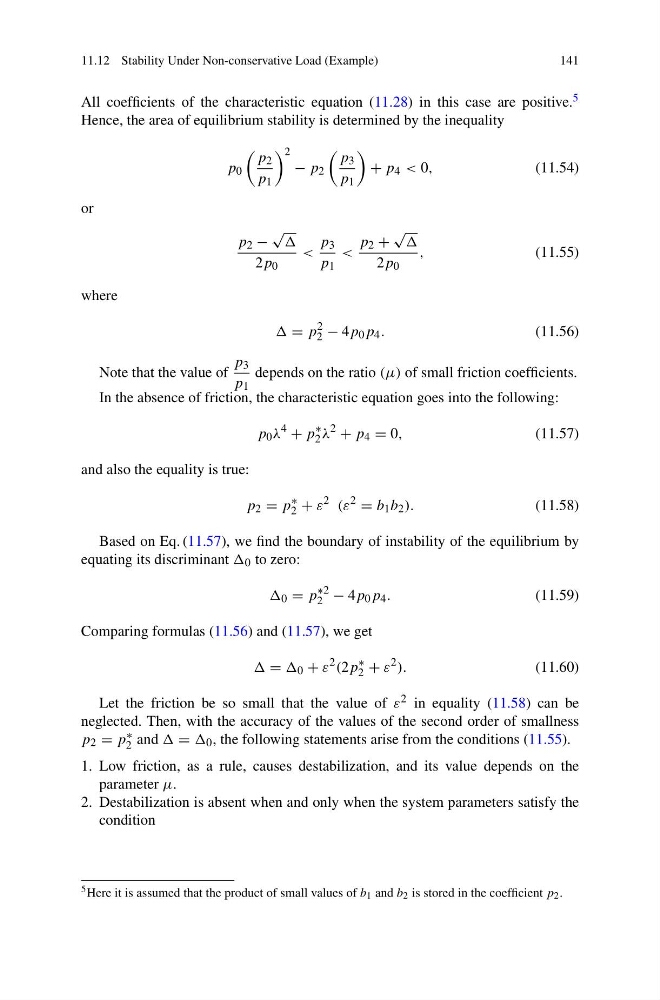
All coefficients of the characteristic equation (11.28) in this case are positive. 5
Hence, the area of equilibrium stability is determined by the inequality
p 0
p 2
p 1
2
− p 2
p 3
p 1
+ p 4 < 0,
(11.54)
or
p 2 −
√
2p 0
<
p 3
p 1
<
p 2 +
√
2p 0
,
(11.55)
where
= p
2
2 − 4p 0 p 4 .
(11.56)
Note that the value of
p 3
p 1
depends on the ratio (μ) of small friction coefficients.
In the absence of friction, the characteristic equation goes into the following:
p 0 λ
4
+ p
∗
2 λ
2
+ p 4 = 0,
(11.57)
and also the equality is true:
p 2 = p
∗
2 + ε
2 (ε
2
= b 1 b 2 ).
(11.58)
Based on Eq. (11.57), we find the boundary of instability of the equilibrium by
equating its discriminant 0 to zero:
0 = p
∗2
2 − 4p 0 p 4 .
(11.59)
Comparing formulas (11.56) and (11.57), we get
= 0 + ε
2 (2p
∗
2 + ε
2 ).
(11.60)
Let the friction be so small that the value of ε 2 in equality (11.58) can be
neglected. Then, with the accuracy of the values of the second order of smallness
p 2 = p ∗
2 and = 0 , the following statements arise from the conditions (11.55).
1. Low friction, as a rule, causes destabilization, and its value depends on the
parameter μ.
2. Destabilization is absent when and only when the system parameters satisfy the
condition
5 Here it is assumed that the product of small values of b 1 and b 2 is stored in the coefficient p 2 .
141
All coefficients of the characteristic equation (11.28) in this case are positive. 5
Hence, the area of equilibrium stability is determined by the inequality
p 0
p 2
p 1
2
− p 2
p 3
p 1
+ p 4 < 0,
(11.54)
or
p 2 −
√
2p 0
<
p 3
p 1
<
p 2 +
√
2p 0
,
(11.55)
where
= p
2
2 − 4p 0 p 4 .
(11.56)
Note that the value of
p 3
p 1
depends on the ratio (μ) of small friction coefficients.
In the absence of friction, the characteristic equation goes into the following:
p 0 λ
4
+ p
∗
2 λ
2
+ p 4 = 0,
(11.57)
and also the equality is true:
p 2 = p
∗
2 + ε
2 (ε
2
= b 1 b 2 ).
(11.58)
Based on Eq. (11.57), we find the boundary of instability of the equilibrium by
equating its discriminant 0 to zero:
0 = p
∗2
2 − 4p 0 p 4 .
(11.59)
Comparing formulas (11.56) and (11.57), we get
= 0 + ε
2 (2p
∗
2 + ε
2 ).
(11.60)
Let the friction be so small that the value of ε 2 in equality (11.58) can be
neglected. Then, with the accuracy of the values of the second order of smallness
p 2 = p ∗
2 and = 0 , the following statements arise from the conditions (11.55).
1. Low friction, as a rule, causes destabilization, and its value depends on the
parameter μ.
2. Destabilization is absent when and only when the system parameters satisfy the
condition
5 Here it is assumed that the product of small values of b 1 and b 2 is stored in the coefficient p 2 .