

132
11 The Beginning of the Theory of Stability of Equilibrium
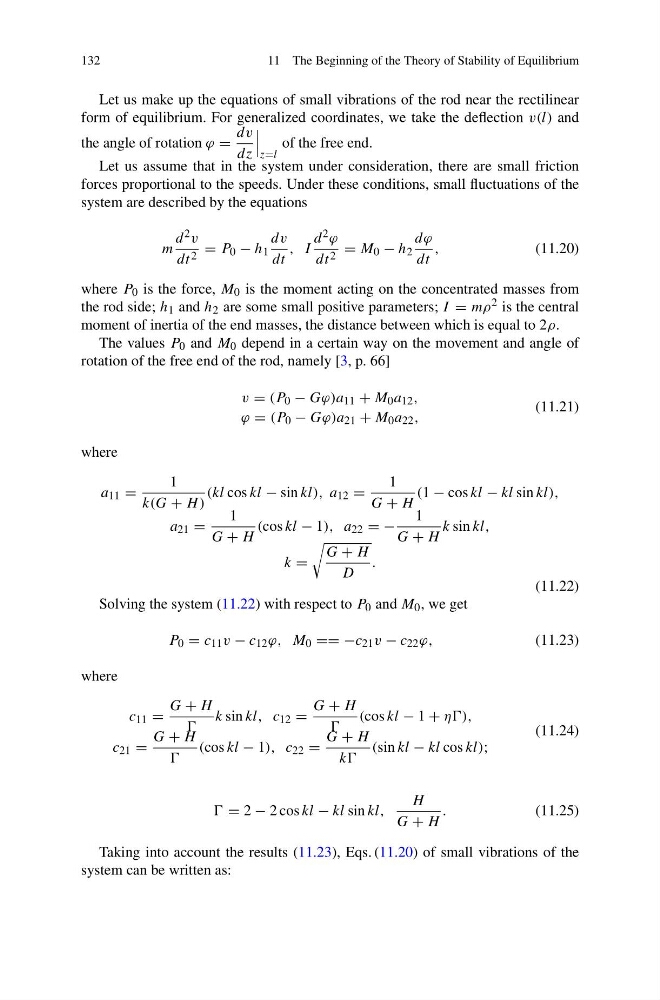
Let us make up the equations of small vibrations of the rod near the rectilinear
form of equilibrium. For generalized coordinates, we take the deflection v(l) and
the angle of rotation ϕ =
dv
dz
z=l
of the free end.
Let us assume that in the system under consideration, there are small friction
forces proportional to the speeds. Under these conditions, small fluctuations of the
system are described by the equations
m
d 2 v
dt 2 = P 0 − h 1
dv
dt
, I
d 2 ϕ
dt 2 = M 0 − h 2
dϕ
dt
,
(11.20)
where P 0 is the force, M 0 is the moment acting on the concentrated masses from
the rod side; h 1 and h 2 are some small positive parameters; I = mρ 2 is the central
moment of inertia of the end masses, the distance between which is equal to 2ρ.
The values P 0 and M 0 depend in a certain way on the movement and angle of
rotation of the free end of the rod, namely [3, p. 66]
v = (P 0 − Gϕ)a 11 + M 0 a 12 ,
ϕ = (P 0 − Gϕ)a 21 + M 0 a 22 ,
(11.21)
where
a 11 =
1
k(G + H )
(kl cos kl − sin kl), a 12 =
1
G + H
(1 − cos kl − kl sin kl),
a 21 =
1
G + H
(cos kl − 1), a 22 = −
1
G + H
k sin kl,
k =
G + H
D
.
(11.22)
Solving the system (11.22) with respect to P 0 and M 0 , we get
P 0 = c 11 v − c 12 ϕ, M 0 == −c 21 v − c 22 ϕ,
(11.23)
where
c 11 =
G + H
k sin kl, c 12 =
G + H
(cos kl − 1 + ηη),
c 21 =
G + H
(cos kl − 1), c 22 =
G + H
kk
(sin kl − kl cos kl);
(11.24)
= 2 − 2 cos kl − kl sin kl,
H
G + H
.
(11.25)
Taking into account the results (11.23), Eqs. (11.20) of small vibrations of the
system can be written as:
11 The Beginning of the Theory of Stability of Equilibrium
Let us make up the equations of small vibrations of the rod near the rectilinear
form of equilibrium. For generalized coordinates, we take the deflection v(l) and
the angle of rotation ϕ =
dv
dz
z=l
of the free end.
Let us assume that in the system under consideration, there are small friction
forces proportional to the speeds. Under these conditions, small fluctuations of the
system are described by the equations
m
d 2 v
dt 2 = P 0 − h 1
dv
dt
, I
d 2 ϕ
dt 2 = M 0 − h 2
dϕ
dt
,
(11.20)
where P 0 is the force, M 0 is the moment acting on the concentrated masses from
the rod side; h 1 and h 2 are some small positive parameters; I = mρ 2 is the central
moment of inertia of the end masses, the distance between which is equal to 2ρ.
The values P 0 and M 0 depend in a certain way on the movement and angle of
rotation of the free end of the rod, namely [3, p. 66]
v = (P 0 − Gϕ)a 11 + M 0 a 12 ,
ϕ = (P 0 − Gϕ)a 21 + M 0 a 22 ,
(11.21)
where
a 11 =
1
k(G + H )
(kl cos kl − sin kl), a 12 =
1
G + H
(1 − cos kl − kl sin kl),
a 21 =
1
G + H
(cos kl − 1), a 22 = −
1
G + H
k sin kl,
k =
G + H
D
.
(11.22)
Solving the system (11.22) with respect to P 0 and M 0 , we get
P 0 = c 11 v − c 12 ϕ, M 0 == −c 21 v − c 22 ϕ,
(11.23)
where
c 11 =
G + H
k sin kl, c 12 =
G + H
(cos kl − 1 + ηη),
c 21 =
G + H
(cos kl − 1), c 22 =
G + H
kk
(sin kl − kl cos kl);
(11.24)
= 2 − 2 cos kl − kl sin kl,
H
G + H
.
(11.25)
Taking into account the results (11.23), Eqs. (11.20) of small vibrations of the
system can be written as: