

11.9 Main Types of Stability Loss
127
1 > 0, , 2 > 0, . . . , , 2n−1 > 0,
(11.6)
where
1 = p 1 , , 2 =
p 1 p 0
p 3 p 2
, , 3 =
p 1 p 0 0
p 3 p 2 p 1
p 5 p 4 p 3
,
2n =
p 1
p 0 0 0 0 0 . . . 0
p 3
p 2 p 1 p 0 9 0 . . . 0
p 5
p 4 p 3 p 2 p 1 p 0 . . . 0
. . .
. . . . . . . . . . . . . . . . . . 0
. . .
. . . . . . . . . . . . . . . . . . 0
p 4n−1 p 4n−2 . . . . . . . . . . . . . . . p 2n
,
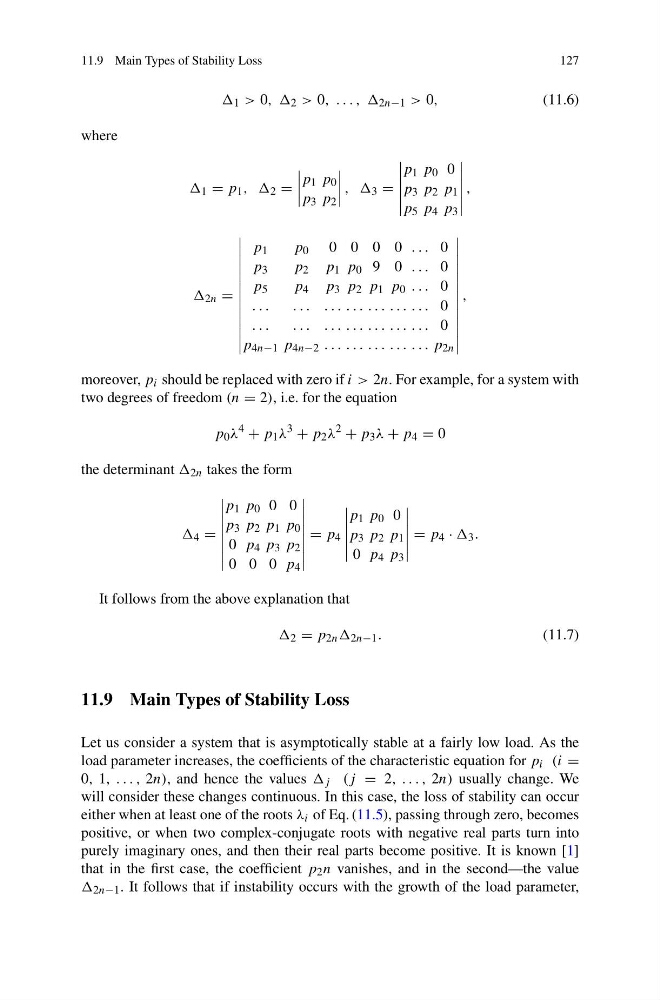
moreover, p i should be replaced with zero if i > 2n. For example, for a system with
two degrees of freedom (n = 2), i.e. for the equation
p 0 λ
4
+ p 1 λ
3
+ p 2 λ
2
+ p 3 λ + p 4 = 0
the determinant 2n takes the form
4 =
p 1 p 0 0 0
p 3 p 2 p 1 p 0
0 p 4 p 3 p 2
0 0 0 p 4
= p 4
p 1 p 0 0
p 3 p 2 p 1
0 p 4 p 3
= p 4 · 3 .
It follows from the above explanation that
2 = p 2n 2n−1 .
(11.7)
11.9 Main Types of Stability Loss
Let us consider a system that is asymptotically stable at a fairly low load. As the
load parameter increases, the coefficients of the characteristic equation for p i (i =
0, 1, . . . , 2n), and hence the values j (j = 2, . . . , 2n) usually change. We
will consider these changes continuous. In this case, the loss of stability can occur
either when at least one of the roots λ i of Eq. (11.5), passing through zero, becomes
positive, or when two complex-conjugate roots with negative real parts turn into
purely imaginary ones, and then their real parts become positive. It is known [1]
that in the first case, the coefficient p 2 n vanishes, and in the second—the value
2n−1 . It follows that if instability occurs with the growth of the load parameter,
127
1 > 0, , 2 > 0, . . . , , 2n−1 > 0,
(11.6)
where
1 = p 1 , , 2 =
p 1 p 0
p 3 p 2
, , 3 =
p 1 p 0 0
p 3 p 2 p 1
p 5 p 4 p 3
,
2n =
p 1
p 0 0 0 0 0 . . . 0
p 3
p 2 p 1 p 0 9 0 . . . 0
p 5
p 4 p 3 p 2 p 1 p 0 . . . 0
. . .
. . . . . . . . . . . . . . . . . . 0
. . .
. . . . . . . . . . . . . . . . . . 0
p 4n−1 p 4n−2 . . . . . . . . . . . . . . . p 2n
,
moreover, p i should be replaced with zero if i > 2n. For example, for a system with
two degrees of freedom (n = 2), i.e. for the equation
p 0 λ
4
+ p 1 λ
3
+ p 2 λ
2
+ p 3 λ + p 4 = 0
the determinant 2n takes the form
4 =
p 1 p 0 0 0
p 3 p 2 p 1 p 0
0 p 4 p 3 p 2
0 0 0 p 4
= p 4
p 1 p 0 0
p 3 p 2 p 1
0 p 4 p 3
= p 4 · 3 .
It follows from the above explanation that
2 = p 2n 2n−1 .
(11.7)
11.9 Main Types of Stability Loss
Let us consider a system that is asymptotically stable at a fairly low load. As the
load parameter increases, the coefficients of the characteristic equation for p i (i =
0, 1, . . . , 2n), and hence the values j (j = 2, . . . , 2n) usually change. We
will consider these changes continuous. In this case, the loss of stability can occur
either when at least one of the roots λ i of Eq. (11.5), passing through zero, becomes
positive, or when two complex-conjugate roots with negative real parts turn into
purely imaginary ones, and then their real parts become positive. It is known [1]
that in the first case, the coefficient p 2 n vanishes, and in the second—the value
2n−1 . It follows that if instability occurs with the growth of the load parameter,