

122
11 The Beginning of the Theory of Stability of Equilibrium
If the body in question moves translationally (any straight line segment, rigidly
connected with the moving body, remains parallel to its original position), then the
work will be equal to the scalar product of force and displacement. If the body
rotates around a certain center located on the line of action of the force, then the
displacements of the points will be perpendicular to this line and the work of the
force is zero.
It is known [4] that any plane motion of a solid can be represented as the sum
of the translational motion with a displacement vector equal to the displacement
vector of the body at an arbitrary given point, called pole, and of rotation around the
specified pole.
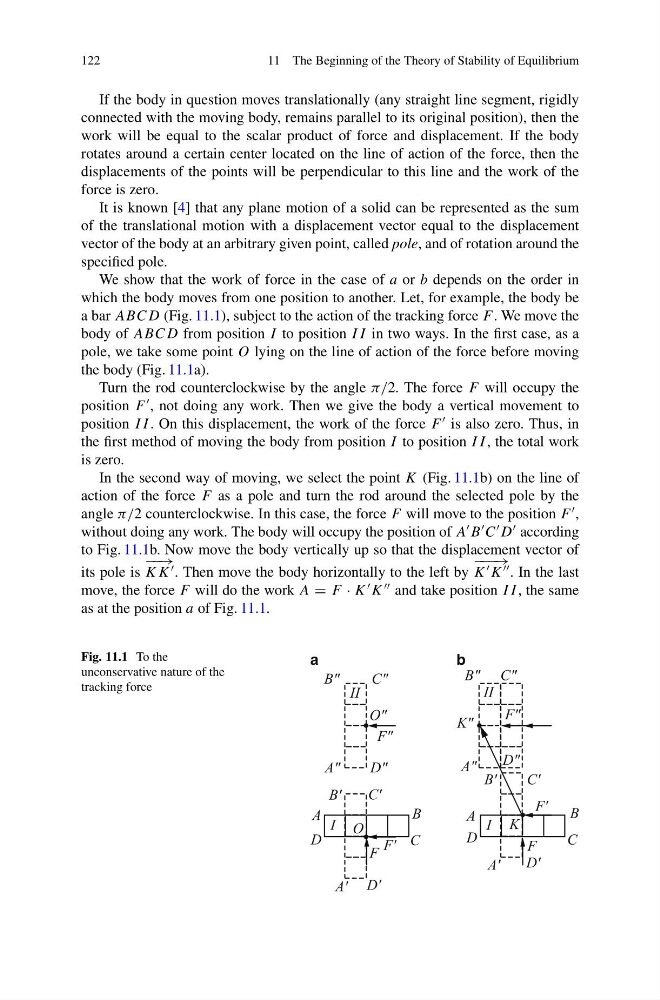
We show that the work of force in the case of a or b depends on the order in
which the body moves from one position to another. Let, for example, the body be
a bar ABCD (Fig. 11.1), subject to the action of the tracking force F . We move the
body of ABCD from position I to position I I in two ways. In the first case, as a
pole, we take some point O lying on the line of action of the force before moving
the body (Fig. 11.1a).
Turn the rod counterclockwise by the angle π/2. The force F will occupy the
position F , not doing any work. Then we give the body a vertical movement to
position I I . On this displacement, the work of the force F is also zero. Thus, in
the first method of moving the body from position I to position I I , the total work
is zero.
In the second way of moving, we select the point K (Fig. 11.1b) on the line of
action of the force F as a pole and turn the rod around the selected pole by the
angle π/2 counterclockwise. In this case, the force F will move to the position F ,
without doing any work. The body will occupy the position of A B C D according
to Fig. 11.1b. Now move the body vertically up so that the displacement vector of
its pole is
− − →
KK . Then move the body horizontally to the left by
− −− →
K K . In the last
move, the force F will do the work A = F · K K and take position I I , the same
as at the position a of Fig. 11.1.
Fig. 11.1 To the
unconservative nature of the
tracking force
a
b
11 The Beginning of the Theory of Stability of Equilibrium
If the body in question moves translationally (any straight line segment, rigidly
connected with the moving body, remains parallel to its original position), then the
work will be equal to the scalar product of force and displacement. If the body
rotates around a certain center located on the line of action of the force, then the
displacements of the points will be perpendicular to this line and the work of the
force is zero.
It is known [4] that any plane motion of a solid can be represented as the sum
of the translational motion with a displacement vector equal to the displacement
vector of the body at an arbitrary given point, called pole, and of rotation around the
specified pole.
We show that the work of force in the case of a or b depends on the order in
which the body moves from one position to another. Let, for example, the body be
a bar ABCD (Fig. 11.1), subject to the action of the tracking force F . We move the
body of ABCD from position I to position I I in two ways. In the first case, as a
pole, we take some point O lying on the line of action of the force before moving
the body (Fig. 11.1a).
Turn the rod counterclockwise by the angle π/2. The force F will occupy the
position F , not doing any work. Then we give the body a vertical movement to
position I I . On this displacement, the work of the force F is also zero. Thus, in
the first method of moving the body from position I to position I I , the total work
is zero.
In the second way of moving, we select the point K (Fig. 11.1b) on the line of
action of the force F as a pole and turn the rod around the selected pole by the
angle π/2 counterclockwise. In this case, the force F will move to the position F ,
without doing any work. The body will occupy the position of A B C D according
to Fig. 11.1b. Now move the body vertically up so that the displacement vector of
its pole is
− − →
KK . Then move the body horizontally to the left by
− −− →
K K . In the last
move, the force F will do the work A = F · K K and take position I I , the same
as at the position a of Fig. 11.1.
Fig. 11.1 To the
unconservative nature of the
tracking force
a
b