

102
10 Mathematical Structural Imperfections
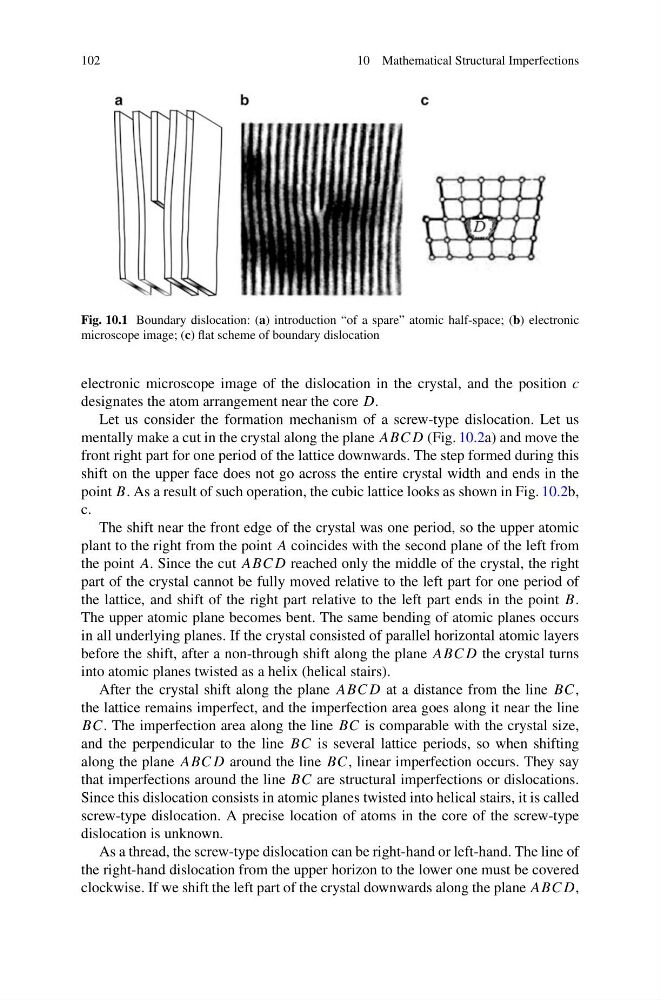
Fig. 10.1 Boundary dislocation: (a) introduction “of a spare” atomic half-space; (b) electronic
microscope image; (c) flat scheme of boundary dislocation
electronic microscope image of the dislocation in the crystal, and the position c
designates the atom arrangement near the core D.
Let us consider the formation mechanism of a screw-type dislocation. Let us
mentally make a cut in the crystal along the plane ABCD (Fig. 10.2a) and move the
front right part for one period of the lattice downwards. The step formed during this
shift on the upper face does not go across the entire crystal width and ends in the
point B. As a result of such operation, the cubic lattice looks as shown in Fig. 10.2b,
c.
The shift near the front edge of the crystal was one period, so the upper atomic
plant to the right from the point A coincides with the second plane of the left from
the point A. Since the cut ABCD reached only the middle of the crystal, the right
part of the crystal cannot be fully moved relative to the left part for one period of
the lattice, and shift of the right part relative to the left part ends in the point B.
The upper atomic plane becomes bent. The same bending of atomic planes occurs
in all underlying planes. If the crystal consisted of parallel horizontal atomic layers
before the shift, after a non-through shift along the plane ABCD the crystal turns
into atomic planes twisted as a helix (helical stairs).
After the crystal shift along the plane ABCD at a distance from the line BC,
the lattice remains imperfect, and the imperfection area goes along it near the line
BC. The imperfection area along the line BC is comparable with the crystal size,
and the perpendicular to the line BC is several lattice periods, so when shifting
along the plane ABCD around the line BC, linear imperfection occurs. They say
that imperfections around the line BC are structural imperfections or dislocations.
Since this dislocation consists in atomic planes twisted into helical stairs, it is called
screw-type dislocation. A precise location of atoms in the core of the screw-type
dislocation is unknown.
As a thread, the screw-type dislocation can be right-hand or left-hand. The line of
the right-hand dislocation from the upper horizon to the lower one must be covered
clockwise. If we shift the left part of the crystal downwards along the plane ABCD,
10 Mathematical Structural Imperfections
Fig. 10.1 Boundary dislocation: (a) introduction “of a spare” atomic half-space; (b) electronic
microscope image; (c) flat scheme of boundary dislocation
electronic microscope image of the dislocation in the crystal, and the position c
designates the atom arrangement near the core D.
Let us consider the formation mechanism of a screw-type dislocation. Let us
mentally make a cut in the crystal along the plane ABCD (Fig. 10.2a) and move the
front right part for one period of the lattice downwards. The step formed during this
shift on the upper face does not go across the entire crystal width and ends in the
point B. As a result of such operation, the cubic lattice looks as shown in Fig. 10.2b,
c.
The shift near the front edge of the crystal was one period, so the upper atomic
plant to the right from the point A coincides with the second plane of the left from
the point A. Since the cut ABCD reached only the middle of the crystal, the right
part of the crystal cannot be fully moved relative to the left part for one period of
the lattice, and shift of the right part relative to the left part ends in the point B.
The upper atomic plane becomes bent. The same bending of atomic planes occurs
in all underlying planes. If the crystal consisted of parallel horizontal atomic layers
before the shift, after a non-through shift along the plane ABCD the crystal turns
into atomic planes twisted as a helix (helical stairs).
After the crystal shift along the plane ABCD at a distance from the line BC,
the lattice remains imperfect, and the imperfection area goes along it near the line
BC. The imperfection area along the line BC is comparable with the crystal size,
and the perpendicular to the line BC is several lattice periods, so when shifting
along the plane ABCD around the line BC, linear imperfection occurs. They say
that imperfections around the line BC are structural imperfections or dislocations.
Since this dislocation consists in atomic planes twisted into helical stairs, it is called
screw-type dislocation. A precise location of atoms in the core of the screw-type
dislocation is unknown.
As a thread, the screw-type dislocation can be right-hand or left-hand. The line of
the right-hand dislocation from the upper horizon to the lower one must be covered
clockwise. If we shift the left part of the crystal downwards along the plane ABCD,