

90
E. L. Stupitsky et al.
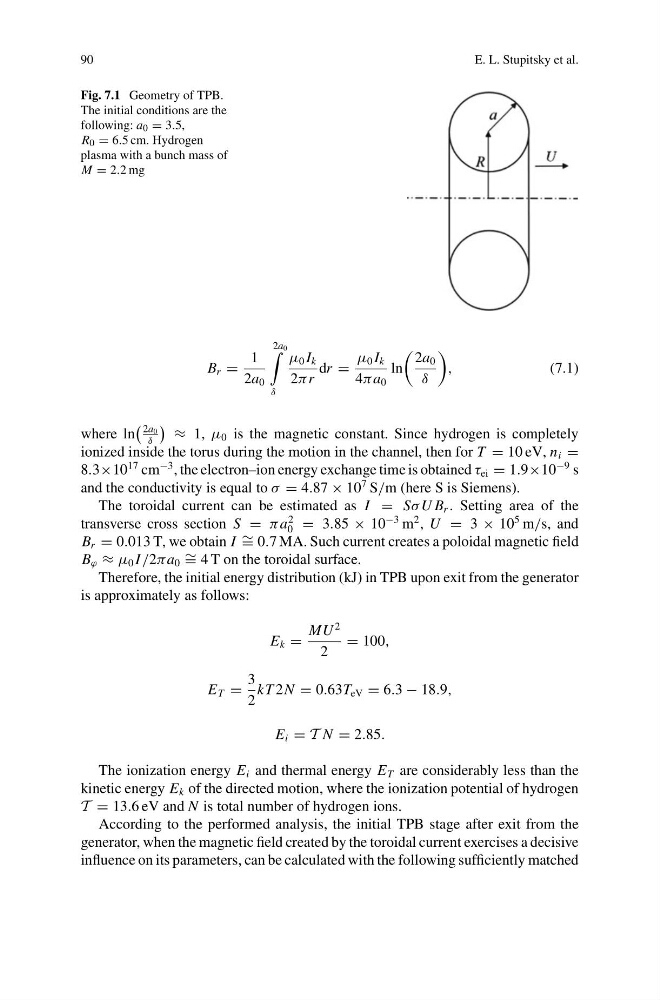
Fig. 7.1 Geometry of TPB.
The initial conditions are the
following: a 0 = 3.5,
R 0 = 6.5 cm. Hydrogen
plasma with a bunch mass of
M = 2.2 mg
B r =
1
2a 0
2a 0
δ
μ 0 I k
2πr
dr =
μ 0 I k
4πa 0
ln
2a 0
δ
,
(7.1)
where ln
2a 0
δ
≈ 1, μ 0 is the magnetic constant. Since hydrogen is completely
ionized inside the torus during the motion in the channel, then for T = 10 eV, n i =
8.3×10
17 cm
−3 , the electron–ion energy exchange time is obtained τ ei = 1.9×10
−9 s
and the conductivity is equal to σ = 4.87 × 10
7 S/m (here S is Siemens).
The toroidal current can be estimated as I = Sσ U B r . Setting area of the
transverse cross section S = πa
2
0 = 3.85 × 10
−3 m
2 , U = 3 × 10
5 m/s, and
B r = 0.013 T, we obtain I ∼ = 0.7 MA. Such current creates a poloidal magnetic field
B ϕ ≈ μ 0 I /2πa 0 ∼ = 4 T on the toroidal surface.
Therefore, the initial energy distribution (kJ) in TPB upon exit from the generator
is approximately as follows:
E k =
MU
2
2
= 100,
E T =
3
2
kT 2N = 0.63T eV = 6.3 − 18.9,
E i = T N = 2.85.
The ionization energy E i and thermal energy E T are considerably less than the
kinetic energy E k of the directed motion, where the ionization potential of hydrogen
T = 13.6 eV and N is total number of hydrogen ions.
According to the performed analysis, the initial TPB stage after exit from the
generator, when the magnetic field created by the toroidal current exercises a decisive
influence on its parameters, can be calculated with the following sufficiently matched
E. L. Stupitsky et al.
Fig. 7.1 Geometry of TPB.
The initial conditions are the
following: a 0 = 3.5,
R 0 = 6.5 cm. Hydrogen
plasma with a bunch mass of
M = 2.2 mg
B r =
1
2a 0
2a 0
δ
μ 0 I k
2πr
dr =
μ 0 I k
4πa 0
ln
2a 0
δ
,
(7.1)
where ln
2a 0
δ
≈ 1, μ 0 is the magnetic constant. Since hydrogen is completely
ionized inside the torus during the motion in the channel, then for T = 10 eV, n i =
8.3×10
17 cm
−3 , the electron–ion energy exchange time is obtained τ ei = 1.9×10
−9 s
and the conductivity is equal to σ = 4.87 × 10
7 S/m (here S is Siemens).
The toroidal current can be estimated as I = Sσ U B r . Setting area of the
transverse cross section S = πa
2
0 = 3.85 × 10
−3 m
2 , U = 3 × 10
5 m/s, and
B r = 0.013 T, we obtain I ∼ = 0.7 MA. Such current creates a poloidal magnetic field
B ϕ ≈ μ 0 I /2πa 0 ∼ = 4 T on the toroidal surface.
Therefore, the initial energy distribution (kJ) in TPB upon exit from the generator
is approximately as follows:
E k =
MU
2
2
= 100,
E T =
3
2
kT 2N = 0.63T eV = 6.3 − 18.9,
E i = T N = 2.85.
The ionization energy E i and thermal energy E T are considerably less than the
kinetic energy E k of the directed motion, where the ionization potential of hydrogen
T = 13.6 eV and N is total number of hydrogen ions.
According to the performed analysis, the initial TPB stage after exit from the
generator, when the magnetic field created by the toroidal current exercises a decisive
influence on its parameters, can be calculated with the following sufficiently matched