

6 The Investigation of the Evolution of Cluster Beam …
77
C Vmixt = (1 − α max )C Va + α max C VV + α(C l − C VV )
(6.25)
C Pmixt = (1 − α max )C Pa + α max C PV + α(C l − C PV )
(6.26)
R mixt = (1 − α max )R a + α max R V − α R V )
(6.27)
γ f =
C Pmixt
C Vmixt
(6.28)
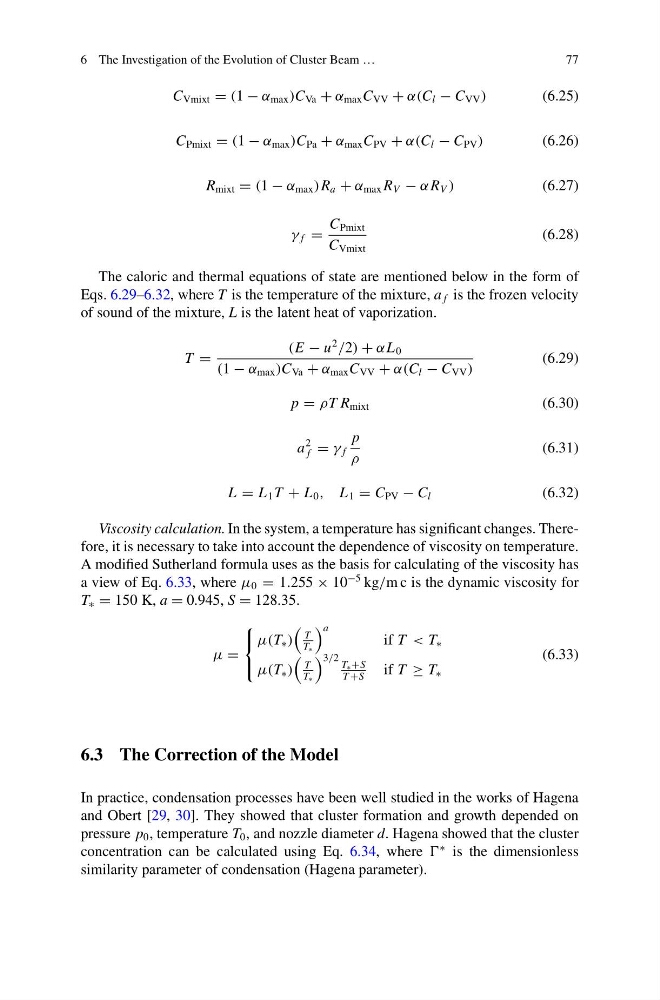
The caloric and thermal equations of state are mentioned below in the form of
Eqs. 6.29–6.32, where T is the temperature of the mixture, a f is the frozen velocity
of sound of the mixture, L is the latent heat of vaporization.
T =
(E − u
2
/2) + αL 0
(1 − α max )C Va + α max C VV + α(C l − C VV )
(6.29)
p = ρT R mixt
(6.30)
a
2
f = γ f
p
ρ
(6.31)
L = L 1 T + L 0 , L 1 = C PV − C l
(6.32)
Viscosity calculation. In the system, a temperature has significant changes. Therefore, it is necessary to take into account the dependence of viscosity on temperature.
A modified Sutherland formula uses as the basis for calculating of the viscosity has
a view of Eq. 6.33, where μ 0 = 1.255 × 10
−5 kg/m c is the dynamic viscosity for
T ∗ = 150 K, a = 0.945, S = 128.35.
μ =
⎧
⎨
⎩
μ(T ∗ )
T
T ∗
a
if T < T ∗
μ(T ∗ )
T
T ∗
3/2 T ∗ +S
T +S
if T ≥ T ∗
(6.33)
6.3 The Correction of the Model
In practice, condensation processes have been well studied in the works of Hagena
and Obert [29, 30]. They showed that cluster formation and growth depended on
pressure p 0 , temperature T 0 , and nozzle diameter d. Hagena showed that the cluster
concentration can be calculated using Eq. 6.34, where
∗ is the dimensionless
similarity parameter of condensation (Hagena parameter).
77
C Vmixt = (1 − α max )C Va + α max C VV + α(C l − C VV )
(6.25)
C Pmixt = (1 − α max )C Pa + α max C PV + α(C l − C PV )
(6.26)
R mixt = (1 − α max )R a + α max R V − α R V )
(6.27)
γ f =
C Pmixt
C Vmixt
(6.28)
The caloric and thermal equations of state are mentioned below in the form of
Eqs. 6.29–6.32, where T is the temperature of the mixture, a f is the frozen velocity
of sound of the mixture, L is the latent heat of vaporization.
T =
(E − u
2
/2) + αL 0
(1 − α max )C Va + α max C VV + α(C l − C VV )
(6.29)
p = ρT R mixt
(6.30)
a
2
f = γ f
p
ρ
(6.31)
L = L 1 T + L 0 , L 1 = C PV − C l
(6.32)
Viscosity calculation. In the system, a temperature has significant changes. Therefore, it is necessary to take into account the dependence of viscosity on temperature.
A modified Sutherland formula uses as the basis for calculating of the viscosity has
a view of Eq. 6.33, where μ 0 = 1.255 × 10
−5 kg/m c is the dynamic viscosity for
T ∗ = 150 K, a = 0.945, S = 128.35.
μ =
⎧
⎨
⎩
μ(T ∗ )
T
T ∗
a
if T < T ∗
μ(T ∗ )
T
T ∗
3/2 T ∗ +S
T +S
if T ≥ T ∗
(6.33)
6.3 The Correction of the Model
In practice, condensation processes have been well studied in the works of Hagena
and Obert [29, 30]. They showed that cluster formation and growth depended on
pressure p 0 , temperature T 0 , and nozzle diameter d. Hagena showed that the cluster
concentration can be calculated using Eq. 6.34, where
∗ is the dimensionless
similarity parameter of condensation (Hagena parameter).