

5 Numerical Simulation of Taylor Vortex Flows …
57
small periodicity size is set, the solution remains flat, and the Taylor vortices are
not formed. The moment of friction in this case corresponds to the Couette solution
C m = 0.036. The requirement of periodicity at a small distance stabilizes the flow
and in fact determines its two-dimensional character preventing the development of
three-dimensional instabilities. In the conditions under consideration, the flat solution
is conserved at L < 0.35.
At a sufficiently large value of L, regardless of the initial conditions, threedimensional instabilities appear in the flow, and they subsequently formed into a
regular flow with the Taylor vortices. One pair of the Taylor vortices is formed in
the 0.4 ≤ L ≤ 1.2 range between the cylinders. With the formation of the Taylor
vortices, the friction moment increases significantly. There is the L ≈ 0.70–0.85
value of the periodicity size at which the maximum value of the friction moment
C m ≈ 0.075 is observed. Both a decrease and an increase in L lead to a decrease in
the friction moment.
If to determine the flow structure by setting the initial conditions (with one pair of
the vortices), then the structure can be preserved in a larger range of the periodicity
size, and the friction moment decreases. Numerically, the solutions with the Taylor
vortices of a relatively larger size are obtained. At L ≥ 1.2, if the flow structure is
not determined in some way, not one but two pairs of the vortices are formed in the
flow area.
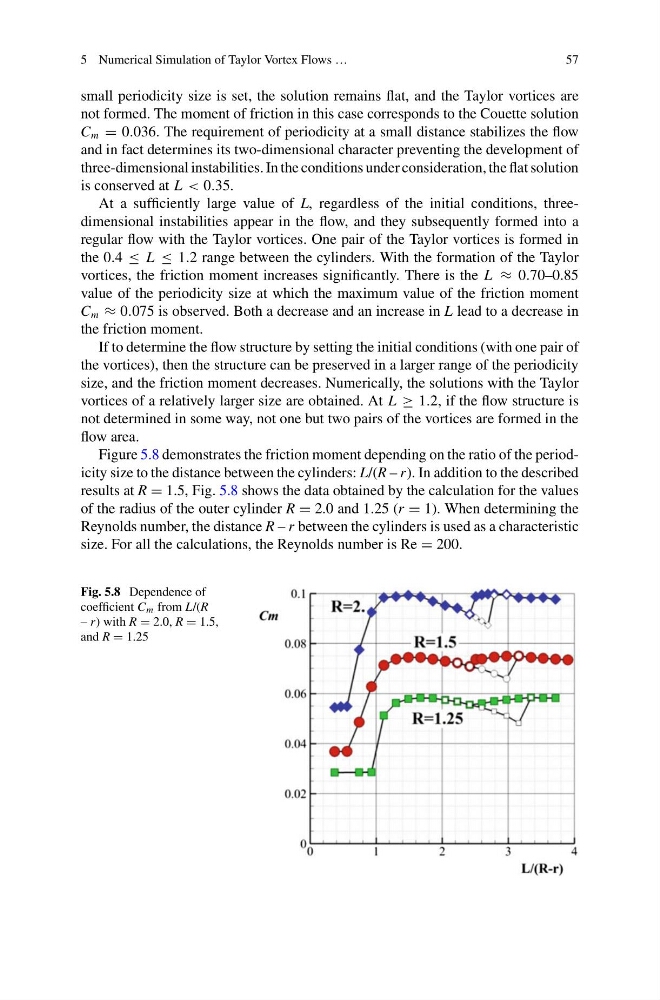
Figure 5.8 demonstrates the friction moment depending on the ratio of the periodicity size to the distance between the cylinders: L/(R – r). In addition to the described
results at R = 1.5, Fig. 5.8 shows the data obtained by the calculation for the values
of the radius of the outer cylinder R = 2.0 and 1.25 (r = 1). When determining the
Reynolds number, the distance R – r between the cylinders is used as a characteristic
size. For all the calculations, the Reynolds number is Re = 200.
Fig. 5.8 Dependence of
coefficient C m from L/(R
– r) with R = 2.0, R = 1.5,
and R = 1.25
57
small periodicity size is set, the solution remains flat, and the Taylor vortices are
not formed. The moment of friction in this case corresponds to the Couette solution
C m = 0.036. The requirement of periodicity at a small distance stabilizes the flow
and in fact determines its two-dimensional character preventing the development of
three-dimensional instabilities. In the conditions under consideration, the flat solution
is conserved at L < 0.35.
At a sufficiently large value of L, regardless of the initial conditions, threedimensional instabilities appear in the flow, and they subsequently formed into a
regular flow with the Taylor vortices. One pair of the Taylor vortices is formed in
the 0.4 ≤ L ≤ 1.2 range between the cylinders. With the formation of the Taylor
vortices, the friction moment increases significantly. There is the L ≈ 0.70–0.85
value of the periodicity size at which the maximum value of the friction moment
C m ≈ 0.075 is observed. Both a decrease and an increase in L lead to a decrease in
the friction moment.
If to determine the flow structure by setting the initial conditions (with one pair of
the vortices), then the structure can be preserved in a larger range of the periodicity
size, and the friction moment decreases. Numerically, the solutions with the Taylor
vortices of a relatively larger size are obtained. At L ≥ 1.2, if the flow structure is
not determined in some way, not one but two pairs of the vortices are formed in the
flow area.
Figure 5.8 demonstrates the friction moment depending on the ratio of the periodicity size to the distance between the cylinders: L/(R – r). In addition to the described
results at R = 1.5, Fig. 5.8 shows the data obtained by the calculation for the values
of the radius of the outer cylinder R = 2.0 and 1.25 (r = 1). When determining the
Reynolds number, the distance R – r between the cylinders is used as a characteristic
size. For all the calculations, the Reynolds number is Re = 200.
Fig. 5.8 Dependence of
coefficient C m from L/(R
– r) with R = 2.0, R = 1.5,
and R = 1.25