

32
A. V. Babakov
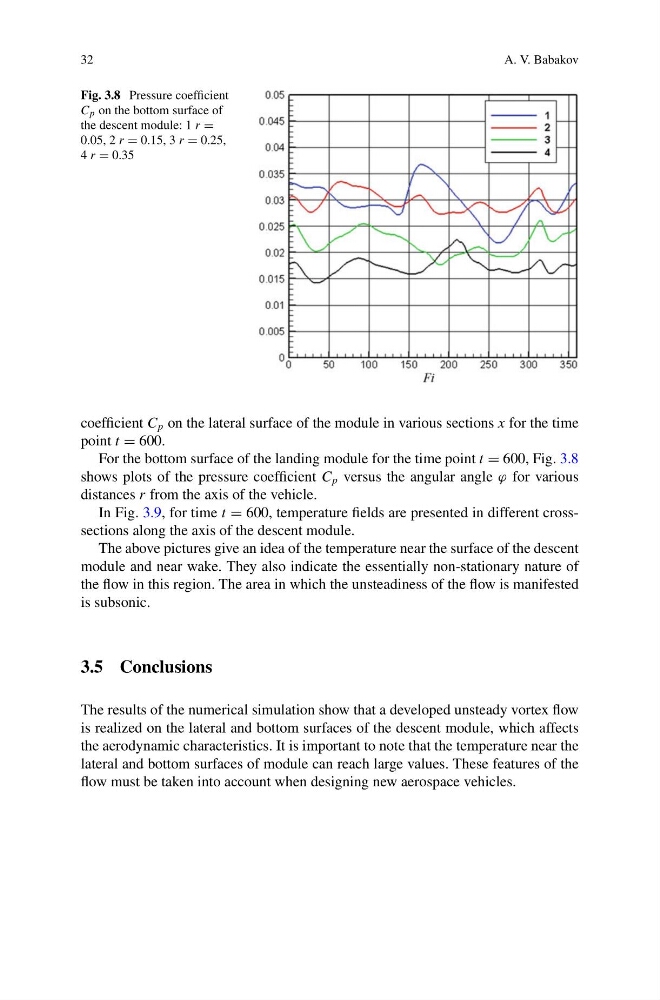
Fig. 3.8 Pressure coefficient
C p on the bottom surface of
the descent module: 1 r =
0.05, 2 r = 0.15, 3 r = 0.25,
4 r = 0.35
coefficient C p on the lateral surface of the module in various sections x for the time
point t = 600.
For the bottom surface of the landing module for the time point t = 600, Fig. 3.8
shows plots of the pressure coefficient C p versus the angular angle ϕ for various
distances r from the axis of the vehicle.
In Fig. 3.9, for time t = 600, temperature fields are presented in different crosssections along the axis of the descent module.
The above pictures give an idea of the temperature near the surface of the descent
module and near wake. They also indicate the essentially non-stationary nature of
the flow in this region. The area in which the unsteadiness of the flow is manifested
is subsonic.
3.5 Conclusions
The results of the numerical simulation show that a developed unsteady vortex flow
is realized on the lateral and bottom surfaces of the descent module, which affects
the aerodynamic characteristics. It is important to note that the temperature near the
lateral and bottom surfaces of module can reach large values. These features of the
flow must be taken into account when designing new aerospace vehicles.
A. V. Babakov
Fig. 3.8 Pressure coefficient
C p on the bottom surface of
the descent module: 1 r =
0.05, 2 r = 0.15, 3 r = 0.25,
4 r = 0.35
coefficient C p on the lateral surface of the module in various sections x for the time
point t = 600.
For the bottom surface of the landing module for the time point t = 600, Fig. 3.8
shows plots of the pressure coefficient C p versus the angular angle ϕ for various
distances r from the axis of the vehicle.
In Fig. 3.9, for time t = 600, temperature fields are presented in different crosssections along the axis of the descent module.
The above pictures give an idea of the temperature near the surface of the descent
module and near wake. They also indicate the essentially non-stationary nature of
the flow in this region. The area in which the unsteadiness of the flow is manifested
is subsonic.
3.5 Conclusions
The results of the numerical simulation show that a developed unsteady vortex flow
is realized on the lateral and bottom surfaces of the descent module, which affects
the aerodynamic characteristics. It is important to note that the temperature near the
lateral and bottom surfaces of module can reach large values. These features of the
flow must be taken into account when designing new aerospace vehicles.