

24 3D Object Classification, Visual Search …
367
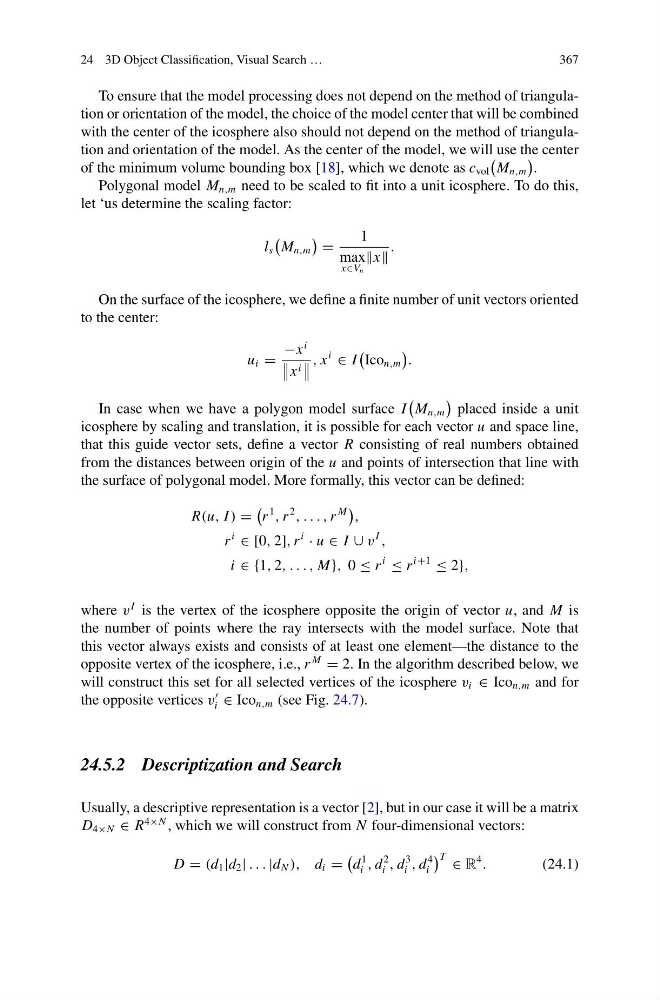
To ensure that the model processing does not depend on the method of triangulation or orientation of the model, the choice of the model center that will be combined
with the center of the icosphere also should not depend on the method of triangulation and orientation of the model. As the center of the model, we will use the center
of the minimum volume bounding box [18], which we denote as c vol
M n,m
.
Polygonal model M n,m need to be scaled to fit into a unit icosphere. To do this,
let ‘us determine the scaling factor:
l s
M n,m
=
1
max
x∈V n
x
.
On the surface of the icosphere, we define a finite number of unit vectors oriented
to the center:
u i =
−x
i
x i
, x
i
∈ I
Ico n,m
.
In case when we have a polygon model surface I
M n,m
placed inside a unit
icosphere by scaling and translation, it is possible for each vector u and space line,
that this guide vector sets, define a vector R consisting of real numbers obtained
from the distances between origin of the u and points of intersection that line with
the surface of polygonal model. More formally, this vector can be defined:
R(u, I ) =
r
1
, r
2
, . . . , r
M
,
r
i
∈ [0, 2], r
i
· u ∈ I ∪ v
I
,
i ∈ {1, 2, . . . , M}, 0 ≤ r
i
≤ r
i+1
≤ 2},
where v
I is the vertex of the icosphere opposite the origin of vector u, and M is
the number of points where the ray intersects with the model surface. Note that
this vector always exists and consists of at least one element—the distance to the
opposite vertex of the icosphere, i.e., r
M
= 2. In the algorithm described below, we
will construct this set for all selected vertices of the icosphere v i ∈ Ico n,m and for
the opposite vertices v
i ∈ Ico n,m (see Fig. 24.7).
24.5.2 Descriptization and Search
Usually, a descriptive representation is a vector [2], but in our case it will be a matrix
D 4×N ∈ R
4×N , which we will construct from N four-dimensional vectors:
D = (d 1 |d 2 | . . . |d N ), d i =
d
1
i , d
2
i , d
3
i , d
4
i
T ∈ R
4
.
(24.1)
367
To ensure that the model processing does not depend on the method of triangulation or orientation of the model, the choice of the model center that will be combined
with the center of the icosphere also should not depend on the method of triangulation and orientation of the model. As the center of the model, we will use the center
of the minimum volume bounding box [18], which we denote as c vol
M n,m
.
Polygonal model M n,m need to be scaled to fit into a unit icosphere. To do this,
let ‘us determine the scaling factor:
l s
M n,m
=
1
max
x∈V n
x
.
On the surface of the icosphere, we define a finite number of unit vectors oriented
to the center:
u i =
−x
i
x i
, x
i
∈ I
Ico n,m
.
In case when we have a polygon model surface I
M n,m
placed inside a unit
icosphere by scaling and translation, it is possible for each vector u and space line,
that this guide vector sets, define a vector R consisting of real numbers obtained
from the distances between origin of the u and points of intersection that line with
the surface of polygonal model. More formally, this vector can be defined:
R(u, I ) =
r
1
, r
2
, . . . , r
M
,
r
i
∈ [0, 2], r
i
· u ∈ I ∪ v
I
,
i ∈ {1, 2, . . . , M}, 0 ≤ r
i
≤ r
i+1
≤ 2},
where v
I is the vertex of the icosphere opposite the origin of vector u, and M is
the number of points where the ray intersects with the model surface. Note that
this vector always exists and consists of at least one element—the distance to the
opposite vertex of the icosphere, i.e., r
M
= 2. In the algorithm described below, we
will construct this set for all selected vertices of the icosphere v i ∈ Ico n,m and for
the opposite vertices v
i ∈ Ico n,m (see Fig. 24.7).
24.5.2 Descriptization and Search
Usually, a descriptive representation is a vector [2], but in our case it will be a matrix
D 4×N ∈ R
4×N , which we will construct from N four-dimensional vectors:
D = (d 1 |d 2 | . . . |d N ), d i =
d
1
i , d
2
i , d
3
i , d
4
i
T ∈ R
4
.
(24.1)