

22 On the Modeling of the University Education …
327
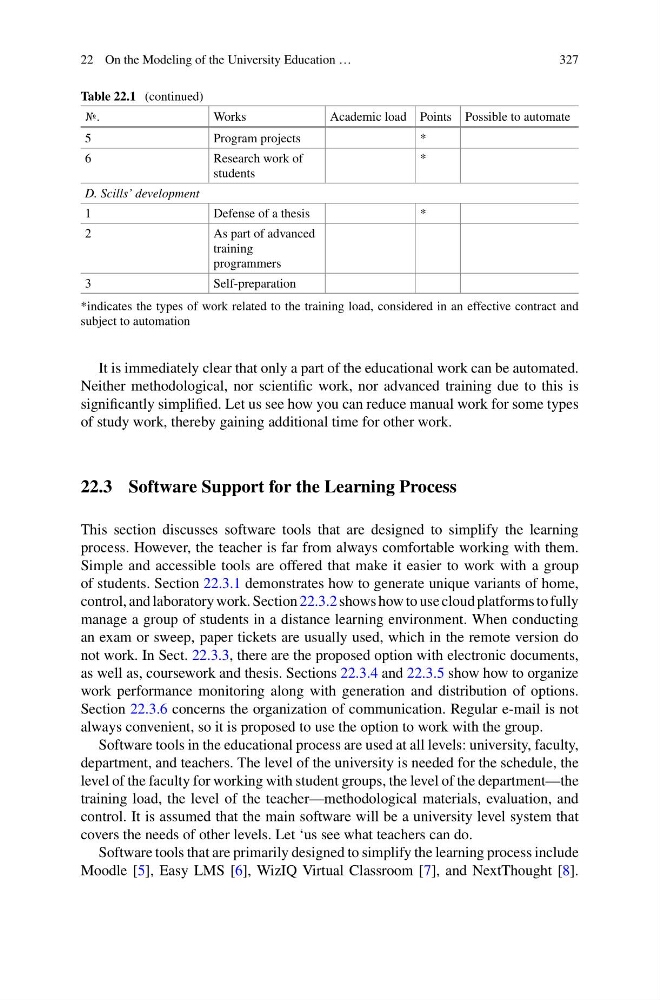
Table 22.1 (continued)
№.
Works
Academic load Points Possible to automate
5
Program projects
*
6
Research work of
students
*
D. Scills’ development
1
Defense of a thesis
*
2
As part of advanced
training
programmers
3
Self-preparation
*indicates the types of work related to the training load, considered in an effective contract and
subject to automation
It is immediately clear that only a part of the educational work can be automated.
Neither methodological, nor scientific work, nor advanced training due to this is
significantly simplified. Let us see how you can reduce manual work for some types
of study work, thereby gaining additional time for other work.
22.3 Software Support for the Learning Process
This section discusses software tools that are designed to simplify the learning
process. However, the teacher is far from always comfortable working with them.
Simple and accessible tools are offered that make it easier to work with a group
of students. Section 22.3.1 demonstrates how to generate unique variants of home,
control, and laboratory work. Section 22.3.2 shows how to use cloud platforms to fully
manage a group of students in a distance learning environment. When conducting
an exam or sweep, paper tickets are usually used, which in the remote version do
not work. In Sect. 22.3.3, there are the proposed option with electronic documents,
as well as, coursework and thesis. Sections 22.3.4 and 22.3.5 show how to organize
work performance monitoring along with generation and distribution of options.
Section 22.3.6 concerns the organization of communication. Regular e-mail is not
always convenient, so it is proposed to use the option to work with the group.
Software tools in the educational process are used at all levels: university, faculty,
department, and teachers. The level of the university is needed for the schedule, the
level of the faculty for working with student groups, the level of the department—the
training load, the level of the teacher—methodological materials, evaluation, and
control. It is assumed that the main software will be a university level system that
covers the needs of other levels. Let ‘us see what teachers can do.
Software tools that are primarily designed to simplify the learning process include
Moodle [5], Easy LMS [6], WizIQ Virtual Classroom [7], and NextThought [8].
327
Table 22.1 (continued)
№.
Works
Academic load Points Possible to automate
5
Program projects
*
6
Research work of
students
*
D. Scills’ development
1
Defense of a thesis
*
2
As part of advanced
training
programmers
3
Self-preparation
*indicates the types of work related to the training load, considered in an effective contract and
subject to automation
It is immediately clear that only a part of the educational work can be automated.
Neither methodological, nor scientific work, nor advanced training due to this is
significantly simplified. Let us see how you can reduce manual work for some types
of study work, thereby gaining additional time for other work.
22.3 Software Support for the Learning Process
This section discusses software tools that are designed to simplify the learning
process. However, the teacher is far from always comfortable working with them.
Simple and accessible tools are offered that make it easier to work with a group
of students. Section 22.3.1 demonstrates how to generate unique variants of home,
control, and laboratory work. Section 22.3.2 shows how to use cloud platforms to fully
manage a group of students in a distance learning environment. When conducting
an exam or sweep, paper tickets are usually used, which in the remote version do
not work. In Sect. 22.3.3, there are the proposed option with electronic documents,
as well as, coursework and thesis. Sections 22.3.4 and 22.3.5 show how to organize
work performance monitoring along with generation and distribution of options.
Section 22.3.6 concerns the organization of communication. Regular e-mail is not
always convenient, so it is proposed to use the option to work with the group.
Software tools in the educational process are used at all levels: university, faculty,
department, and teachers. The level of the university is needed for the schedule, the
level of the faculty for working with student groups, the level of the department—the
training load, the level of the teacher—methodological materials, evaluation, and
control. It is assumed that the main software will be a university level system that
covers the needs of other levels. Let ‘us see what teachers can do.
Software tools that are primarily designed to simplify the learning process include
Moodle [5], Easy LMS [6], WizIQ Virtual Classroom [7], and NextThought [8].