

2 Aspects of Meteoroids Flight in the Earth’s Atmosphere
21
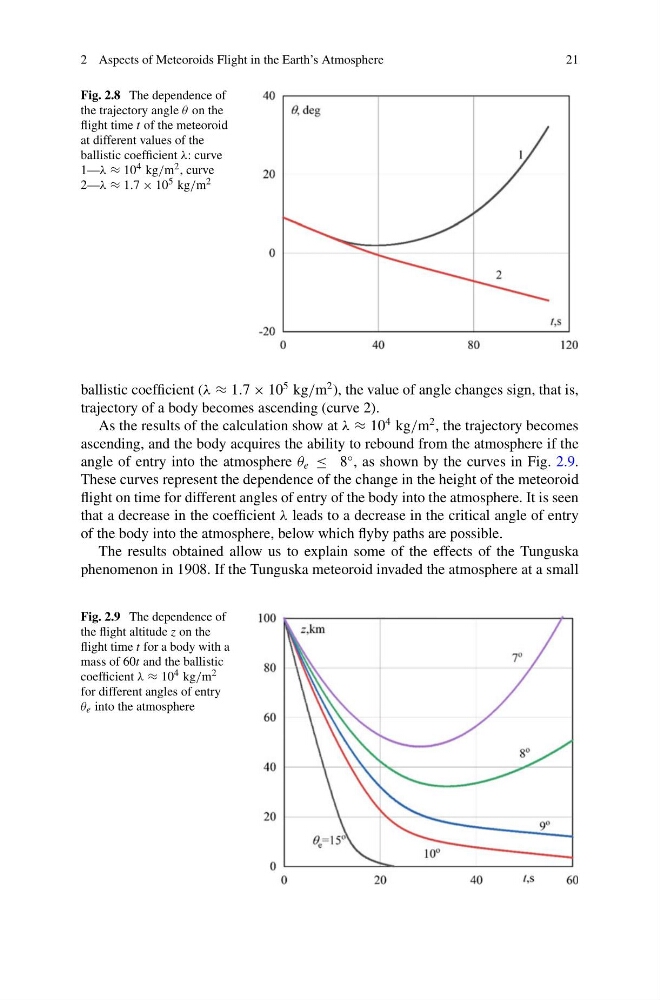
Fig. 2.8 The dependence of
the trajectory angle θ on the
flight time t of the meteoroid
at different values of the
ballistic coefficient λ: curve
1—λ ≈ 10 4 kg/m 2 , curve
2—λ ≈ 1.7 × 10 5 kg/m 2
ballistic coefficient (λ ≈ 1.7 × 10
5 kg/m
2 ), the value of angle changes sign, that is,
trajectory of a body becomes ascending (curve 2).
As the results of the calculation show at λ ≈ 10
4 kg/m
2 , the trajectory becomes
ascending, and the body acquires the ability to rebound from the atmosphere if the
angle of entry into the atmosphere θ e ≤ 8
◦ , as shown by the curves in Fig. 2.9.
These curves represent the dependence of the change in the height of the meteoroid
flight on time for different angles of entry of the body into the atmosphere. It is seen
that a decrease in the coefficient λ leads to a decrease in the critical angle of entry
of the body into the atmosphere, below which flyby paths are possible.
The results obtained allow us to explain some of the effects of the Tunguska
phenomenon in 1908. If the Tunguska meteoroid invaded the atmosphere at a small
Fig. 2.9 The dependence of
the flight altitude z on the
flight time t for a body with a
mass of 60t and the ballistic
coefficient λ ≈ 10 4 kg/m 2
for different angles of entry
θ e into the atmosphere
21
Fig. 2.8 The dependence of
the trajectory angle θ on the
flight time t of the meteoroid
at different values of the
ballistic coefficient λ: curve
1—λ ≈ 10 4 kg/m 2 , curve
2—λ ≈ 1.7 × 10 5 kg/m 2
ballistic coefficient (λ ≈ 1.7 × 10
5 kg/m
2 ), the value of angle changes sign, that is,
trajectory of a body becomes ascending (curve 2).
As the results of the calculation show at λ ≈ 10
4 kg/m
2 , the trajectory becomes
ascending, and the body acquires the ability to rebound from the atmosphere if the
angle of entry into the atmosphere θ e ≤ 8
◦ , as shown by the curves in Fig. 2.9.
These curves represent the dependence of the change in the height of the meteoroid
flight on time for different angles of entry of the body into the atmosphere. It is seen
that a decrease in the coefficient λ leads to a decrease in the critical angle of entry
of the body into the atmosphere, below which flyby paths are possible.
The results obtained allow us to explain some of the effects of the Tunguska
phenomenon in 1908. If the Tunguska meteoroid invaded the atmosphere at a small
Fig. 2.9 The dependence of
the flight altitude z on the
flight time t for a body with a
mass of 60t and the ballistic
coefficient λ ≈ 10 4 kg/m 2
for different angles of entry
θ e into the atmosphere