

14
N. G. Syzranova and V. A. Andrushchenko
Everything pointed to the fact that the object was supposed to descend and fall to the
ground, but its fall was never registered. This happened because the body was flying
at a slight angle to the Earth’s surface and “bounced” from the layers of the atmosphere, returned back to outer space [1, 2]. Estimates made in [3] show that such an
intrusion into the atmosphere occurs quite rarely, and even more rarely, about once
a century, such phenomena are observed. It is possible that such a meteor body was
Tunguska (1908), the dynamics of which in the atmosphere is still a big mystery.
Thus, one of the important aspects of meteoritics is the study of the trajectories of
meteor bodies under various conditions of entry into the Earth’s atmosphere, which
is the purpose of this chapter. Section 2.2 presents the basic equations for modeling
the movement of large meteor bodies in the Earth’s atmosphere. Section 2.3 presents
the results of numerical calculations of the trajectories of meteor bodies at different
angles of their entry into the atmosphere. Conclusions are presented in Sect. 2.4.
2.2 Basic Equations
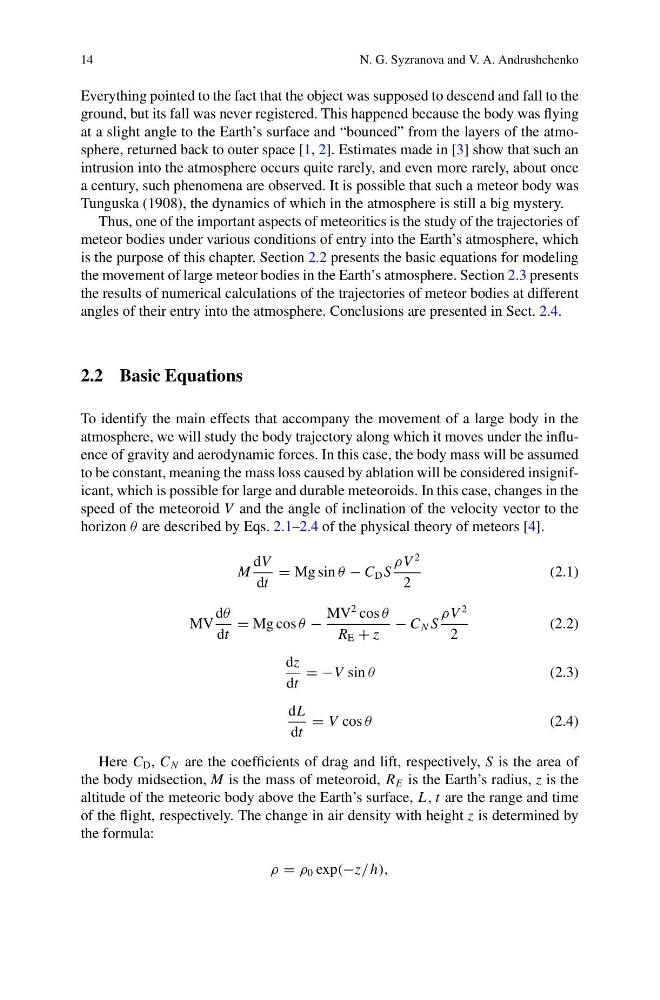
To identify the main effects that accompany the movement of a large body in the
atmosphere, we will study the body trajectory along which it moves under the influence of gravity and aerodynamic forces. In this case, the body mass will be assumed
to be constant, meaning the mass loss caused by ablation will be considered insignificant, which is possible for large and durable meteoroids. In this case, changes in the
speed of the meteoroid V and the angle of inclination of the velocity vector to the
horizon θ are described by Eqs. 2.1–2.4 of the physical theory of meteors [4].
M
dV
dt
= Mg sin θ − C D S
ρV
2
2
(2.1)
MV
dθ
dt
= Mg cos θ −
MV
2 cos θ
R E + z
− C N S
ρV
2
2
(2.2)
dz
dt
= −V sin θ
(2.3)
dL
dt
= V cos θ
(2.4)
Here C D , C N are the coefficients of drag and lift, respectively, S is the area of
the body midsection, M is the mass of meteoroid, R E is the Earth’s radius, z is the
altitude of the meteoric body above the Earth’s surface, L , t are the range and time
of the flight, respectively. The change in air density with height z is determined by
the formula:
ρ = ρ 0 exp(−z/ h),
N. G. Syzranova and V. A. Andrushchenko
Everything pointed to the fact that the object was supposed to descend and fall to the
ground, but its fall was never registered. This happened because the body was flying
at a slight angle to the Earth’s surface and “bounced” from the layers of the atmosphere, returned back to outer space [1, 2]. Estimates made in [3] show that such an
intrusion into the atmosphere occurs quite rarely, and even more rarely, about once
a century, such phenomena are observed. It is possible that such a meteor body was
Tunguska (1908), the dynamics of which in the atmosphere is still a big mystery.
Thus, one of the important aspects of meteoritics is the study of the trajectories of
meteor bodies under various conditions of entry into the Earth’s atmosphere, which
is the purpose of this chapter. Section 2.2 presents the basic equations for modeling
the movement of large meteor bodies in the Earth’s atmosphere. Section 2.3 presents
the results of numerical calculations of the trajectories of meteor bodies at different
angles of their entry into the atmosphere. Conclusions are presented in Sect. 2.4.
2.2 Basic Equations
To identify the main effects that accompany the movement of a large body in the
atmosphere, we will study the body trajectory along which it moves under the influence of gravity and aerodynamic forces. In this case, the body mass will be assumed
to be constant, meaning the mass loss caused by ablation will be considered insignificant, which is possible for large and durable meteoroids. In this case, changes in the
speed of the meteoroid V and the angle of inclination of the velocity vector to the
horizon θ are described by Eqs. 2.1–2.4 of the physical theory of meteors [4].
M
dV
dt
= Mg sin θ − C D S
ρV
2
2
(2.1)
MV
dθ
dt
= Mg cos θ −
MV
2 cos θ
R E + z
− C N S
ρV
2
2
(2.2)
dz
dt
= −V sin θ
(2.3)
dL
dt
= V cos θ
(2.4)
Here C D , C N are the coefficients of drag and lift, respectively, S is the area of
the body midsection, M is the mass of meteoroid, R E is the Earth’s radius, z is the
altitude of the meteoric body above the Earth’s surface, L , t are the range and time
of the flight, respectively. The change in air density with height z is determined by
the formula:
ρ = ρ 0 exp(−z/ h),