

14 Numerical Study on the Teeth Installation Parameters: Shift …
191
features of oral cavity. However, there are quite limited number of studies on the
permissible range for the teeth block shift and tilt angles. According to the basics of
mechanics, the most critical case for the structural integrity of the prosthesis basis
is the loads applied to the shift teeth blocks or on the block with a tilt angle. In the
framework of this study, all the configurations are studied: oral and external teeth
block shift (from block 1 to block 4) and oral and external tilt angles for these four
blocks. The maximum teeth shift is ±1 mm from the normal installation line. The
tilt angle is varying from –20° to 20°. The results for extreme values are given.
Hereinafter, the studies on the shift effect and tilt angle effect are presented in
Sects. 14.4.1–14.4.2, respectively.
14.4.1 Study on the Shift Effect
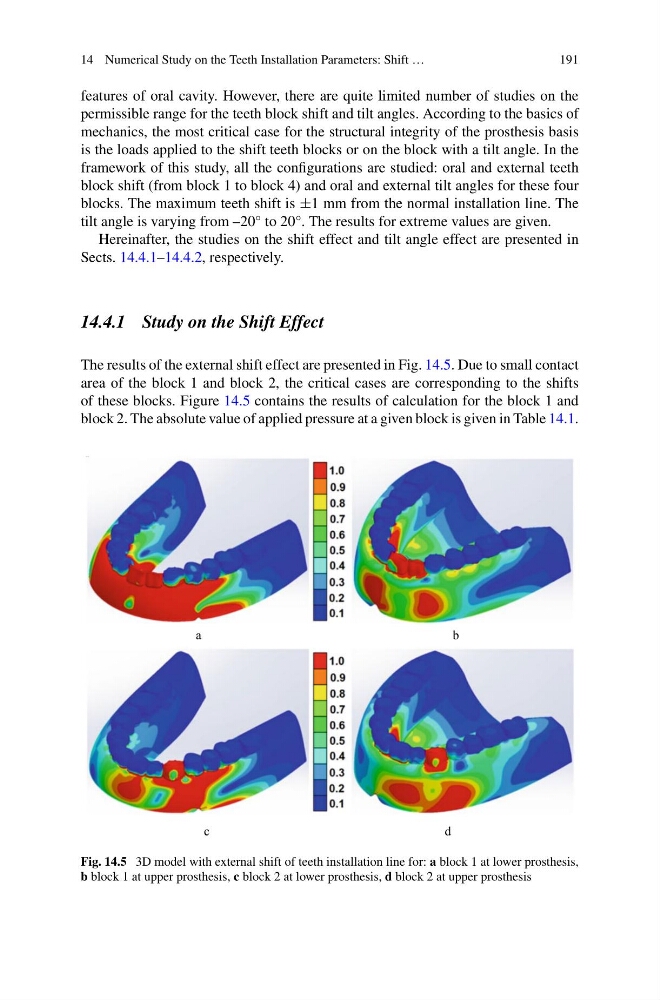
The results of the external shift effect are presented in Fig. 14.5. Due to small contact
area of the block 1 and block 2, the critical cases are corresponding to the shifts
of these blocks. Figure 14.5 contains the results of calculation for the block 1 and
block 2. The absolute value of applied pressure at a given block is given in Table 14.1.
a
b
c
d
Fig. 14.5 3D model with external shift of teeth installation line for: a block 1 at lower prosthesis,
b block 1 at upper prosthesis, c block 2 at lower prosthesis, d block 2 at upper prosthesis
191
features of oral cavity. However, there are quite limited number of studies on the
permissible range for the teeth block shift and tilt angles. According to the basics of
mechanics, the most critical case for the structural integrity of the prosthesis basis
is the loads applied to the shift teeth blocks or on the block with a tilt angle. In the
framework of this study, all the configurations are studied: oral and external teeth
block shift (from block 1 to block 4) and oral and external tilt angles for these four
blocks. The maximum teeth shift is ±1 mm from the normal installation line. The
tilt angle is varying from –20° to 20°. The results for extreme values are given.
Hereinafter, the studies on the shift effect and tilt angle effect are presented in
Sects. 14.4.1–14.4.2, respectively.
14.4.1 Study on the Shift Effect
The results of the external shift effect are presented in Fig. 14.5. Due to small contact
area of the block 1 and block 2, the critical cases are corresponding to the shifts
of these blocks. Figure 14.5 contains the results of calculation for the block 1 and
block 2. The absolute value of applied pressure at a given block is given in Table 14.1.
a
b
c
d
Fig. 14.5 3D model with external shift of teeth installation line for: a block 1 at lower prosthesis,
b block 1 at upper prosthesis, c block 2 at lower prosthesis, d block 2 at upper prosthesis