

180
I. B. Petrov et al.
a
b
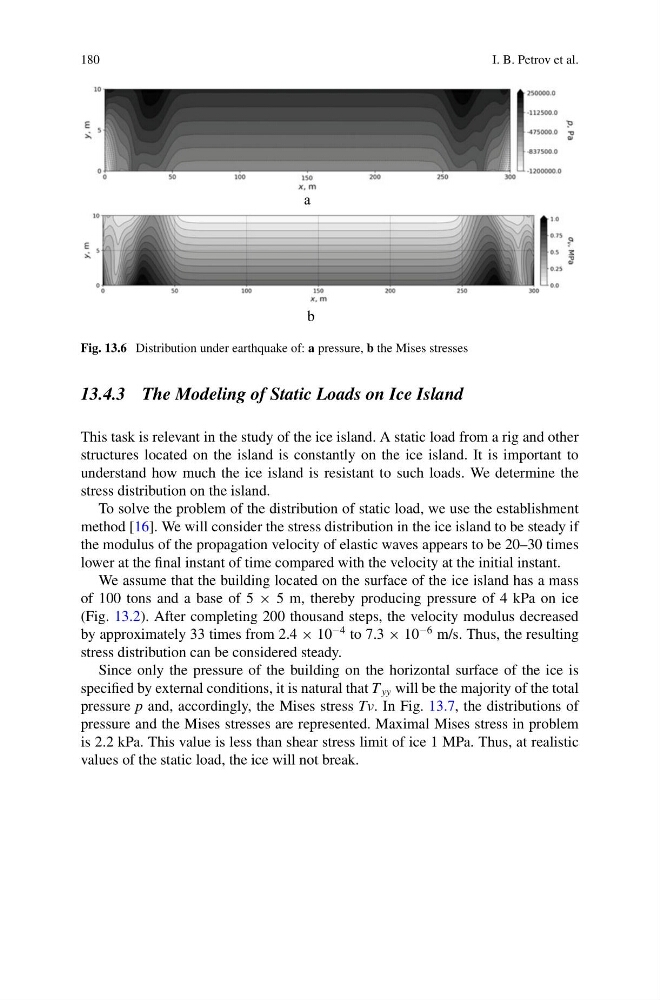
Fig. 13.6 Distribution under earthquake of: a pressure, b the Mises stresses
13.4.3 The Modeling of Static Loads on Ice Island
This task is relevant in the study of the ice island. A static load from a rig and other
structures located on the island is constantly on the ice island. It is important to
understand how much the ice island is resistant to such loads. We determine the
stress distribution on the island.
To solve the problem of the distribution of static load, we use the establishment
method [16]. We will consider the stress distribution in the ice island to be steady if
the modulus of the propagation velocity of elastic waves appears to be 20–30 times
lower at the final instant of time compared with the velocity at the initial instant.
We assume that the building located on the surface of the ice island has a mass
of 100 tons and a base of 5 × 5 m, thereby producing pressure of 4 kPa on ice
(Fig. 13.2). After completing 200 thousand steps, the velocity modulus decreased
by approximately 33 times from 2.4 × 10
−4 to 7.3 × 10
−6 m/s. Thus, the resulting
stress distribution can be considered steady.
Since only the pressure of the building on the horizontal surface of the ice is
specified by external conditions, it is natural that T yy will be the majority of the total
pressure p and, accordingly, the Mises stress Tν. In Fig. 13.7, the distributions of
pressure and the Mises stresses are represented. Maximal Mises stress in problem
is 2.2 kPa. This value is less than shear stress limit of ice 1 MPa. Thus, at realistic
values of the static load, the ice will not break.
I. B. Petrov et al.
a
b
Fig. 13.6 Distribution under earthquake of: a pressure, b the Mises stresses
13.4.3 The Modeling of Static Loads on Ice Island
This task is relevant in the study of the ice island. A static load from a rig and other
structures located on the island is constantly on the ice island. It is important to
understand how much the ice island is resistant to such loads. We determine the
stress distribution on the island.
To solve the problem of the distribution of static load, we use the establishment
method [16]. We will consider the stress distribution in the ice island to be steady if
the modulus of the propagation velocity of elastic waves appears to be 20–30 times
lower at the final instant of time compared with the velocity at the initial instant.
We assume that the building located on the surface of the ice island has a mass
of 100 tons and a base of 5 × 5 m, thereby producing pressure of 4 kPa on ice
(Fig. 13.2). After completing 200 thousand steps, the velocity modulus decreased
by approximately 33 times from 2.4 × 10
−4 to 7.3 × 10
−6 m/s. Thus, the resulting
stress distribution can be considered steady.
Since only the pressure of the building on the horizontal surface of the ice is
specified by external conditions, it is natural that T yy will be the majority of the total
pressure p and, accordingly, the Mises stress Tν. In Fig. 13.7, the distributions of
pressure and the Mises stresses are represented. Maximal Mises stress in problem
is 2.2 kPa. This value is less than shear stress limit of ice 1 MPa. Thus, at realistic
values of the static load, the ice will not break.