

178
I. B. Petrov et al.
13.4 The Results of Modeling
This section is devoted to the results of mathematical modeling. All the above statements are considered: the modeling of drill strikes, modeling earthquakes impacts
on ice island, modeling of static loads on ice island, and modeling of collision of ice
island with ice layer in Sects. 13.4.1 and 13.4.4, respectively.
13.4.1 The Modeling of Drill Strikes
The drill was set by a point source at a depth of 20 m with a Ricker wave pulse. We
studied the process of propagation of waves from a drill in the medium, as well as the
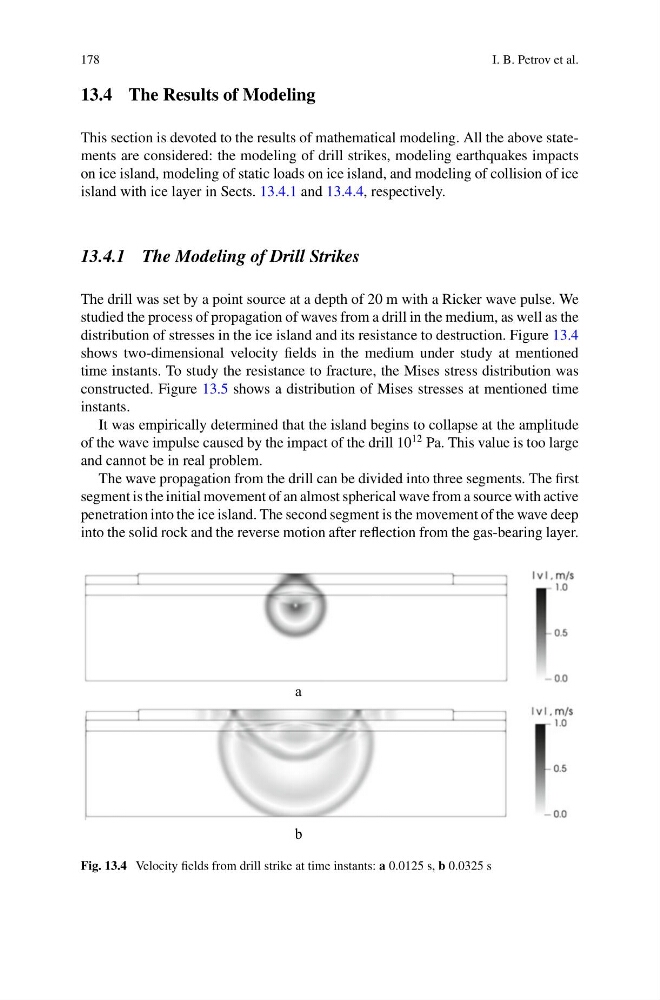
distribution of stresses in the ice island and its resistance to destruction. Figure 13.4
shows two-dimensional velocity fields in the medium under study at mentioned
time instants. To study the resistance to fracture, the Mises stress distribution was
constructed. Figure 13.5 shows a distribution of Mises stresses at mentioned time
instants.
It was empirically determined that the island begins to collapse at the amplitude
of the wave impulse caused by the impact of the drill 10
12 Pa. This value is too large
and cannot be in real problem.
The wave propagation from the drill can be divided into three segments. The first
segment is the initial movement of an almost spherical wave from a source with active
penetration into the ice island. The second segment is the movement of the wave deep
into the solid rock and the reverse motion after reflection from the gas-bearing layer.
a
b
Fig. 13.4 Velocity fields from drill strike at time instants: a 0.0125 s, b 0.0325 s
I. B. Petrov et al.
13.4 The Results of Modeling
This section is devoted to the results of mathematical modeling. All the above statements are considered: the modeling of drill strikes, modeling earthquakes impacts
on ice island, modeling of static loads on ice island, and modeling of collision of ice
island with ice layer in Sects. 13.4.1 and 13.4.4, respectively.
13.4.1 The Modeling of Drill Strikes
The drill was set by a point source at a depth of 20 m with a Ricker wave pulse. We
studied the process of propagation of waves from a drill in the medium, as well as the
distribution of stresses in the ice island and its resistance to destruction. Figure 13.4
shows two-dimensional velocity fields in the medium under study at mentioned
time instants. To study the resistance to fracture, the Mises stress distribution was
constructed. Figure 13.5 shows a distribution of Mises stresses at mentioned time
instants.
It was empirically determined that the island begins to collapse at the amplitude
of the wave impulse caused by the impact of the drill 10
12 Pa. This value is too large
and cannot be in real problem.
The wave propagation from the drill can be divided into three segments. The first
segment is the initial movement of an almost spherical wave from a source with active
penetration into the ice island. The second segment is the movement of the wave deep
into the solid rock and the reverse motion after reflection from the gas-bearing layer.
a
b
Fig. 13.4 Velocity fields from drill strike at time instants: a 0.0125 s, b 0.0325 s