

176
I. B. Petrov et al.
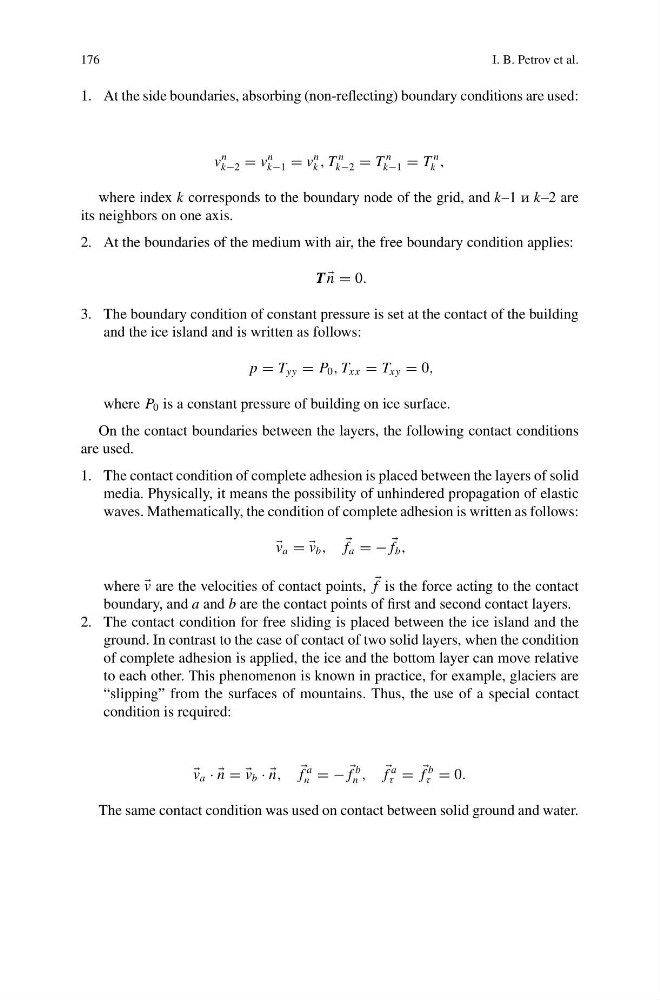
1. At the side boundaries, absorbing (non-reflecting) boundary conditions are used:
v
n
k−2 = v
n
k−1 = v
n
k , T
n
k−2 = T
n
k−1 = T
n
k ,
where index k corresponds to the boundary node of the grid, and k–1 i k–2 are
its neighbors on one axis.
2. At the boundaries of the medium with air, the free boundary condition applies:
T
n = 0.
3. The boundary condition of constant pressure is set at the contact of the building
and the ice island and is written as follows:
p = T yy = P 0 , T xx = T xy = 0,
where P 0 is a constant pressure of building on ice surface.
On the contact boundaries between the layers, the following contact conditions
are used.
1. The contact condition of complete adhesion is placed between the layers of solid
media. Physically, it means the possibility of unhindered propagation of elastic
waves. Mathematically, the condition of complete adhesion is written as follows:
v a = =
v b ,
f a = −
f b ,
where
v are the velocities of contact points,
f is the force acting to the contact
boundary, and a and b are the contact points of first and second contact layers.
2. The contact condition for free sliding is placed between the ice island and the
ground. In contrast to the case of contact of two solid layers, when the condition
of complete adhesion is applied, the ice and the bottom layer can move relative
to each other. This phenomenon is known in practice, for example, glaciers are
“slipping” from the surfaces of mountains. Thus, the use of a special contact
condition is required:
v a · ·
n = =
v b · ·
n,
f
a
n = −
f
b
n ,
f
a
τ =
f
b
τ = 0.
The same contact condition was used on contact between solid ground and water.
I. B. Petrov et al.
1. At the side boundaries, absorbing (non-reflecting) boundary conditions are used:
v
n
k−2 = v
n
k−1 = v
n
k , T
n
k−2 = T
n
k−1 = T
n
k ,
where index k corresponds to the boundary node of the grid, and k–1 i k–2 are
its neighbors on one axis.
2. At the boundaries of the medium with air, the free boundary condition applies:
T
n = 0.
3. The boundary condition of constant pressure is set at the contact of the building
and the ice island and is written as follows:
p = T yy = P 0 , T xx = T xy = 0,
where P 0 is a constant pressure of building on ice surface.
On the contact boundaries between the layers, the following contact conditions
are used.
1. The contact condition of complete adhesion is placed between the layers of solid
media. Physically, it means the possibility of unhindered propagation of elastic
waves. Mathematically, the condition of complete adhesion is written as follows:
v a = =
v b ,
f a = −
f b ,
where
v are the velocities of contact points,
f is the force acting to the contact
boundary, and a and b are the contact points of first and second contact layers.
2. The contact condition for free sliding is placed between the ice island and the
ground. In contrast to the case of contact of two solid layers, when the condition
of complete adhesion is applied, the ice and the bottom layer can move relative
to each other. This phenomenon is known in practice, for example, glaciers are
“slipping” from the surfaces of mountains. Thus, the use of a special contact
condition is required:
v a · ·
n = =
v b · ·
n,
f
a
n = −
f
b
n ,
f
a
τ =
f
b
τ = 0.
The same contact condition was used on contact between solid ground and water.