

11 Application of Low-Power Pulse Plasma Thrusters in Thrust Units …
153
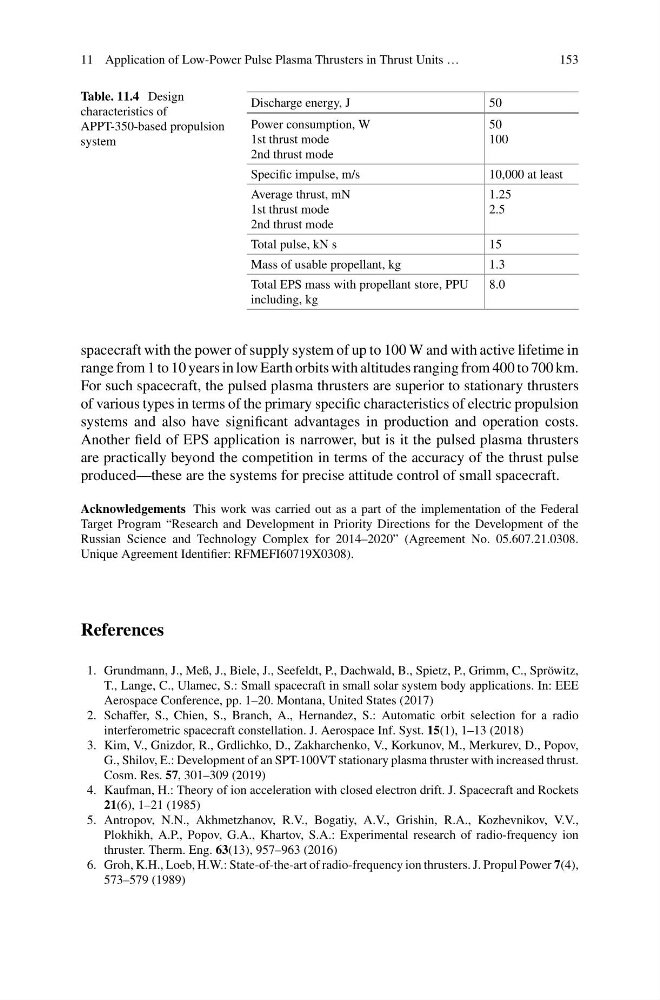
Table. 11.4 Design
characteristics of
APPT-350-based propulsion
system
Discharge energy, J
50
Power consumption, W
1st thrust mode
2nd thrust mode
50
100
Specific impulse, m/s
10,000 at least
Average thrust, mN
1st thrust mode
2nd thrust mode
1.25
2.5
Total pulse, kN s
15
Mass of usable propellant, kg
1.3
Total EPS mass with propellant store, PPU
including, kg
8.0
spacecraft with the power of supply system of up to 100 W and with active lifetime in
range from 1 to 10 years in low Earth orbits with altitudes ranging from 400 to 700 km.
For such spacecraft, the pulsed plasma thrusters are superior to stationary thrusters
of various types in terms of the primary specific characteristics of electric propulsion
systems and also have significant advantages in production and operation costs.
Another field of EPS application is narrower, but is it the pulsed plasma thrusters
are practically beyond the competition in terms of the accuracy of the thrust pulse
produced—these are the systems for precise attitude control of small spacecraft.
Acknowledgements This work was carried out as a part of the implementation of the Federal
Target Program “Research and Development in Priority Directions for the Development of the
Russian Science and Technology Complex for 2014–2020” (Agreement No. 05.607.21.0308.
Unique Agreement Identifier: RFMEFI60719X0308).
References
1. Grundmann, J., Meß, J., Biele, J., Seefeldt, P., Dachwald, B., Spietz, P., Grimm, C., Spröwitz,
T., Lange, C., Ulamec, S.: Small spacecraft in small solar system body applications. In: EEE
Aerospace Conference, pp. 1–20. Montana, United States (2017)
2. Schaffer, S., Chien, S., Branch, A., Hernandez, S.: Automatic orbit selection for a radio
interferometric spacecraft constellation. J. Aerospace Inf. Syst. 15(1), 1–13 (2018)
3. Kim, V., Gnizdor, R., Grdlichko, D., Zakharchenko, V., Korkunov, M., Merkurev, D., Popov,
G., Shilov, E.: Development of an SPT-100VT stationary plasma thruster with increased thrust.
Cosm. Res. 57, 301–309 (2019)
4. Kaufman, H.: Theory of ion acceleration with closed electron drift. J. Spacecraft and Rockets
21(6), 1–21 (1985)
5. Antropov, N.N., Akhmetzhanov, R.V., Bogatiy, A.V., Grishin, R.A., Kozhevnikov, V.V.,
Plokhikh, A.P., Popov, G.A., Khartov, S.A.: Experimental research of radio-frequency ion
thruster. Therm. Eng. 63(13), 957–963 (2016)
6. Groh, K.H., Loeb, H.W.: State-of-the-art of radio-frequency ion thrusters. J. Propul Power 7(4),
573–579 (1989)
153
Table. 11.4 Design
characteristics of
APPT-350-based propulsion
system
Discharge energy, J
50
Power consumption, W
1st thrust mode
2nd thrust mode
50
100
Specific impulse, m/s
10,000 at least
Average thrust, mN
1st thrust mode
2nd thrust mode
1.25
2.5
Total pulse, kN s
15
Mass of usable propellant, kg
1.3
Total EPS mass with propellant store, PPU
including, kg
8.0
spacecraft with the power of supply system of up to 100 W and with active lifetime in
range from 1 to 10 years in low Earth orbits with altitudes ranging from 400 to 700 km.
For such spacecraft, the pulsed plasma thrusters are superior to stationary thrusters
of various types in terms of the primary specific characteristics of electric propulsion
systems and also have significant advantages in production and operation costs.
Another field of EPS application is narrower, but is it the pulsed plasma thrusters
are practically beyond the competition in terms of the accuracy of the thrust pulse
produced—these are the systems for precise attitude control of small spacecraft.
Acknowledgements This work was carried out as a part of the implementation of the Federal
Target Program “Research and Development in Priority Directions for the Development of the
Russian Science and Technology Complex for 2014–2020” (Agreement No. 05.607.21.0308.
Unique Agreement Identifier: RFMEFI60719X0308).
References
1. Grundmann, J., Meß, J., Biele, J., Seefeldt, P., Dachwald, B., Spietz, P., Grimm, C., Spröwitz,
T., Lange, C., Ulamec, S.: Small spacecraft in small solar system body applications. In: EEE
Aerospace Conference, pp. 1–20. Montana, United States (2017)
2. Schaffer, S., Chien, S., Branch, A., Hernandez, S.: Automatic orbit selection for a radio
interferometric spacecraft constellation. J. Aerospace Inf. Syst. 15(1), 1–13 (2018)
3. Kim, V., Gnizdor, R., Grdlichko, D., Zakharchenko, V., Korkunov, M., Merkurev, D., Popov,
G., Shilov, E.: Development of an SPT-100VT stationary plasma thruster with increased thrust.
Cosm. Res. 57, 301–309 (2019)
4. Kaufman, H.: Theory of ion acceleration with closed electron drift. J. Spacecraft and Rockets
21(6), 1–21 (1985)
5. Antropov, N.N., Akhmetzhanov, R.V., Bogatiy, A.V., Grishin, R.A., Kozhevnikov, V.V.,
Plokhikh, A.P., Popov, G.A., Khartov, S.A.: Experimental research of radio-frequency ion
thruster. Therm. Eng. 63(13), 957–963 (2016)
6. Groh, K.H., Loeb, H.W.: State-of-the-art of radio-frequency ion thrusters. J. Propul Power 7(4),
573–579 (1989)