

132
V. A. Obukhov et al.
value. The second rotation angle relative to the axis OZ S and the
rotation angles relative to the axis OX S are calculated by Eq. 10.1
based on the required values of the thrust projections, taking into
account the sign of the total momentum relative to the axis OY S .
10.4 Model of the Ion Beam Momentum Transfer to Space
Debris Object
Calculation of the IB momentum transfer to SDO is an independent complicated
problem. The forces and momentums acting on SDO depend on the SDO configuration, the location and orientation of SDO relative to IB, and also on the IB parameters.
Various aspects of the calculation of forces and momentums are considered in [2,
3, 6, 7]. When analyzing divergence of IB flowing out into the outer space, it is
necessary to take into account the initial divergence angle and the action of electron
pressure and ambipolar electric field in the beam. For a conical IB, the end formulas
were obtained, which allow one to calculate the parameters of IB in the far field in the
region of interaction with SDO [8]. When calculating the force acting on SDO, the
shape of the latter is usually idealized, taking it for a sphere or a cylinder. In the exact
calculation of forces and momentums, to assess the quality of the control process, it
is necessary to conduct statistical modeling taking into account the angular motion
of SDO, in which the initial conditions for the SDO orientation take random values.
In this chapter, we have interest to evaluate algorithms of the SSC control and the
EPT rotation control for various types and different parameters of the SDO angular
motion. To this end, it is proposed to use a simplified simulation model of IB impact
on SDO, presented in [5]. The model assumes that for a specific SDO orientation,
there is a circle with the effective radius R T , the influence of IB on which is equivalent
to IB impact on SDO.
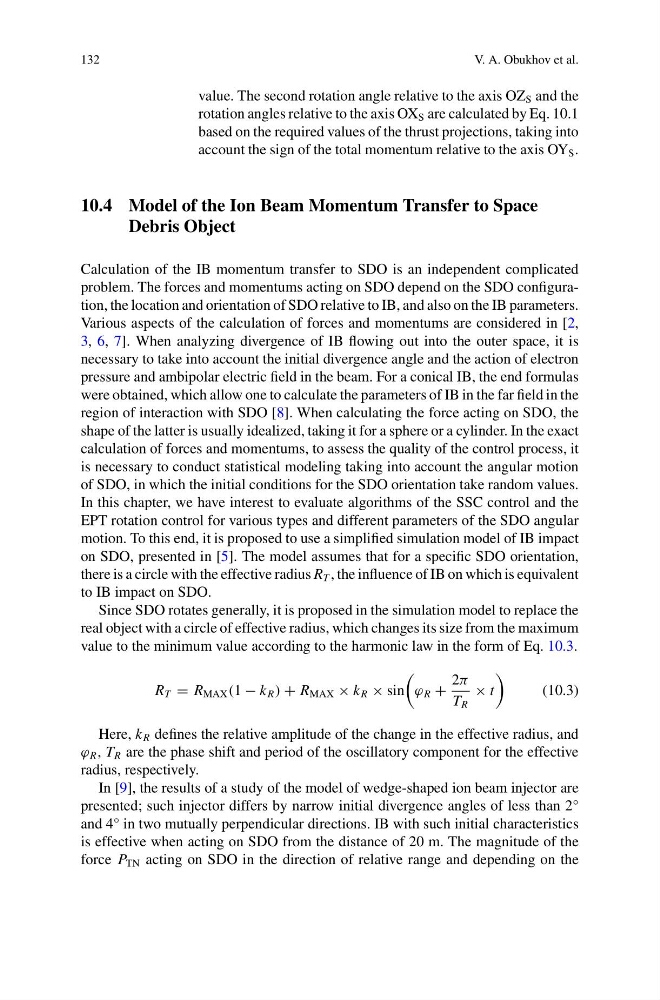
Since SDO rotates generally, it is proposed in the simulation model to replace the
real object with a circle of effective radius, which changes its size from the maximum
value to the minimum value according to the harmonic law in the form of Eq. 10.3.
R T = R MAX (1 − k R ) + R MAX × k R × sin
ϕ R +
2π
T R
× t
(10.3)
Here, k R defines the relative amplitude of the change in the effective radius, and
ϕ R , T R are the phase shift and period of the oscillatory component for the effective
radius, respectively.
In [9], the results of a study of the model of wedge-shaped ion beam injector are
presented; such injector differs by narrow initial divergence angles of less than 2°
and 4° in two mutually perpendicular directions. IB with such initial characteristics
is effective when acting on SDO from the distance of 20 m. The magnitude of the
force P TN acting on SDO in the direction of relative range and depending on the
V. A. Obukhov et al.
value. The second rotation angle relative to the axis OZ S and the
rotation angles relative to the axis OX S are calculated by Eq. 10.1
based on the required values of the thrust projections, taking into
account the sign of the total momentum relative to the axis OY S .
10.4 Model of the Ion Beam Momentum Transfer to Space
Debris Object
Calculation of the IB momentum transfer to SDO is an independent complicated
problem. The forces and momentums acting on SDO depend on the SDO configuration, the location and orientation of SDO relative to IB, and also on the IB parameters.
Various aspects of the calculation of forces and momentums are considered in [2,
3, 6, 7]. When analyzing divergence of IB flowing out into the outer space, it is
necessary to take into account the initial divergence angle and the action of electron
pressure and ambipolar electric field in the beam. For a conical IB, the end formulas
were obtained, which allow one to calculate the parameters of IB in the far field in the
region of interaction with SDO [8]. When calculating the force acting on SDO, the
shape of the latter is usually idealized, taking it for a sphere or a cylinder. In the exact
calculation of forces and momentums, to assess the quality of the control process, it
is necessary to conduct statistical modeling taking into account the angular motion
of SDO, in which the initial conditions for the SDO orientation take random values.
In this chapter, we have interest to evaluate algorithms of the SSC control and the
EPT rotation control for various types and different parameters of the SDO angular
motion. To this end, it is proposed to use a simplified simulation model of IB impact
on SDO, presented in [5]. The model assumes that for a specific SDO orientation,
there is a circle with the effective radius R T , the influence of IB on which is equivalent
to IB impact on SDO.
Since SDO rotates generally, it is proposed in the simulation model to replace the
real object with a circle of effective radius, which changes its size from the maximum
value to the minimum value according to the harmonic law in the form of Eq. 10.3.
R T = R MAX (1 − k R ) + R MAX × k R × sin
ϕ R +
2π
T R
× t
(10.3)
Here, k R defines the relative amplitude of the change in the effective radius, and
ϕ R , T R are the phase shift and period of the oscillatory component for the effective
radius, respectively.
In [9], the results of a study of the model of wedge-shaped ion beam injector are
presented; such injector differs by narrow initial divergence angles of less than 2°
and 4° in two mutually perpendicular directions. IB with such initial characteristics
is effective when acting on SDO from the distance of 20 m. The magnitude of the
force P TN acting on SDO in the direction of relative range and depending on the