

614
F. Abdelradi and D. Yassin
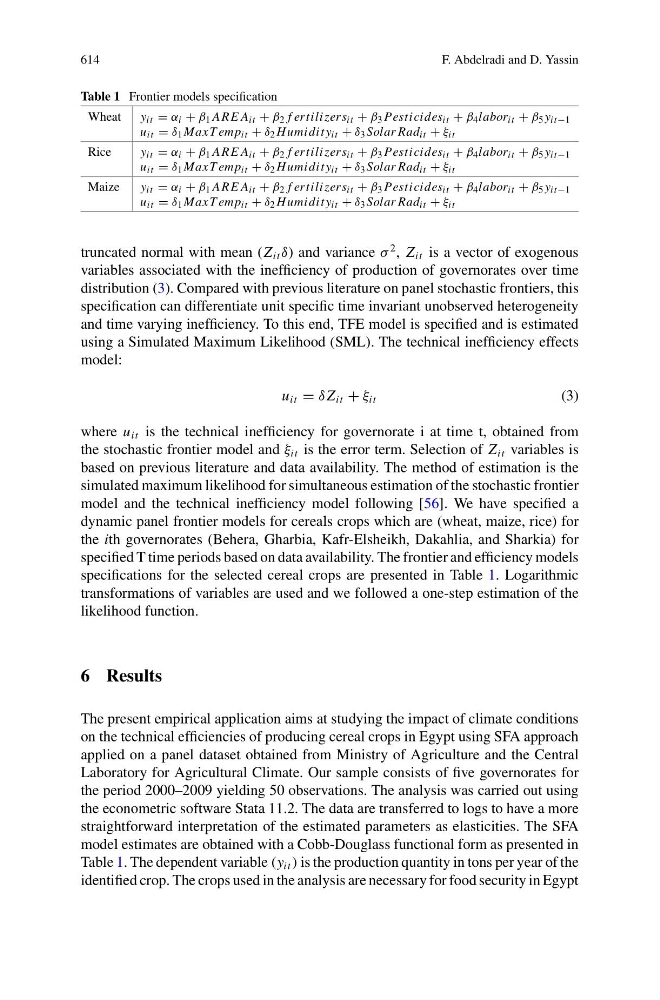
Table 1 Frontier models specification
Wheat
y it = α i + β 1 AR E A it + β 2 f ertilizers it + β 3 Pesticides it + β 4 labor it + β 5 y it−1
u it = δ 1 Max T emp it + δ 2 Humidit y it + δ 3 Solar Rad it + ξ it
Rice
y it = α i + β 1 AR E A it + β 2 f ertilizers it + β 3 Pesticides it + β 4 labor it + β 5 y it−1
u it = δ 1 Max T emp it + δ 2 Humidit y it + δ 3 Solar Rad it + ξ it
Maize
y it = α i + β 1 AR E A it + β 2 f ertilizers it + β 3 Pesticides it + β 4 labor it + β 5 y it−1
u it = δ 1 Max T emp it + δ 2 Humidit y it + δ 3 Solar Rad it + ξ it
truncated normal with mean (Z it δ) and variance σ
2 , Z it is a vector of exogenous
variables associated with the inefficiency of production of governorates over time
distribution (3). Compared with previous literature on panel stochastic frontiers, this
specification can differentiate unit specific time invariant unobserved heterogeneity
and time varying inefficiency. To this end, TFE model is specified and is estimated
using a Simulated Maximum Likelihood (SML). The technical inefficiency effects
model:
u it = δ Z it + ξ it
(3)
where u it is the technical inefficiency for governorate i at time t, obtained from
the stochastic frontier model and ξ it is the error term. Selection of Z it variables is
based on previous literature and data availability. The method of estimation is the
simulated maximum likelihood for simultaneous estimation of the stochastic frontier
model and the technical inefficiency model following [56]. We have specified a
dynamic panel frontier models for cereals crops which are (wheat, maize, rice) for
the ith governorates (Behera, Gharbia, Kafr-Elsheikh, Dakahlia, and Sharkia) for
specified T time periods based on data availability. The frontier and efficiency models
specifications for the selected cereal crops are presented in Table 1. Logarithmic
transformations of variables are used and we followed a one-step estimation of the
likelihood function.
6 Results
The present empirical application aims at studying the impact of climate conditions
on the technical efficiencies of producing cereal crops in Egypt using SFA approach
applied on a panel dataset obtained from Ministry of Agriculture and the Central
Laboratory for Agricultural Climate. Our sample consists of five governorates for
the period 2000–2009 yielding 50 observations. The analysis was carried out using
the econometric software Stata 11.2. The data are transferred to logs to have a more
straightforward interpretation of the estimated parameters as elasticities. The SFA
model estimates are obtained with a Cobb-Douglass functional form as presented in
Table 1. The dependent variable (y it ) is the production quantity in tons per year of the
identified crop. The crops used in the analysis are necessary for food security in Egypt
F. Abdelradi and D. Yassin
Table 1 Frontier models specification
Wheat
y it = α i + β 1 AR E A it + β 2 f ertilizers it + β 3 Pesticides it + β 4 labor it + β 5 y it−1
u it = δ 1 Max T emp it + δ 2 Humidit y it + δ 3 Solar Rad it + ξ it
Rice
y it = α i + β 1 AR E A it + β 2 f ertilizers it + β 3 Pesticides it + β 4 labor it + β 5 y it−1
u it = δ 1 Max T emp it + δ 2 Humidit y it + δ 3 Solar Rad it + ξ it
Maize
y it = α i + β 1 AR E A it + β 2 f ertilizers it + β 3 Pesticides it + β 4 labor it + β 5 y it−1
u it = δ 1 Max T emp it + δ 2 Humidit y it + δ 3 Solar Rad it + ξ it
truncated normal with mean (Z it δ) and variance σ
2 , Z it is a vector of exogenous
variables associated with the inefficiency of production of governorates over time
distribution (3). Compared with previous literature on panel stochastic frontiers, this
specification can differentiate unit specific time invariant unobserved heterogeneity
and time varying inefficiency. To this end, TFE model is specified and is estimated
using a Simulated Maximum Likelihood (SML). The technical inefficiency effects
model:
u it = δ Z it + ξ it
(3)
where u it is the technical inefficiency for governorate i at time t, obtained from
the stochastic frontier model and ξ it is the error term. Selection of Z it variables is
based on previous literature and data availability. The method of estimation is the
simulated maximum likelihood for simultaneous estimation of the stochastic frontier
model and the technical inefficiency model following [56]. We have specified a
dynamic panel frontier models for cereals crops which are (wheat, maize, rice) for
the ith governorates (Behera, Gharbia, Kafr-Elsheikh, Dakahlia, and Sharkia) for
specified T time periods based on data availability. The frontier and efficiency models
specifications for the selected cereal crops are presented in Table 1. Logarithmic
transformations of variables are used and we followed a one-step estimation of the
likelihood function.
6 Results
The present empirical application aims at studying the impact of climate conditions
on the technical efficiencies of producing cereal crops in Egypt using SFA approach
applied on a panel dataset obtained from Ministry of Agriculture and the Central
Laboratory for Agricultural Climate. Our sample consists of five governorates for
the period 2000–2009 yielding 50 observations. The analysis was carried out using
the econometric software Stata 11.2. The data are transferred to logs to have a more
straightforward interpretation of the estimated parameters as elasticities. The SFA
model estimates are obtained with a Cobb-Douglass functional form as presented in
Table 1. The dependent variable (y it ) is the production quantity in tons per year of the
identified crop. The crops used in the analysis are necessary for food security in Egypt