

504
A. M. M. Hamdy
4.1 Adaptation Suggestions
Heat stress begins when the ambient temperature surges above 80 °F and is readily
apparent above 85 °F. When a bird begins to pant, physiological changes have already
started within its body to dissipate excess heat. Even before the bird reaches this point,
anything that you do to help birds remain comfortable will help to maintain optimum
growth rates, hatchability, egg size, egg shell quality, and egg production [21, 22]
Chicken producers should reconsider building design in new designs to be more
effectively cope with new climate and weather extremes, including the installation of
more/new equipments to cope with extreme climatic changes [23]. These incorporate
the establishment of sustainable power source—, for example, sun oriented or wind
control—to control poultry sheds, and utilizing biomass boilers or anaerobic aging
of chicken litter. Albeit a portion of the effects may happen to a more noteworthy or
lesser degree in the short, medium or longer term, it is critical to think ahead for the
future, particularly in connection to issues, for example, building plan.
4.2 Heat Stress
Heat stress (HS) occurs after exposure to high ambient temperatures beyond the
thermo-neutral zone (TNZ) for a given species. Both acute, a brief intense HS episode,
and chronic pro-longed exposure to high temperatures, or HS, can cause adverse
effects on the chicken’s well-being. The TNZ is a physiological range with limited
variability of biological function [24]. Individual chickens can exhibit a wide range
of reactions to HS, showing from the little effect on their health to experiencing mortality. However, even with the determined optimal temperature per species, different
biological functions and activities play a role for different individuals. The optimum
temperature for hen egg production is estimated to be between 19 and 22 °C, but
between 18 and 30 °C for meat producing birds [2, 14]. Chicken farms have various zones of thermal comfort predominantly dependent on the species of chicken
and their physiological status (internal factors) and relative humidity, the velocity
of ambient air, and the degree of solar radiation (external factors) also contribute to
their TNZ [25]. By including these additional factors, a more useful index can be
created in determining the optimal temperature and potential for HS [26]. As guidelines, the theory of Livestock and Poultry Heat Stress indices, [27], was developed in
order to determine the extent of HS on chickens. Two various indices derived from
meteorological measurements have been developed and recently reviewed by Hahn
et al. [26]. The most common one is the temperature humidity index (THI) [28].
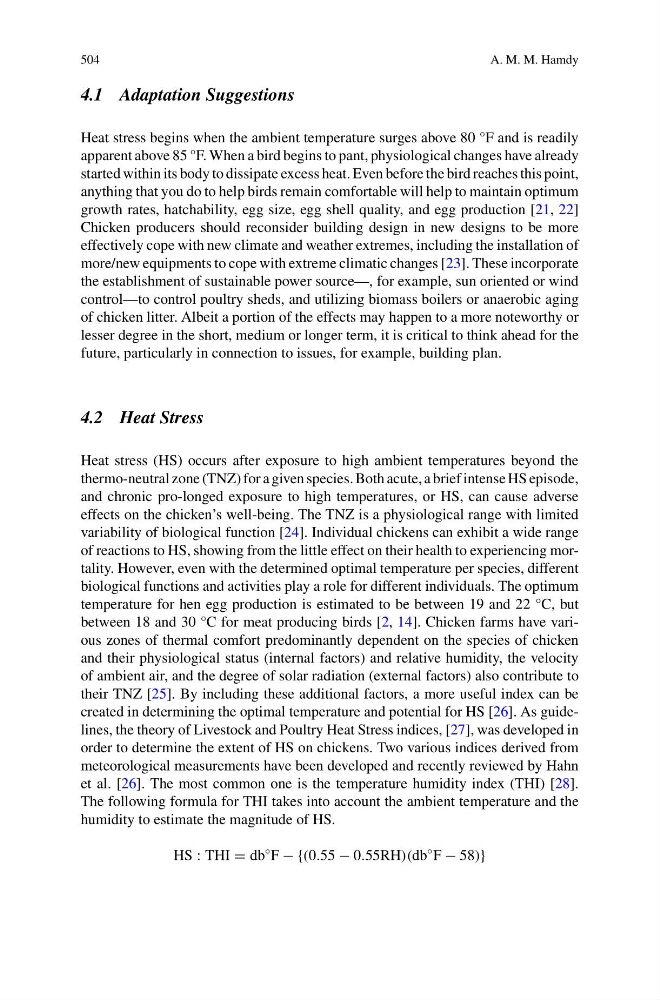
The following formula for THI takes into account the ambient temperature and the
humidity to estimate the magnitude of HS.
HS : THI = db
◦ F − {(0.55 − 0.55RH)(db
◦ F − 58)}
A. M. M. Hamdy
4.1 Adaptation Suggestions
Heat stress begins when the ambient temperature surges above 80 °F and is readily
apparent above 85 °F. When a bird begins to pant, physiological changes have already
started within its body to dissipate excess heat. Even before the bird reaches this point,
anything that you do to help birds remain comfortable will help to maintain optimum
growth rates, hatchability, egg size, egg shell quality, and egg production [21, 22]
Chicken producers should reconsider building design in new designs to be more
effectively cope with new climate and weather extremes, including the installation of
more/new equipments to cope with extreme climatic changes [23]. These incorporate
the establishment of sustainable power source—, for example, sun oriented or wind
control—to control poultry sheds, and utilizing biomass boilers or anaerobic aging
of chicken litter. Albeit a portion of the effects may happen to a more noteworthy or
lesser degree in the short, medium or longer term, it is critical to think ahead for the
future, particularly in connection to issues, for example, building plan.
4.2 Heat Stress
Heat stress (HS) occurs after exposure to high ambient temperatures beyond the
thermo-neutral zone (TNZ) for a given species. Both acute, a brief intense HS episode,
and chronic pro-longed exposure to high temperatures, or HS, can cause adverse
effects on the chicken’s well-being. The TNZ is a physiological range with limited
variability of biological function [24]. Individual chickens can exhibit a wide range
of reactions to HS, showing from the little effect on their health to experiencing mortality. However, even with the determined optimal temperature per species, different
biological functions and activities play a role for different individuals. The optimum
temperature for hen egg production is estimated to be between 19 and 22 °C, but
between 18 and 30 °C for meat producing birds [2, 14]. Chicken farms have various zones of thermal comfort predominantly dependent on the species of chicken
and their physiological status (internal factors) and relative humidity, the velocity
of ambient air, and the degree of solar radiation (external factors) also contribute to
their TNZ [25]. By including these additional factors, a more useful index can be
created in determining the optimal temperature and potential for HS [26]. As guidelines, the theory of Livestock and Poultry Heat Stress indices, [27], was developed in
order to determine the extent of HS on chickens. Two various indices derived from
meteorological measurements have been developed and recently reviewed by Hahn
et al. [26]. The most common one is the temperature humidity index (THI) [28].
The following formula for THI takes into account the ambient temperature and the
humidity to estimate the magnitude of HS.
HS : THI = db
◦ F − {(0.55 − 0.55RH)(db
◦ F − 58)}