

32
H. Khozyem
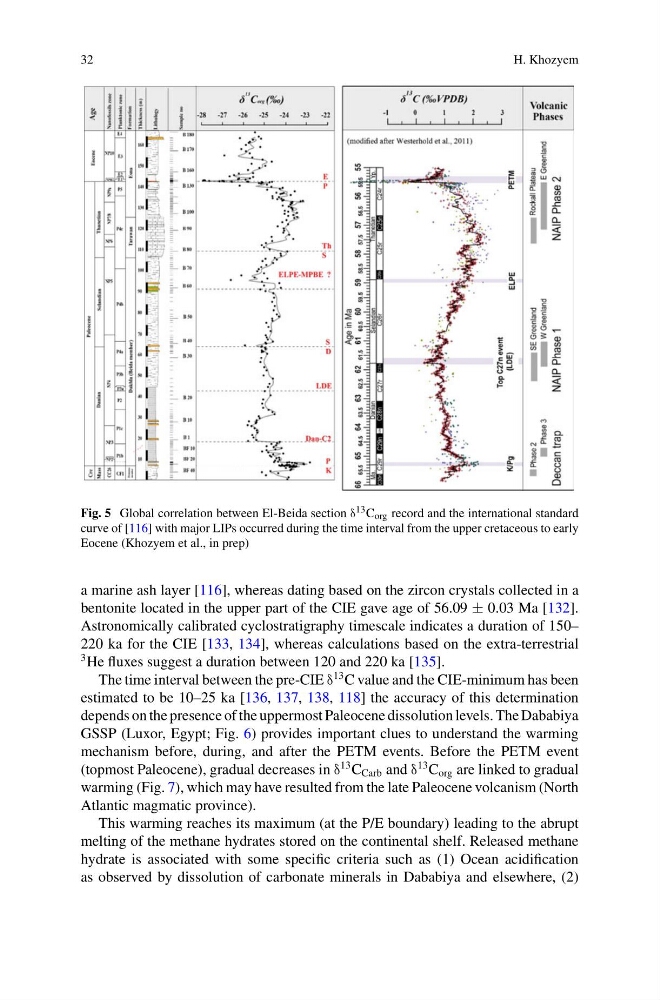
Fig. 5 Global correlation between El-Beida section δ 13 C org record and the international standard
curve of [116] with major LIPs occurred during the time interval from the upper cretaceous to early
Eocene (Khozyem et al., in prep)
a marine ash layer [116], whereas dating based on the zircon crystals collected in a
bentonite located in the upper part of the CIE gave age of 56.09 ± 0.03 Ma [132].
Astronomically calibrated cyclostratigraphy timescale indicates a duration of 150–
220 ka for the CIE [133, 134], whereas calculations based on the extra-terrestrial
3 He fluxes suggest a duration between 120 and 220 ka [135].
The time interval between the pre-CIE δ
13 C value and the CIE-minimum has been
estimated to be 10–25 ka [136, 137, 138, 118] the accuracy of this determination
depends on the presence of the uppermost Paleocene dissolution levels. The Dababiya
GSSP (Luxor, Egypt; Fig. 6) provides important clues to understand the warming
mechanism before, during, and after the PETM events. Before the PETM event
(topmost Paleocene), gradual decreases in δ
13 C Carb and δ
13 C org are linked to gradual
warming (Fig. 7), which may have resulted from the late Paleocene volcanism (North
Atlantic magmatic province).
This warming reaches its maximum (at the P/E boundary) leading to the abrupt
melting of the methane hydrates stored on the continental shelf. Released methane
hydrate is associated with some specific criteria such as (1) Ocean acidification
as observed by dissolution of carbonate minerals in Dababiya and elsewhere, (2)
H. Khozyem
Fig. 5 Global correlation between El-Beida section δ 13 C org record and the international standard
curve of [116] with major LIPs occurred during the time interval from the upper cretaceous to early
Eocene (Khozyem et al., in prep)
a marine ash layer [116], whereas dating based on the zircon crystals collected in a
bentonite located in the upper part of the CIE gave age of 56.09 ± 0.03 Ma [132].
Astronomically calibrated cyclostratigraphy timescale indicates a duration of 150–
220 ka for the CIE [133, 134], whereas calculations based on the extra-terrestrial
3 He fluxes suggest a duration between 120 and 220 ka [135].
The time interval between the pre-CIE δ
13 C value and the CIE-minimum has been
estimated to be 10–25 ka [136, 137, 138, 118] the accuracy of this determination
depends on the presence of the uppermost Paleocene dissolution levels. The Dababiya
GSSP (Luxor, Egypt; Fig. 6) provides important clues to understand the warming
mechanism before, during, and after the PETM events. Before the PETM event
(topmost Paleocene), gradual decreases in δ
13 C Carb and δ
13 C org are linked to gradual
warming (Fig. 7), which may have resulted from the late Paleocene volcanism (North
Atlantic magmatic province).
This warming reaches its maximum (at the P/E boundary) leading to the abrupt
melting of the methane hydrates stored on the continental shelf. Released methane
hydrate is associated with some specific criteria such as (1) Ocean acidification
as observed by dissolution of carbonate minerals in Dababiya and elsewhere, (2)