

Facing Climate Change: Urban Gardening and Sustainable …
405
18.1 What Is Greenbelt?
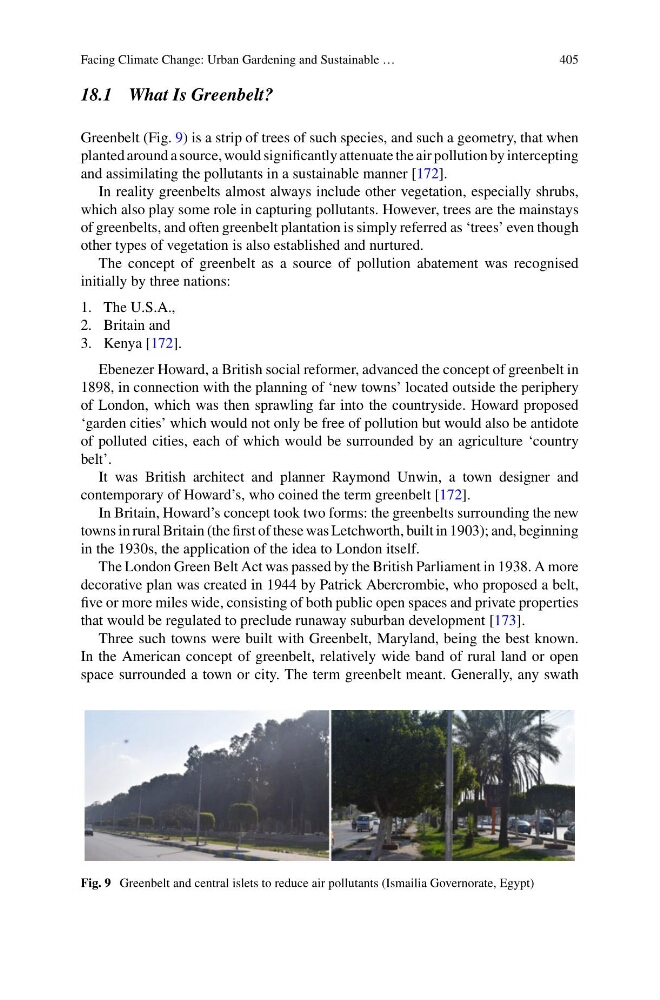
Greenbelt (Fig. 9) is a strip of trees of such species, and such a geometry, that when
planted around a source, would significantly attenuate the air pollution by intercepting
and assimilating the pollutants in a sustainable manner [172].
In reality greenbelts almost always include other vegetation, especially shrubs,
which also play some role in capturing pollutants. However, trees are the mainstays
of greenbelts, and often greenbelt plantation is simply referred as ‘trees’ even though
other types of vegetation is also established and nurtured.
The concept of greenbelt as a source of pollution abatement was recognised
initially by three nations:
1. The U.S.A.,
2. Britain and
3. Kenya [172].
Ebenezer Howard, a British social reformer, advanced the concept of greenbelt in
1898, in connection with the planning of ‘new towns’ located outside the periphery
of London, which was then sprawling far into the countryside. Howard proposed
‘garden cities’ which would not only be free of pollution but would also be antidote
of polluted cities, each of which would be surrounded by an agriculture ‘country
belt’.
It was British architect and planner Raymond Unwin, a town designer and
contemporary of Howard’s, who coined the term greenbelt [172].
In Britain, Howard’s concept took two forms: the greenbelts surrounding the new
towns in rural Britain (the first of these was Letchworth, built in 1903); and, beginning
in the 1930s, the application of the idea to London itself.
The London Green Belt Act was passed by the British Parliament in 1938. A more
decorative plan was created in 1944 by Patrick Abercrombie, who proposed a belt,
five or more miles wide, consisting of both public open spaces and private properties
that would be regulated to preclude runaway suburban development [173].
Three such towns were built with Greenbelt, Maryland, being the best known.
In the American concept of greenbelt, relatively wide band of rural land or open
space surrounded a town or city. The term greenbelt meant. Generally, any swath
Fig. 9 Greenbelt and central islets to reduce air pollutants (Ismailia Governorate, Egypt)
405
18.1 What Is Greenbelt?
Greenbelt (Fig. 9) is a strip of trees of such species, and such a geometry, that when
planted around a source, would significantly attenuate the air pollution by intercepting
and assimilating the pollutants in a sustainable manner [172].
In reality greenbelts almost always include other vegetation, especially shrubs,
which also play some role in capturing pollutants. However, trees are the mainstays
of greenbelts, and often greenbelt plantation is simply referred as ‘trees’ even though
other types of vegetation is also established and nurtured.
The concept of greenbelt as a source of pollution abatement was recognised
initially by three nations:
1. The U.S.A.,
2. Britain and
3. Kenya [172].
Ebenezer Howard, a British social reformer, advanced the concept of greenbelt in
1898, in connection with the planning of ‘new towns’ located outside the periphery
of London, which was then sprawling far into the countryside. Howard proposed
‘garden cities’ which would not only be free of pollution but would also be antidote
of polluted cities, each of which would be surrounded by an agriculture ‘country
belt’.
It was British architect and planner Raymond Unwin, a town designer and
contemporary of Howard’s, who coined the term greenbelt [172].
In Britain, Howard’s concept took two forms: the greenbelts surrounding the new
towns in rural Britain (the first of these was Letchworth, built in 1903); and, beginning
in the 1930s, the application of the idea to London itself.
The London Green Belt Act was passed by the British Parliament in 1938. A more
decorative plan was created in 1944 by Patrick Abercrombie, who proposed a belt,
five or more miles wide, consisting of both public open spaces and private properties
that would be regulated to preclude runaway suburban development [173].
Three such towns were built with Greenbelt, Maryland, being the best known.
In the American concept of greenbelt, relatively wide band of rural land or open
space surrounded a town or city. The term greenbelt meant. Generally, any swath
Fig. 9 Greenbelt and central islets to reduce air pollutants (Ismailia Governorate, Egypt)