

382
E. M. Koriesh and I. H. Abo-Soud
0
2
4
6
8
10
12
14
Transpiration rate mmol m-2 min-1
Transpiration rate mmol m-2
min-1
0
2
4
6
8
10
12
14
16
18
Transpiration rate mmol m-2 min-1
Transpiration rate mmol m-2
min-1
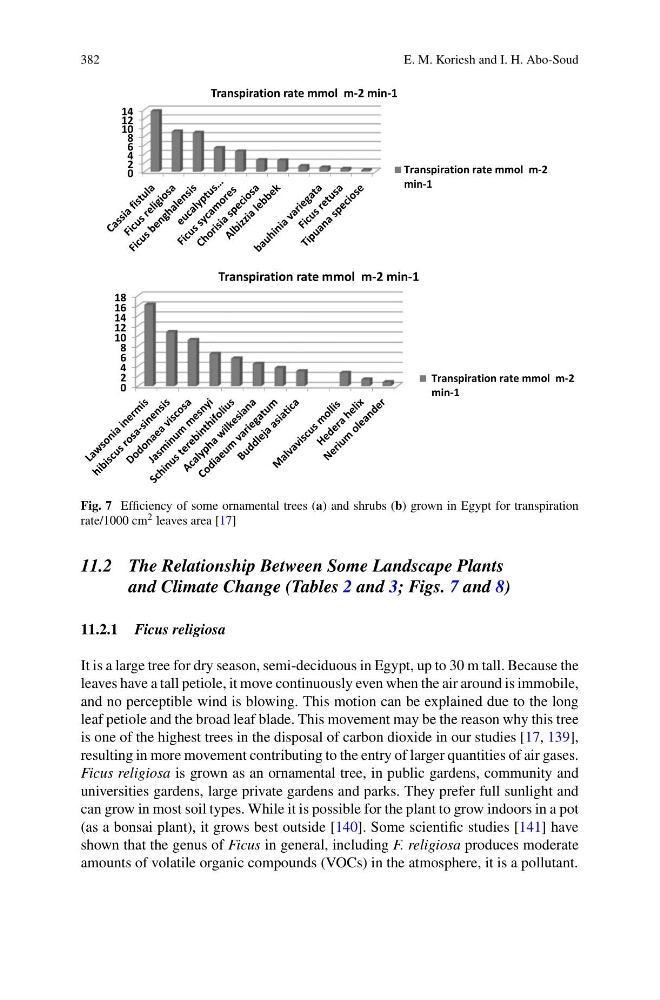
Fig. 7 Efficiency of some ornamental trees (a) and shrubs (b) grown in Egypt for transpiration
rate/1000 cm 2 leaves area [17]
11.2 The Relationship Between Some Landscape Plants
and Climate Change (Tables 2 and 3; Figs. 7 and 8)
11.2.1 Ficus religiosa
It is a large tree for dry season, semi-deciduous in Egypt, up to 30 m tall. Because the
leaves have a tall petiole, it move continuously even when the air around is immobile,
and no perceptible wind is blowing. This motion can be explained due to the long
leaf petiole and the broad leaf blade. This movement may be the reason why this tree
is one of the highest trees in the disposal of carbon dioxide in our studies [17, 139],
resulting in more movement contributing to the entry of larger quantities of air gases.
Ficus religiosa is grown as an ornamental tree, in public gardens, community and
universities gardens, large private gardens and parks. They prefer full sunlight and
can grow in most soil types. While it is possible for the plant to grow indoors in a pot
(as a bonsai plant), it grows best outside [140]. Some scientific studies [141] have
shown that the genus of Ficus in general, including F. religiosa produces moderate
amounts of volatile organic compounds (VOCs) in the atmosphere, it is a pollutant.
E. M. Koriesh and I. H. Abo-Soud
0
2
4
6
8
10
12
14
Transpiration rate mmol m-2 min-1
Transpiration rate mmol m-2
min-1
0
2
4
6
8
10
12
14
16
18
Transpiration rate mmol m-2 min-1
Transpiration rate mmol m-2
min-1
Fig. 7 Efficiency of some ornamental trees (a) and shrubs (b) grown in Egypt for transpiration
rate/1000 cm 2 leaves area [17]
11.2 The Relationship Between Some Landscape Plants
and Climate Change (Tables 2 and 3; Figs. 7 and 8)
11.2.1 Ficus religiosa
It is a large tree for dry season, semi-deciduous in Egypt, up to 30 m tall. Because the
leaves have a tall petiole, it move continuously even when the air around is immobile,
and no perceptible wind is blowing. This motion can be explained due to the long
leaf petiole and the broad leaf blade. This movement may be the reason why this tree
is one of the highest trees in the disposal of carbon dioxide in our studies [17, 139],
resulting in more movement contributing to the entry of larger quantities of air gases.
Ficus religiosa is grown as an ornamental tree, in public gardens, community and
universities gardens, large private gardens and parks. They prefer full sunlight and
can grow in most soil types. While it is possible for the plant to grow indoors in a pot
(as a bonsai plant), it grows best outside [140]. Some scientific studies [141] have
shown that the genus of Ficus in general, including F. religiosa produces moderate
amounts of volatile organic compounds (VOCs) in the atmosphere, it is a pollutant.