

380
E. M. Koriesh and I. H. Abo-Soud
Nitrogen-fixing trees will help build soil and most bear blossoms that attract
insects. In Egypt, these include Erythrina indica, Cassia nodosa, Delonex regia,
Jacaranda ovalifola and Albizia lebbeck. The canopy trees will describe the chief
patterns of the forest garden, thus they necessity be chosen wisely. Plant them with
careful in respect to their expected final size so enough light will fall among all aboveground tree parts [138]. Most Important Street Trees According to Their Efficiency
for Reducing Carbon Dioxide from Atmosphere.
1. Albizzia lebbeck
2. Bauhinia variegate
3. Bombax malabaricum
4. Cassia fistula
5. Cassia nodosa
6. Chorisia speciosa
7. Erythrina variegate
8. Eucalyptus camaldulensis
9. Ficus retusa
10. Ficus benghalensis
11. Ficus religiosa
12. Ficus sycamores
13. Khaya senegalensis
14. Tipuana speciose
Table 2 shows the role of Egyptian street trees in reducing carbon emissions or
absorbing carbon dioxide from the surrounding air. The results deal with specific
leaf area, i.e. calculated for every 1000 cm
3 of one leaf surface only. It is better to
calculate the total leaf area of the entire tree. Because it is difficult to find different
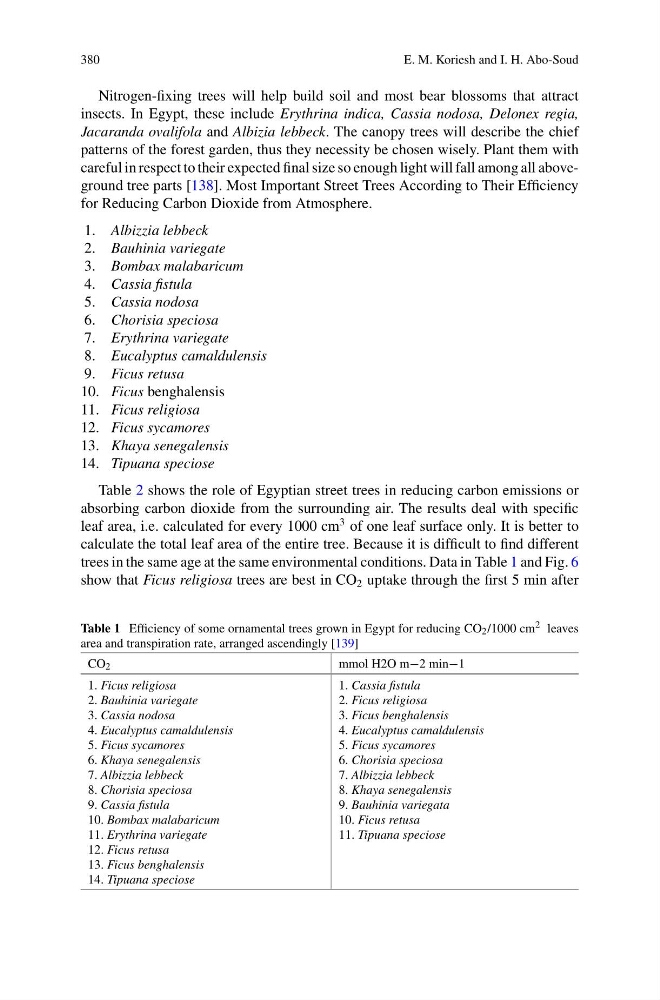
trees in the same age at the same environmental conditions. Data in Table 1 and Fig. 6
show that Ficus religiosa trees are best in CO 2 uptake through the first 5 min after
Table 1 Efficiency of some ornamental trees grown in Egypt for reducing CO 2 /1000 cm 2 leaves
area and transpiration rate, arranged ascendingly [139]
CO 2
mmol H2O m−2 min−1
1. Ficus religiosa
2. Bauhinia variegate
3. Cassia nodosa
4. Eucalyptus camaldulensis
5. Ficus sycamores
6. Khaya senegalensis
7. Albizzia lebbeck
8. Chorisia speciosa
9. Cassia fistula
10. Bombax malabaricum
11. Erythrina variegate
12. Ficus retusa
13. Ficus benghalensis
14. Tipuana speciose
1. Cassia fistula
2. Ficus religiosa
3. Ficus benghalensis
4. Eucalyptus camaldulensis
5. Ficus sycamores
6. Chorisia speciosa
7. Albizzia lebbeck
8. Khaya senegalensis
9. Bauhinia variegata
10. Ficus retusa
11. Tipuana speciose
E. M. Koriesh and I. H. Abo-Soud
Nitrogen-fixing trees will help build soil and most bear blossoms that attract
insects. In Egypt, these include Erythrina indica, Cassia nodosa, Delonex regia,
Jacaranda ovalifola and Albizia lebbeck. The canopy trees will describe the chief
patterns of the forest garden, thus they necessity be chosen wisely. Plant them with
careful in respect to their expected final size so enough light will fall among all aboveground tree parts [138]. Most Important Street Trees According to Their Efficiency
for Reducing Carbon Dioxide from Atmosphere.
1. Albizzia lebbeck
2. Bauhinia variegate
3. Bombax malabaricum
4. Cassia fistula
5. Cassia nodosa
6. Chorisia speciosa
7. Erythrina variegate
8. Eucalyptus camaldulensis
9. Ficus retusa
10. Ficus benghalensis
11. Ficus religiosa
12. Ficus sycamores
13. Khaya senegalensis
14. Tipuana speciose
Table 2 shows the role of Egyptian street trees in reducing carbon emissions or
absorbing carbon dioxide from the surrounding air. The results deal with specific
leaf area, i.e. calculated for every 1000 cm
3 of one leaf surface only. It is better to
calculate the total leaf area of the entire tree. Because it is difficult to find different
trees in the same age at the same environmental conditions. Data in Table 1 and Fig. 6
show that Ficus religiosa trees are best in CO 2 uptake through the first 5 min after
Table 1 Efficiency of some ornamental trees grown in Egypt for reducing CO 2 /1000 cm 2 leaves
area and transpiration rate, arranged ascendingly [139]
CO 2
mmol H2O m−2 min−1
1. Ficus religiosa
2. Bauhinia variegate
3. Cassia nodosa
4. Eucalyptus camaldulensis
5. Ficus sycamores
6. Khaya senegalensis
7. Albizzia lebbeck
8. Chorisia speciosa
9. Cassia fistula
10. Bombax malabaricum
11. Erythrina variegate
12. Ficus retusa
13. Ficus benghalensis
14. Tipuana speciose
1. Cassia fistula
2. Ficus religiosa
3. Ficus benghalensis
4. Eucalyptus camaldulensis
5. Ficus sycamores
6. Chorisia speciosa
7. Albizzia lebbeck
8. Khaya senegalensis
9. Bauhinia variegata
10. Ficus retusa
11. Tipuana speciose