

378
E. M. Koriesh and I. H. Abo-Soud
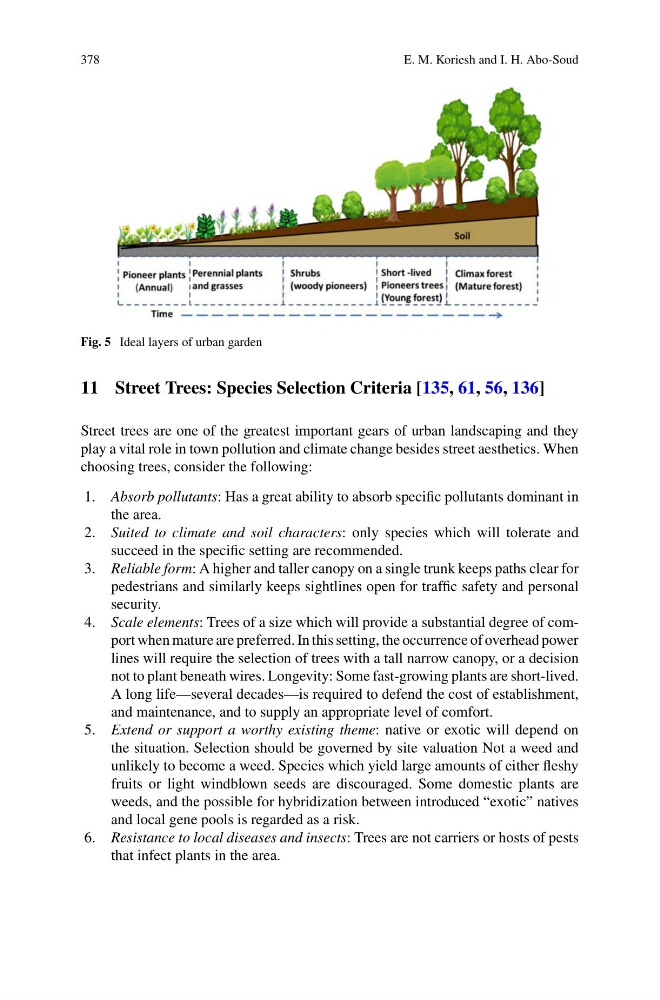
Fig. 5 Ideal layers of urban garden
11 Street Trees: Species Selection Criteria [135, 61, 56, 136]
Street trees are one of the greatest important gears of urban landscaping and they
play a vital role in town pollution and climate change besides street aesthetics. When
choosing trees, consider the following:
1. Absorb pollutants: Has a great ability to absorb specific pollutants dominant in
the area.
2. Suited to climate and soil characters: only species which will tolerate and
succeed in the specific setting are recommended.
3. Reliable form: A higher and taller canopy on a single trunk keeps paths clear for
pedestrians and similarly keeps sightlines open for traffic safety and personal
security.
4. Scale elements: Trees of a size which will provide a substantial degree of comport when mature are preferred. In this setting, the occurrence of overhead power
lines will require the selection of trees with a tall narrow canopy, or a decision
not to plant beneath wires. Longevity: Some fast-growing plants are short-lived.
A long life—several decades—is required to defend the cost of establishment,
and maintenance, and to supply an appropriate level of comfort.
5. Extend or support a worthy existing theme: native or exotic will depend on
the situation. Selection should be governed by site valuation Not a weed and
unlikely to become a weed. Species which yield large amounts of either fleshy
fruits or light windblown seeds are discouraged. Some domestic plants are
weeds, and the possible for hybridization between introduced “exotic” natives
and local gene pools is regarded as a risk.
6. Resistance to local diseases and insects: Trees are not carriers or hosts of pests
that infect plants in the area.
E. M. Koriesh and I. H. Abo-Soud
Fig. 5 Ideal layers of urban garden
11 Street Trees: Species Selection Criteria [135, 61, 56, 136]
Street trees are one of the greatest important gears of urban landscaping and they
play a vital role in town pollution and climate change besides street aesthetics. When
choosing trees, consider the following:
1. Absorb pollutants: Has a great ability to absorb specific pollutants dominant in
the area.
2. Suited to climate and soil characters: only species which will tolerate and
succeed in the specific setting are recommended.
3. Reliable form: A higher and taller canopy on a single trunk keeps paths clear for
pedestrians and similarly keeps sightlines open for traffic safety and personal
security.
4. Scale elements: Trees of a size which will provide a substantial degree of comport when mature are preferred. In this setting, the occurrence of overhead power
lines will require the selection of trees with a tall narrow canopy, or a decision
not to plant beneath wires. Longevity: Some fast-growing plants are short-lived.
A long life—several decades—is required to defend the cost of establishment,
and maintenance, and to supply an appropriate level of comfort.
5. Extend or support a worthy existing theme: native or exotic will depend on
the situation. Selection should be governed by site valuation Not a weed and
unlikely to become a weed. Species which yield large amounts of either fleshy
fruits or light windblown seeds are discouraged. Some domestic plants are
weeds, and the possible for hybridization between introduced “exotic” natives
and local gene pools is regarded as a risk.
6. Resistance to local diseases and insects: Trees are not carriers or hosts of pests
that infect plants in the area.