

366
E. M. Koriesh and I. H. Abo-Soud
8.1 Uptake of Radionuclides by Plants
Measurements of some plants showed that radioactivity in plants depended on the
area of surface exposed, the developmental seasons, and on the external morphology
of their above and underground parts.
Auto-radiographs on several plants showed the presence of radioactivity in certain
spots (hot spots) which were distributed randomly on the surface of the plants and
differed in size and activity [80]. Studies of Itoh et al. [81] showed that radioactive
particles attached to outdoor plant leaves persisted for nearly 1 year.
8.2 Accumulation of Radionuclides by Plants as a Monitor
System
The accumulation of radionuclides by plants acting as a monitoring system in the
environment may occur by two modes; foliar absorption by the leaves and shoot of
the plant, or by root uptake from the soil [82, 83]. The epidermal features of plant
foliage may exert an effect upon particle retention by leaves, and subsequent uptake
of radionuclides from the surface. The role of plants as monitors of radionuclides is
threefold:
– as monitors of recent atmospheric releases of radionuclides; and
– as indicators of the long-term behavior of aged deposits of radionuclides in the
soil [82].
– different plant species had different uptake activities for the elements [84].
Pulhani et al. [85] found that fertilizer application and soil nutrient content can
affect the absorption of radionuclides by plants.
Phytoremediation of radioactive waste is a process that uses plants to remove,
transfer, or immobilize radionuclides from the contaminated soil, sediment, sludge,
or water, and it is a useful method for treating large-scale low-level radionuclide
contamination.
There have not been established criteria which can be utilized to screen out suitable
plant species that are capable of remediating the radioactivity. Important factors
influencing the selection of a natural plant to remediate radioactivity, including the
vegetation plant species and vegetation community composition and the criteria
based on the phytoremediation factor (PF) for the selection of a natural plant to
remediate radioactive waste. The vegetation plant species and vegetation community
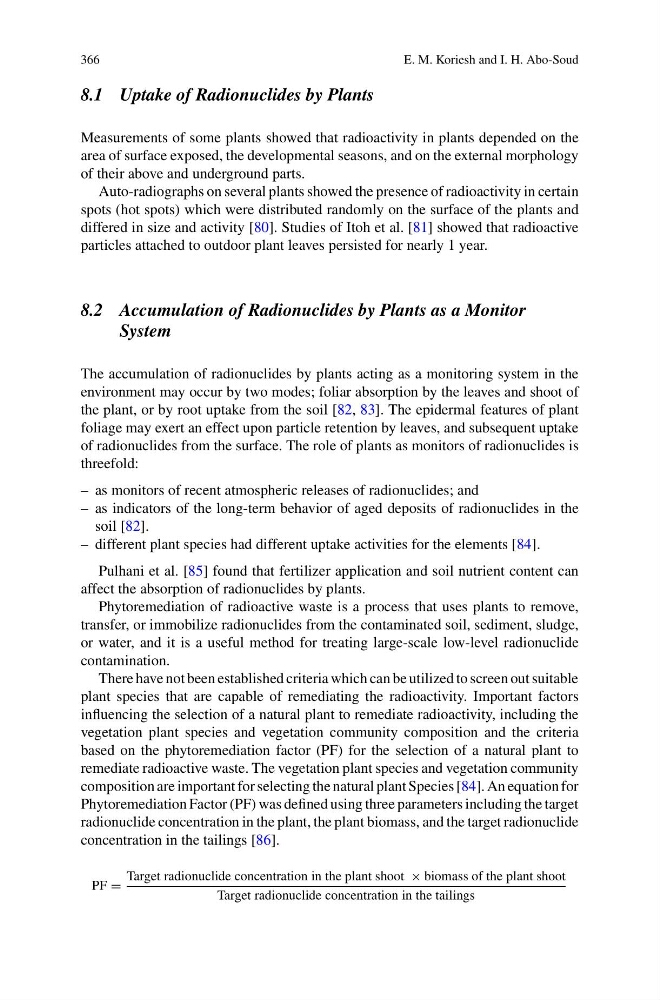
composition are important for selecting the natural plant Species [84]. An equation for
Phytoremediation Factor (PF) was defined using three parameters including the target
radionuclide concentration in the plant, the plant biomass, and the target radionuclide
concentration in the tailings [86].
PF =
Target radionuclide concentration in the plant shoot × biomass of the plant shoot
Target radionuclide concentration in the tailings
E. M. Koriesh and I. H. Abo-Soud
8.1 Uptake of Radionuclides by Plants
Measurements of some plants showed that radioactivity in plants depended on the
area of surface exposed, the developmental seasons, and on the external morphology
of their above and underground parts.
Auto-radiographs on several plants showed the presence of radioactivity in certain
spots (hot spots) which were distributed randomly on the surface of the plants and
differed in size and activity [80]. Studies of Itoh et al. [81] showed that radioactive
particles attached to outdoor plant leaves persisted for nearly 1 year.
8.2 Accumulation of Radionuclides by Plants as a Monitor
System
The accumulation of radionuclides by plants acting as a monitoring system in the
environment may occur by two modes; foliar absorption by the leaves and shoot of
the plant, or by root uptake from the soil [82, 83]. The epidermal features of plant
foliage may exert an effect upon particle retention by leaves, and subsequent uptake
of radionuclides from the surface. The role of plants as monitors of radionuclides is
threefold:
– as monitors of recent atmospheric releases of radionuclides; and
– as indicators of the long-term behavior of aged deposits of radionuclides in the
soil [82].
– different plant species had different uptake activities for the elements [84].
Pulhani et al. [85] found that fertilizer application and soil nutrient content can
affect the absorption of radionuclides by plants.
Phytoremediation of radioactive waste is a process that uses plants to remove,
transfer, or immobilize radionuclides from the contaminated soil, sediment, sludge,
or water, and it is a useful method for treating large-scale low-level radionuclide
contamination.
There have not been established criteria which can be utilized to screen out suitable
plant species that are capable of remediating the radioactivity. Important factors
influencing the selection of a natural plant to remediate radioactivity, including the
vegetation plant species and vegetation community composition and the criteria
based on the phytoremediation factor (PF) for the selection of a natural plant to
remediate radioactive waste. The vegetation plant species and vegetation community
composition are important for selecting the natural plant Species [84]. An equation for
Phytoremediation Factor (PF) was defined using three parameters including the target
radionuclide concentration in the plant, the plant biomass, and the target radionuclide
concentration in the tailings [86].
PF =
Target radionuclide concentration in the plant shoot × biomass of the plant shoot
Target radionuclide concentration in the tailings