

Facing Climate Change: Urban Gardening and Sustainable …
363
3. Herbaceous perennials
4. Some annuals and biennials
5. Ground-cover plant life
6. Garden and meadow vegetation in small areas
7. Pond, wetland flowers
8. Climbers
9. Portable gardens
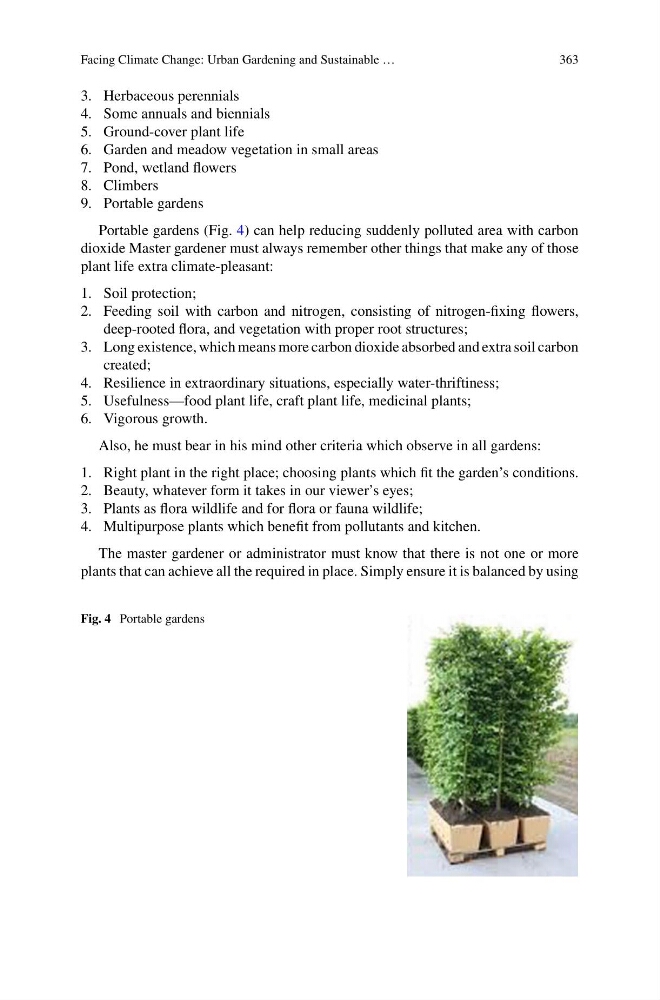
Portable gardens (Fig. 4) can help reducing suddenly polluted area with carbon
dioxide Master gardener must always remember other things that make any of those
plant life extra climate-pleasant:
1. Soil protection;
2. Feeding soil with carbon and nitrogen, consisting of nitrogen-fixing flowers,
deep-rooted flora, and vegetation with proper root structures;
3. Long existence, which means more carbon dioxide absorbed and extra soil carbon
created;
4. Resilience in extraordinary situations, especially water-thriftiness;
5. Usefulness—food plant life, craft plant life, medicinal plants;
6. Vigorous growth.
Also, he must bear in his mind other criteria which observe in all gardens:
1. Right plant in the right place; choosing plants which fit the garden’s conditions.
2. Beauty, whatever form it takes in our viewer’s eyes;
3. Plants as flora wildlife and for flora or fauna wildlife;
4. Multipurpose plants which benefit from pollutants and kitchen.
The master gardener or administrator must know that there is not one or more
plants that can achieve all the required in place. Simply ensure it is balanced by using
Fig. 4 Portable gardens
363
3. Herbaceous perennials
4. Some annuals and biennials
5. Ground-cover plant life
6. Garden and meadow vegetation in small areas
7. Pond, wetland flowers
8. Climbers
9. Portable gardens
Portable gardens (Fig. 4) can help reducing suddenly polluted area with carbon
dioxide Master gardener must always remember other things that make any of those
plant life extra climate-pleasant:
1. Soil protection;
2. Feeding soil with carbon and nitrogen, consisting of nitrogen-fixing flowers,
deep-rooted flora, and vegetation with proper root structures;
3. Long existence, which means more carbon dioxide absorbed and extra soil carbon
created;
4. Resilience in extraordinary situations, especially water-thriftiness;
5. Usefulness—food plant life, craft plant life, medicinal plants;
6. Vigorous growth.
Also, he must bear in his mind other criteria which observe in all gardens:
1. Right plant in the right place; choosing plants which fit the garden’s conditions.
2. Beauty, whatever form it takes in our viewer’s eyes;
3. Plants as flora wildlife and for flora or fauna wildlife;
4. Multipurpose plants which benefit from pollutants and kitchen.
The master gardener or administrator must know that there is not one or more
plants that can achieve all the required in place. Simply ensure it is balanced by using
Fig. 4 Portable gardens