

Facing Climate Change: Urban Gardening and Sustainable …
353
Semir, Cinnamomum camphora (L.) J. Presl., Ilex rotunda Thunb., Lysidice rhodostegia Hance and Michelia chapensis Dandy [37]. They measured net photosynthesis
rate, leaf sulfur content and other physiological parameters under 1.31 mg m
−3 SO 2
fumigation for eight days. Their results showed that the six landscape tree species
differed in their responses under SO 2 stress. Based on these data, the most appropriate species for planting in SO 2 polluted areas (in China) was Ilex rotunda, since it
grew normally under SO 2 stress and can able to absorb SO 2 . This study confirms the
importance of planting trees to absorb pollutants. Besides, the selection of trees to
be cultivated in different locations according to their efficiency in the disposal of the
most common polluter in this location. So, this makes us say that planting appropriate
tree species nearby industrial complexes is critical for pollution mitigation besides
aesthetic value.
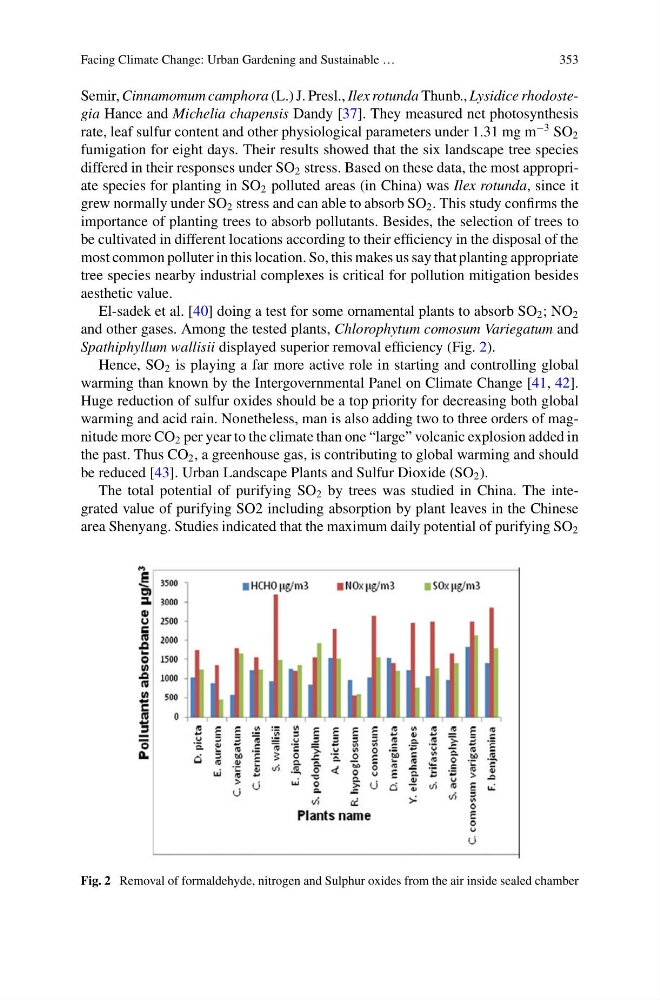
El-sadek et al. [40] doing a test for some ornamental plants to absorb SO 2 ; NO 2
and other gases. Among the tested plants, Chlorophytum comosum Variegatum and
Spathiphyllum wallisii displayed superior removal efficiency (Fig. 2).
Hence, SO 2 is playing a far more active role in starting and controlling global
warming than known by the Intergovernmental Panel on Climate Change [41, 42].
Huge reduction of sulfur oxides should be a top priority for decreasing both global
warming and acid rain. Nonetheless, man is also adding two to three orders of magnitude more CO 2 per year to the climate than one “large” volcanic explosion added in
the past. Thus CO 2 , a greenhouse gas, is contributing to global warming and should
be reduced [43]. Urban Landscape Plants and Sulfur Dioxide (SO 2 ).
The total potential of purifying SO 2 by trees was studied in China. The integrated value of purifying SO2 including absorption by plant leaves in the Chinese
area Shenyang. Studies indicated that the maximum daily potential of purifying SO 2
Fig. 2 Removal of formaldehyde, nitrogen and Sulphur oxides from the air inside sealed chamber
353
Semir, Cinnamomum camphora (L.) J. Presl., Ilex rotunda Thunb., Lysidice rhodostegia Hance and Michelia chapensis Dandy [37]. They measured net photosynthesis
rate, leaf sulfur content and other physiological parameters under 1.31 mg m
−3 SO 2
fumigation for eight days. Their results showed that the six landscape tree species
differed in their responses under SO 2 stress. Based on these data, the most appropriate species for planting in SO 2 polluted areas (in China) was Ilex rotunda, since it
grew normally under SO 2 stress and can able to absorb SO 2 . This study confirms the
importance of planting trees to absorb pollutants. Besides, the selection of trees to
be cultivated in different locations according to their efficiency in the disposal of the
most common polluter in this location. So, this makes us say that planting appropriate
tree species nearby industrial complexes is critical for pollution mitigation besides
aesthetic value.
El-sadek et al. [40] doing a test for some ornamental plants to absorb SO 2 ; NO 2
and other gases. Among the tested plants, Chlorophytum comosum Variegatum and
Spathiphyllum wallisii displayed superior removal efficiency (Fig. 2).
Hence, SO 2 is playing a far more active role in starting and controlling global
warming than known by the Intergovernmental Panel on Climate Change [41, 42].
Huge reduction of sulfur oxides should be a top priority for decreasing both global
warming and acid rain. Nonetheless, man is also adding two to three orders of magnitude more CO 2 per year to the climate than one “large” volcanic explosion added in
the past. Thus CO 2 , a greenhouse gas, is contributing to global warming and should
be reduced [43]. Urban Landscape Plants and Sulfur Dioxide (SO 2 ).
The total potential of purifying SO 2 by trees was studied in China. The integrated value of purifying SO2 including absorption by plant leaves in the Chinese
area Shenyang. Studies indicated that the maximum daily potential of purifying SO 2
Fig. 2 Removal of formaldehyde, nitrogen and Sulphur oxides from the air inside sealed chamber