

330
E.-S. E. Omran
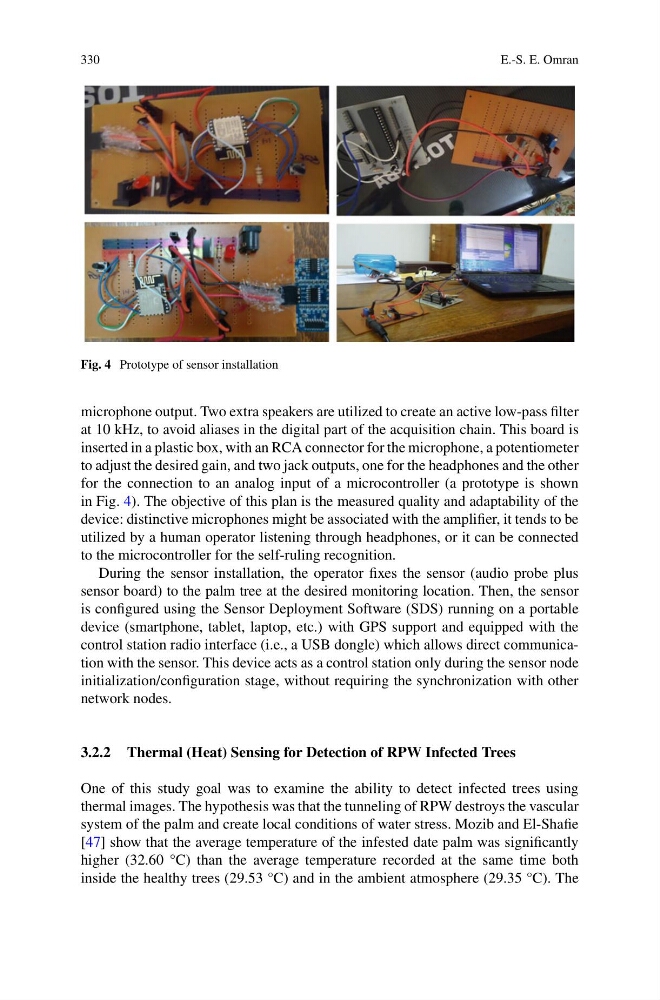
Fig. 4 Prototype of sensor installation
microphone output. Two extra speakers are utilized to create an active low-pass filter
at 10 kHz, to avoid aliases in the digital part of the acquisition chain. This board is
inserted in a plastic box, with an RCA connector for the microphone, a potentiometer
to adjust the desired gain, and two jack outputs, one for the headphones and the other
for the connection to an analog input of a microcontroller (a prototype is shown
in Fig. 4). The objective of this plan is the measured quality and adaptability of the
device: distinctive microphones might be associated with the amplifier, it tends to be
utilized by a human operator listening through headphones, or it can be connected
to the microcontroller for the self-ruling recognition.
During the sensor installation, the operator fixes the sensor (audio probe plus
sensor board) to the palm tree at the desired monitoring location. Then, the sensor
is configured using the Sensor Deployment Software (SDS) running on a portable
device (smartphone, tablet, laptop, etc.) with GPS support and equipped with the
control station radio interface (i.e., a USB dongle) which allows direct communication with the sensor. This device acts as a control station only during the sensor node
initialization/configuration stage, without requiring the synchronization with other
network nodes.
3.2.2 Thermal (Heat) Sensing for Detection of RPW Infected Trees
One of this study goal was to examine the ability to detect infected trees using
thermal images. The hypothesis was that the tunneling of RPW destroys the vascular
system of the palm and create local conditions of water stress. Mozib and El-Shafie
[47] show that the average temperature of the infested date palm was significantly
higher (32.60 °C) than the average temperature recorded at the same time both
inside the healthy trees (29.53 °C) and in the ambient atmosphere (29.35 °C). The
E.-S. E. Omran
Fig. 4 Prototype of sensor installation
microphone output. Two extra speakers are utilized to create an active low-pass filter
at 10 kHz, to avoid aliases in the digital part of the acquisition chain. This board is
inserted in a plastic box, with an RCA connector for the microphone, a potentiometer
to adjust the desired gain, and two jack outputs, one for the headphones and the other
for the connection to an analog input of a microcontroller (a prototype is shown
in Fig. 4). The objective of this plan is the measured quality and adaptability of the
device: distinctive microphones might be associated with the amplifier, it tends to be
utilized by a human operator listening through headphones, or it can be connected
to the microcontroller for the self-ruling recognition.
During the sensor installation, the operator fixes the sensor (audio probe plus
sensor board) to the palm tree at the desired monitoring location. Then, the sensor
is configured using the Sensor Deployment Software (SDS) running on a portable
device (smartphone, tablet, laptop, etc.) with GPS support and equipped with the
control station radio interface (i.e., a USB dongle) which allows direct communication with the sensor. This device acts as a control station only during the sensor node
initialization/configuration stage, without requiring the synchronization with other
network nodes.
3.2.2 Thermal (Heat) Sensing for Detection of RPW Infected Trees
One of this study goal was to examine the ability to detect infected trees using
thermal images. The hypothesis was that the tunneling of RPW destroys the vascular
system of the palm and create local conditions of water stress. Mozib and El-Shafie
[47] show that the average temperature of the infested date palm was significantly
higher (32.60 °C) than the average temperature recorded at the same time both
inside the healthy trees (29.53 °C) and in the ambient atmosphere (29.35 °C). The