

Projected Crop Coefficients Under Climate Change in Egypt
277
Table 1 Prediction equations, the coefficient of determination (R 2 ) and root mean square error per
observation (RMSE/obs) for ET(P-M) values in the agro-climatic zones of Egypt
Zone
Prediction equation
R 2
RMSE/obs
Zone 1
ET(P-M) = 0.95 + 1.21 * ET(H-S)
0.97
0.35
Zone 2
ET(P-M) = 0.98 + 1.16 * ET(H-S)
0.97
0.31
Zone 3
ET(P-M) = 0.58 + 1.13 * ET(H-S)
0.99
0.22
Zone 4
ET(P-M) = 0.30 + 1.40 * ET(H-S)
0.99
0.35
Zone 5
ET(P-M) = 0.04 + 1.42 * ET(H-S)
0.99
0.34
2.3 The Predicted Values of ETo Using Penman-Monteith
Equation in 2030
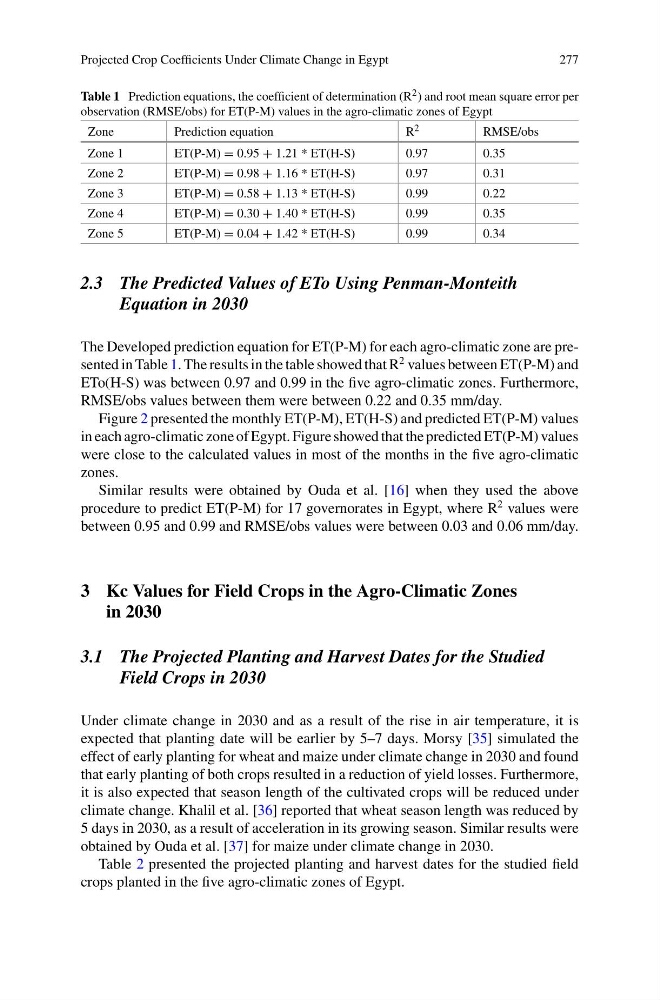
The Developed prediction equation for ET(P-M) for each agro-climatic zone are presented in Table 1. The results in the table showed that R
2 values between ET(P-M) and
ETo(H-S) was between 0.97 and 0.99 in the five agro-climatic zones. Furthermore,
RMSE/obs values between them were between 0.22 and 0.35 mm/day.
Figure 2 presented the monthly ET(P-M), ET(H-S) and predicted ET(P-M) values
in each agro-climatic zone of Egypt. Figure showed that the predicted ET(P-M) values
were close to the calculated values in most of the months in the five agro-climatic
zones.
Similar results were obtained by Ouda et al. [16] when they used the above
procedure to predict ET(P-M) for 17 governorates in Egypt, where R
2 values were
between 0.95 and 0.99 and RMSE/obs values were between 0.03 and 0.06 mm/day.
3 Kc Values for Field Crops in the Agro-Climatic Zones
in 2030
3.1 The Projected Planting and Harvest Dates for the Studied
Field Crops in 2030
Under climate change in 2030 and as a result of the rise in air temperature, it is
expected that planting date will be earlier by 5–7 days. Morsy [35] simulated the
effect of early planting for wheat and maize under climate change in 2030 and found
that early planting of both crops resulted in a reduction of yield losses. Furthermore,
it is also expected that season length of the cultivated crops will be reduced under
climate change. Khalil et al. [36] reported that wheat season length was reduced by
5 days in 2030, as a result of acceleration in its growing season. Similar results were
obtained by Ouda et al. [37] for maize under climate change in 2030.
Table 2 presented the projected planting and harvest dates for the studied field
crops planted in the five agro-climatic zones of Egypt.
277
Table 1 Prediction equations, the coefficient of determination (R 2 ) and root mean square error per
observation (RMSE/obs) for ET(P-M) values in the agro-climatic zones of Egypt
Zone
Prediction equation
R 2
RMSE/obs
Zone 1
ET(P-M) = 0.95 + 1.21 * ET(H-S)
0.97
0.35
Zone 2
ET(P-M) = 0.98 + 1.16 * ET(H-S)
0.97
0.31
Zone 3
ET(P-M) = 0.58 + 1.13 * ET(H-S)
0.99
0.22
Zone 4
ET(P-M) = 0.30 + 1.40 * ET(H-S)
0.99
0.35
Zone 5
ET(P-M) = 0.04 + 1.42 * ET(H-S)
0.99
0.34
2.3 The Predicted Values of ETo Using Penman-Monteith
Equation in 2030
The Developed prediction equation for ET(P-M) for each agro-climatic zone are presented in Table 1. The results in the table showed that R
2 values between ET(P-M) and
ETo(H-S) was between 0.97 and 0.99 in the five agro-climatic zones. Furthermore,
RMSE/obs values between them were between 0.22 and 0.35 mm/day.
Figure 2 presented the monthly ET(P-M), ET(H-S) and predicted ET(P-M) values
in each agro-climatic zone of Egypt. Figure showed that the predicted ET(P-M) values
were close to the calculated values in most of the months in the five agro-climatic
zones.
Similar results were obtained by Ouda et al. [16] when they used the above
procedure to predict ET(P-M) for 17 governorates in Egypt, where R
2 values were
between 0.95 and 0.99 and RMSE/obs values were between 0.03 and 0.06 mm/day.
3 Kc Values for Field Crops in the Agro-Climatic Zones
in 2030
3.1 The Projected Planting and Harvest Dates for the Studied
Field Crops in 2030
Under climate change in 2030 and as a result of the rise in air temperature, it is
expected that planting date will be earlier by 5–7 days. Morsy [35] simulated the
effect of early planting for wheat and maize under climate change in 2030 and found
that early planting of both crops resulted in a reduction of yield losses. Furthermore,
it is also expected that season length of the cultivated crops will be reduced under
climate change. Khalil et al. [36] reported that wheat season length was reduced by
5 days in 2030, as a result of acceleration in its growing season. Similar results were
obtained by Ouda et al. [37] for maize under climate change in 2030.
Table 2 presented the projected planting and harvest dates for the studied field
crops planted in the five agro-climatic zones of Egypt.