

120
R. R. Shahin
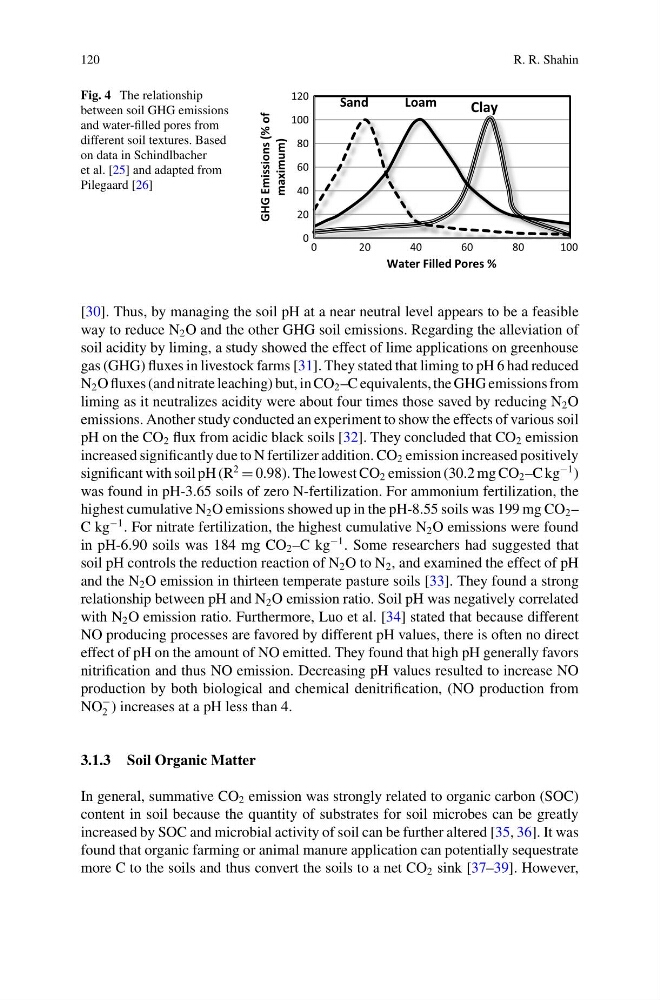
Fig. 4 The relationship
between soil GHG emissions
and water-filled pores from
different soil textures. Based
on data in Schindlbacher
et al. [25] and adapted from
Pilegaard [26]
0
20
40
60
80
100
120
0
2 0
4 0
6 0
8 0
1 0 0
GHG Emissions (% of
maximum)
Water Filled Pores %
Sand
Loam
Clay
[30]. Thus, by managing the soil pH at a near neutral level appears to be a feasible
way to reduce N 2 O and the other GHG soil emissions. Regarding the alleviation of
soil acidity by liming, a study showed the effect of lime applications on greenhouse
gas (GHG) fluxes in livestock farms [31]. They stated that liming to pH 6 had reduced
N 2 O fluxes (and nitrate leaching) but, in CO 2 –C equivalents, the GHG emissions from
liming as it neutralizes acidity were about four times those saved by reducing N 2 O
emissions. Another study conducted an experiment to show the effects of various soil
pH on the CO 2 flux from acidic black soils [32]. They concluded that CO 2 emission
increased significantly due to N fertilizer addition. CO 2 emission increased positively
significant with soil pH (R
2
= 0.98). The lowest CO 2 emission (30.2 mg CO 2 –C kg
−1 )
was found in pH-3.65 soils of zero N-fertilization. For ammonium fertilization, the
highest cumulative N 2 O emissions showed up in the pH-8.55 soils was 199 mg CO 2 –
C kg
−1 . For nitrate fertilization, the highest cumulative N 2 O emissions were found
in pH-6.90 soils was 184 mg CO 2 –C kg
−1 . Some researchers had suggested that
soil pH controls the reduction reaction of N 2 O to N 2 , and examined the effect of pH
and the N 2 O emission in thirteen temperate pasture soils [33]. They found a strong
relationship between pH and N 2 O emission ratio. Soil pH was negatively correlated
with N 2 O emission ratio. Furthermore, Luo et al. [34] stated that because different
NO producing processes are favored by different pH values, there is often no direct
effect of pH on the amount of NO emitted. They found that high pH generally favors
nitrification and thus NO emission. Decreasing pH values resulted to increase NO
production by both biological and chemical denitrification, (NO production from
NO
−
2 ) increases at a pH less than 4.
3.1.3 Soil Organic Matter
In general, summative CO 2 emission was strongly related to organic carbon (SOC)
content in soil because the quantity of substrates for soil microbes can be greatly
increased by SOC and microbial activity of soil can be further altered [35, 36]. It was
found that organic farming or animal manure application can potentially sequestrate
more C to the soils and thus convert the soils to a net CO 2 sink [37–39]. However,
R. R. Shahin
Fig. 4 The relationship
between soil GHG emissions
and water-filled pores from
different soil textures. Based
on data in Schindlbacher
et al. [25] and adapted from
Pilegaard [26]
0
20
40
60
80
100
120
0
2 0
4 0
6 0
8 0
1 0 0
GHG Emissions (% of
maximum)
Water Filled Pores %
Sand
Loam
Clay
[30]. Thus, by managing the soil pH at a near neutral level appears to be a feasible
way to reduce N 2 O and the other GHG soil emissions. Regarding the alleviation of
soil acidity by liming, a study showed the effect of lime applications on greenhouse
gas (GHG) fluxes in livestock farms [31]. They stated that liming to pH 6 had reduced
N 2 O fluxes (and nitrate leaching) but, in CO 2 –C equivalents, the GHG emissions from
liming as it neutralizes acidity were about four times those saved by reducing N 2 O
emissions. Another study conducted an experiment to show the effects of various soil
pH on the CO 2 flux from acidic black soils [32]. They concluded that CO 2 emission
increased significantly due to N fertilizer addition. CO 2 emission increased positively
significant with soil pH (R
2
= 0.98). The lowest CO 2 emission (30.2 mg CO 2 –C kg
−1 )
was found in pH-3.65 soils of zero N-fertilization. For ammonium fertilization, the
highest cumulative N 2 O emissions showed up in the pH-8.55 soils was 199 mg CO 2 –
C kg
−1 . For nitrate fertilization, the highest cumulative N 2 O emissions were found
in pH-6.90 soils was 184 mg CO 2 –C kg
−1 . Some researchers had suggested that
soil pH controls the reduction reaction of N 2 O to N 2 , and examined the effect of pH
and the N 2 O emission in thirteen temperate pasture soils [33]. They found a strong
relationship between pH and N 2 O emission ratio. Soil pH was negatively correlated
with N 2 O emission ratio. Furthermore, Luo et al. [34] stated that because different
NO producing processes are favored by different pH values, there is often no direct
effect of pH on the amount of NO emitted. They found that high pH generally favors
nitrification and thus NO emission. Decreasing pH values resulted to increase NO
production by both biological and chemical denitrification, (NO production from
NO
−
2 ) increases at a pH less than 4.
3.1.3 Soil Organic Matter
In general, summative CO 2 emission was strongly related to organic carbon (SOC)
content in soil because the quantity of substrates for soil microbes can be greatly
increased by SOC and microbial activity of soil can be further altered [35, 36]. It was
found that organic farming or animal manure application can potentially sequestrate
more C to the soils and thus convert the soils to a net CO 2 sink [37–39]. However,