

46
3.4 Socio-ecological System Framework
Another multi-level perspective approach for framing complex problems is the
socio-ecological system (SES) framework. The approach has strong connections to
the institutional analysis framework (IAD) (Ostrom 1990) work by Elinor Ostrom
and colleagues to combine and to better understand the interactions and subsequent
outcomes of complex social phenomena and ecological systems.
This classificatory framework is useful for how actors self-organize around the
use of common pool resources, and around the identification of strategies to safeguard the resource in question (Ostrom 2007, 2009). A conceptualization, often
constructed in a participatory manner, contributes to identifying common and relevant variables for a specific resource system. The strength of the framework is its
capability for users to connect a number of multilevel nested systems. The core
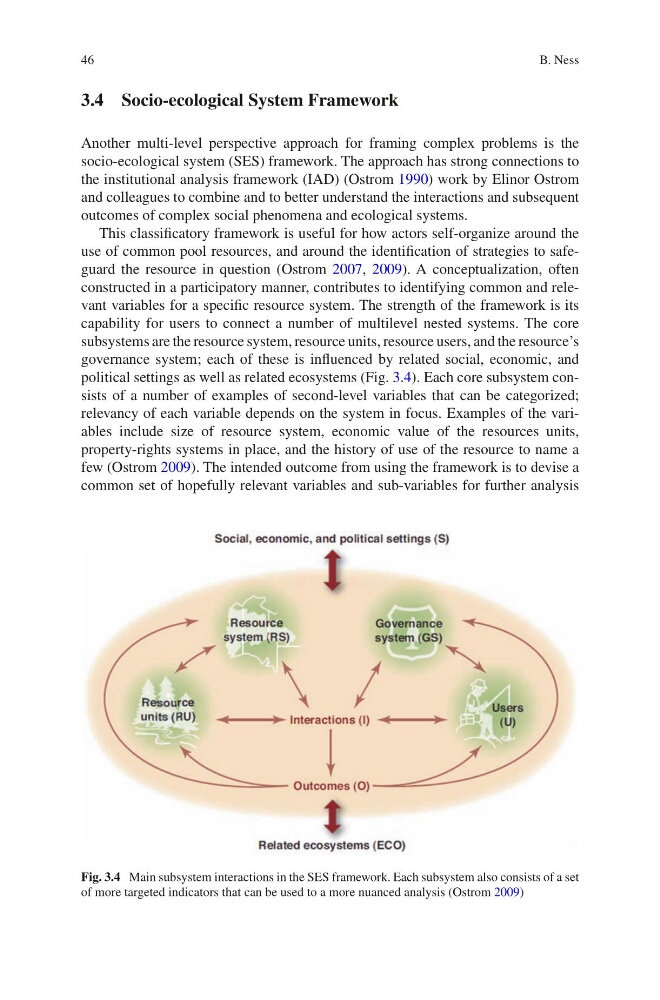
subsystems are the resource system, resource units, resource users, and the resource’s
governance system; each of these is influenced by related social, economic, and
political settings as well as related ecosystems (Fig. 3.4). Each core subsystem consists of a number of examples of second-level variables that can be categorized;
relevancy of each variable depends on the system in focus. Examples of the variables include size of resource system, economic value of the resources units,
property- rights systems in place, and the history of use of the resource to name a
few (Ostrom 2009). The intended outcome from using the framework is to devise a
common set of hopefully relevant variables and sub-variables for further analysis
Fig. 3.4 Main subsystem interactions in the SES framework. Each subsystem also consists of a set
of more targeted indicators that can be used to a more nuanced analysis (Ostrom 2009)
B. Ness
3.4 Socio-ecological System Framework
Another multi-level perspective approach for framing complex problems is the
socio-ecological system (SES) framework. The approach has strong connections to
the institutional analysis framework (IAD) (Ostrom 1990) work by Elinor Ostrom
and colleagues to combine and to better understand the interactions and subsequent
outcomes of complex social phenomena and ecological systems.
This classificatory framework is useful for how actors self-organize around the
use of common pool resources, and around the identification of strategies to safeguard the resource in question (Ostrom 2007, 2009). A conceptualization, often
constructed in a participatory manner, contributes to identifying common and relevant variables for a specific resource system. The strength of the framework is its
capability for users to connect a number of multilevel nested systems. The core
subsystems are the resource system, resource units, resource users, and the resource’s
governance system; each of these is influenced by related social, economic, and
political settings as well as related ecosystems (Fig. 3.4). Each core subsystem consists of a number of examples of second-level variables that can be categorized;
relevancy of each variable depends on the system in focus. Examples of the variables include size of resource system, economic value of the resources units,
property- rights systems in place, and the history of use of the resource to name a
few (Ostrom 2009). The intended outcome from using the framework is to devise a
common set of hopefully relevant variables and sub-variables for further analysis
Fig. 3.4 Main subsystem interactions in the SES framework. Each subsystem also consists of a set
of more targeted indicators that can be used to a more nuanced analysis (Ostrom 2009)
B. Ness