

41
the DPSIR scheme are its ability for practitioners to gain an overview of targeted
(environmental) policy issues, and to estimate the appropriateness and efficiency of
different governance responses (EEA 1999). It also permits the integration of socioeconomic and ecological system information into one framework (Bidone and
Lacerda 2004). The scheme helps to structure information into the five distinct
areas, making it possible to identify and structure the important causal relationships.
DPSIR conceptualizations can be simplistic or sophisticated dependent on the focus
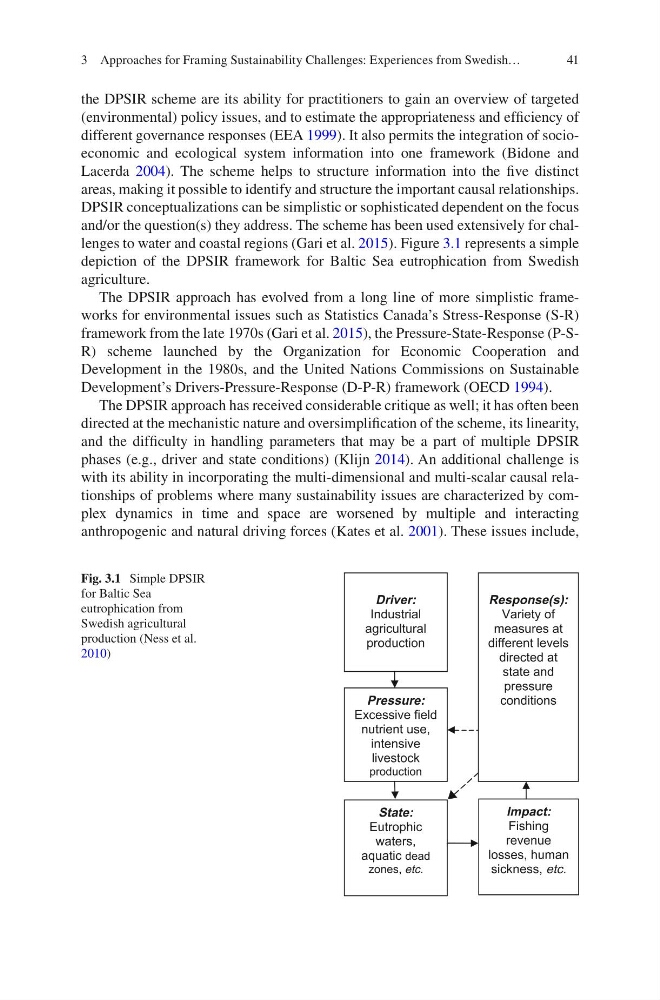
and/or the question(s) they address. The scheme has been used extensively for challenges to water and coastal regions (Gari et al. 2015). Figure 3.1 represents a simple
depiction of the DPSIR framework for Baltic Sea eutrophication from Swedish
agriculture.
The DPSIR approach has evolved from a long line of more simplistic frameworks for environmental issues such as Statistics Canada’s Stress-Response (S-R)
framework from the late 1970s (Gari et al. 2015), the Pressure-State-Response (P-SR) scheme launched by the Organization for Economic Cooperation and
Development in the 1980s, and the United Nations Commissions on Sustainable
Development’s Drivers-Pressure-Response (D-P-R) framework (OECD 1994).
The DPSIR approach has received considerable critique as well; it has often been
directed at the mechanistic nature and oversimplification of the scheme, its linearity,
and the difficulty in handling parameters that may be a part of multiple DPSIR
phases (e.g., driver and state conditions) (Klijn 2014). An additional challenge is
with its ability in incorporating the multi-dimensional and multi-scalar causal relationships of problems where many sustainability issues are characterized by complex dynamics in time and space are worsened by multiple and interacting
anthropogenic and natural driving forces (Kates et al. 2001). These issues include,
Fig. 3.1 Simple DPSIR
for Baltic Sea
eutrophication from
Swedish agricultural
production (Ness et al.
2010)
3 Approaches for Framing Sustainability Challenges: Experiences from Swedish…
the DPSIR scheme are its ability for practitioners to gain an overview of targeted
(environmental) policy issues, and to estimate the appropriateness and efficiency of
different governance responses (EEA 1999). It also permits the integration of socioeconomic and ecological system information into one framework (Bidone and
Lacerda 2004). The scheme helps to structure information into the five distinct
areas, making it possible to identify and structure the important causal relationships.
DPSIR conceptualizations can be simplistic or sophisticated dependent on the focus
and/or the question(s) they address. The scheme has been used extensively for challenges to water and coastal regions (Gari et al. 2015). Figure 3.1 represents a simple
depiction of the DPSIR framework for Baltic Sea eutrophication from Swedish
agriculture.
The DPSIR approach has evolved from a long line of more simplistic frameworks for environmental issues such as Statistics Canada’s Stress-Response (S-R)
framework from the late 1970s (Gari et al. 2015), the Pressure-State-Response (P-SR) scheme launched by the Organization for Economic Cooperation and
Development in the 1980s, and the United Nations Commissions on Sustainable
Development’s Drivers-Pressure-Response (D-P-R) framework (OECD 1994).
The DPSIR approach has received considerable critique as well; it has often been
directed at the mechanistic nature and oversimplification of the scheme, its linearity,
and the difficulty in handling parameters that may be a part of multiple DPSIR
phases (e.g., driver and state conditions) (Klijn 2014). An additional challenge is
with its ability in incorporating the multi-dimensional and multi-scalar causal relationships of problems where many sustainability issues are characterized by complex dynamics in time and space are worsened by multiple and interacting
anthropogenic and natural driving forces (Kates et al. 2001). These issues include,
Fig. 3.1 Simple DPSIR
for Baltic Sea
eutrophication from
Swedish agricultural
production (Ness et al.
2010)
3 Approaches for Framing Sustainability Challenges: Experiences from Swedish…