

29
modernity as a worldview is less coherent than the other two worldviews in terms of
the processes of social change that may be required for sustainability. Anti-modernity
has a strong focus on the, often utopian, images of sustainability (Naess and
Rothenberg 1990; Taylor 2011) rather than on the processes of social change leading to these outcomes.
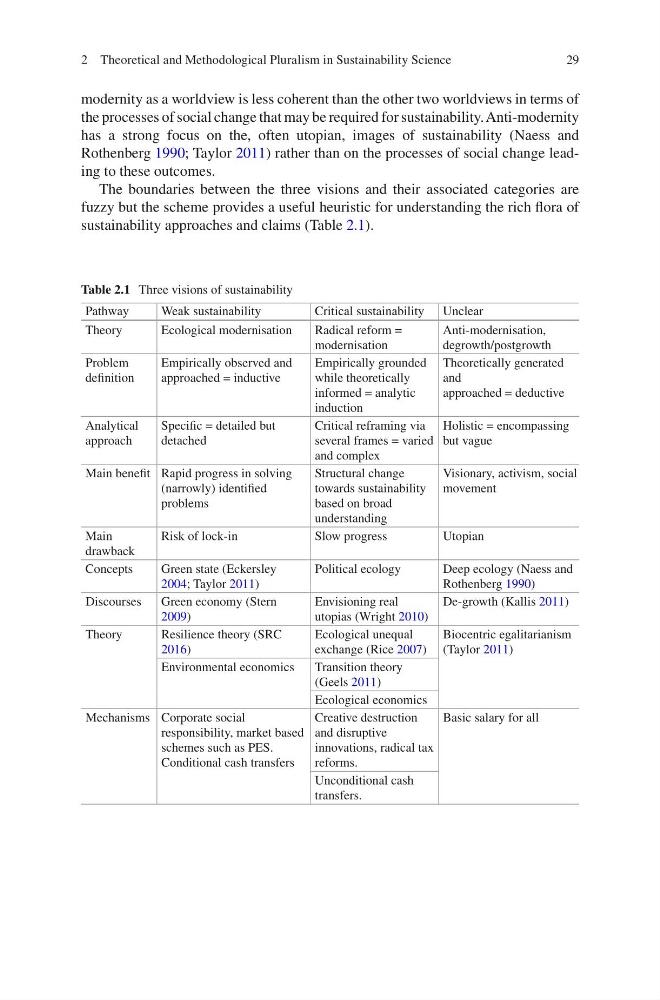
The boundaries between the three visions and their associated categories are
fuzzy but the scheme provides a useful heuristic for understanding the rich flora of
sustainability approaches and claims (Table 2.1).
Table 2.1 Three visions of sustainability
Pathway
Weak sustainability
Critical sustainability Unclear
Theory
Ecological modernisation
Radical reform =
modernisation
Anti-modernisation,
degrowth/postgrowth
Problem
definition
Empirically observed and
approached = inductive
Empirically grounded
while theoretically
informed = analytic
induction
Theoretically generated
and
approached = deductive
Analytical
approach
Specific = detailed but
detached
Critical reframing via
several frames = varied
and complex
Holistic = encompassing
but vague
Main benefit Rapid progress in solving
(narrowly) identified
problems
Structural change
towards sustainability
based on broad
understanding
Visionary, activism, social
movement
Main
drawback
Risk of lock-in
Slow progress
Utopian
Concepts
Green state (Eckersley
2004; Taylor 2011)
Political ecology
Deep ecology (Naess and
Rothenberg 1990)
Discourses
Green economy (Stern
2009)
Envisioning real
utopias (Wright 2010)
De-growth (Kallis 2011)
Theory
Resilience theory (SRC
2016)
Ecological unequal
exchange (Rice 2007)
Biocentric egalitarianism
(Taylor 2011)
Environmental economics
Transition theory
(Geels 2011)
Ecological economics
Mechanisms Corporate social
responsibility, market based
schemes such as PES.
Conditional cash transfers
Creative destruction
and disruptive
innovations, radical tax
reforms.
Basic salary for all
Unconditional cash
transfers.
2 Theoretical and Methodological Pluralism in Sustainability Science
modernity as a worldview is less coherent than the other two worldviews in terms of
the processes of social change that may be required for sustainability. Anti-modernity
has a strong focus on the, often utopian, images of sustainability (Naess and
Rothenberg 1990; Taylor 2011) rather than on the processes of social change leading to these outcomes.
The boundaries between the three visions and their associated categories are
fuzzy but the scheme provides a useful heuristic for understanding the rich flora of
sustainability approaches and claims (Table 2.1).
Table 2.1 Three visions of sustainability
Pathway
Weak sustainability
Critical sustainability Unclear
Theory
Ecological modernisation
Radical reform =
modernisation
Anti-modernisation,
degrowth/postgrowth
Problem
definition
Empirically observed and
approached = inductive
Empirically grounded
while theoretically
informed = analytic
induction
Theoretically generated
and
approached = deductive
Analytical
approach
Specific = detailed but
detached
Critical reframing via
several frames = varied
and complex
Holistic = encompassing
but vague
Main benefit Rapid progress in solving
(narrowly) identified
problems
Structural change
towards sustainability
based on broad
understanding
Visionary, activism, social
movement
Main
drawback
Risk of lock-in
Slow progress
Utopian
Concepts
Green state (Eckersley
2004; Taylor 2011)
Political ecology
Deep ecology (Naess and
Rothenberg 1990)
Discourses
Green economy (Stern
2009)
Envisioning real
utopias (Wright 2010)
De-growth (Kallis 2011)
Theory
Resilience theory (SRC
2016)
Ecological unequal
exchange (Rice 2007)
Biocentric egalitarianism
(Taylor 2011)
Environmental economics
Transition theory
(Geels 2011)
Ecological economics
Mechanisms Corporate social
responsibility, market based
schemes such as PES.
Conditional cash transfers
Creative destruction
and disruptive
innovations, radical tax
reforms.
Basic salary for all
Unconditional cash
transfers.
2 Theoretical and Methodological Pluralism in Sustainability Science