

27
diverse and complex and do not follow any simple cause-effect pattern. Adaptation
studies thus provide a good illustration of how multiple ontologies, i.e. fields and
systems can support and promote the production of actionable knowledge.
To take an example, the climatic event affects a clearly defined geographical
space or system. In the case of a flood, the impact is usually defined by the watersheds affected, i.e. a hydrological system. Using hydrological process models (e.g.
SWAT, MIKE_SHE, or TOPMODEL (Devia et al. 2015)) the extent and severity of
flood impacts can be understood and predicted. But neither the social repercussions
nor all social drivers follow the natural system boundaries. Here strategic action
fields can effectively be used to analyse and explain how social dynamics interact
with the natural systems. In the figure below we try to illustrate how increasing
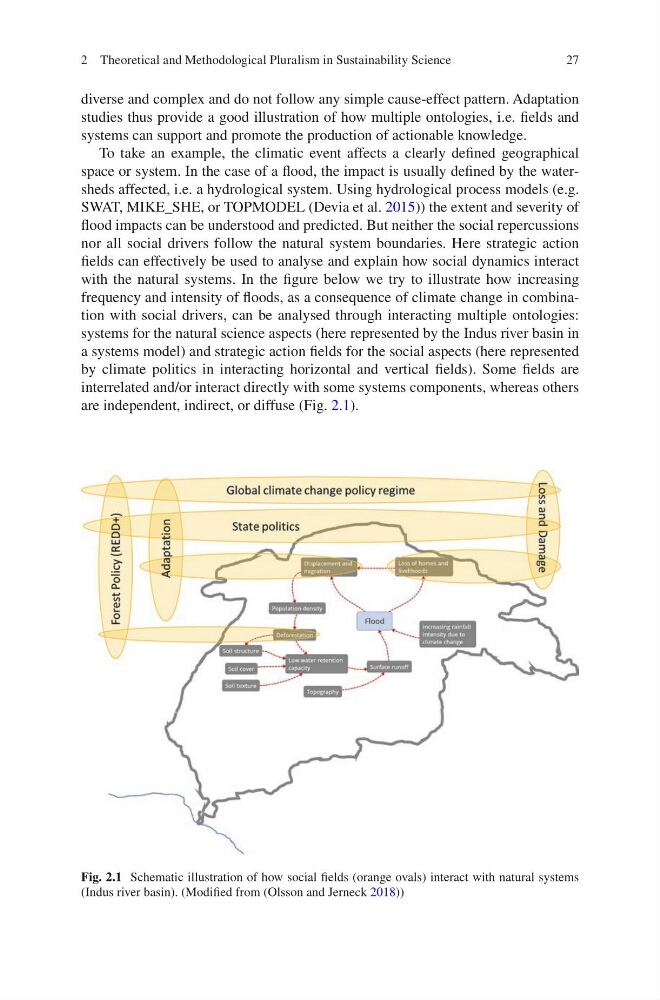
frequency and intensity of floods, as a consequence of climate change in combination with social drivers, can be analysed through interacting multiple ontologies:
systems for the natural science aspects (here represented by the Indus river basin in
a systems model) and strategic action fields for the social aspects (here represented
by climate politics in interacting horizontal and vertical fields). Some fields are
interrelated and/or interact directly with some systems components, whereas others
are independent, indirect, or diffuse (Fig. 2.1).
Fig. 2.1 Schematic illustration of how social fields (orange ovals) interact with natural systems
(Indus river basin). (Modified from (Olsson and Jerneck 2018))
2 Theoretical and Methodological Pluralism in Sustainability Science
diverse and complex and do not follow any simple cause-effect pattern. Adaptation
studies thus provide a good illustration of how multiple ontologies, i.e. fields and
systems can support and promote the production of actionable knowledge.
To take an example, the climatic event affects a clearly defined geographical
space or system. In the case of a flood, the impact is usually defined by the watersheds affected, i.e. a hydrological system. Using hydrological process models (e.g.
SWAT, MIKE_SHE, or TOPMODEL (Devia et al. 2015)) the extent and severity of
flood impacts can be understood and predicted. But neither the social repercussions
nor all social drivers follow the natural system boundaries. Here strategic action
fields can effectively be used to analyse and explain how social dynamics interact
with the natural systems. In the figure below we try to illustrate how increasing
frequency and intensity of floods, as a consequence of climate change in combination with social drivers, can be analysed through interacting multiple ontologies:
systems for the natural science aspects (here represented by the Indus river basin in
a systems model) and strategic action fields for the social aspects (here represented
by climate politics in interacting horizontal and vertical fields). Some fields are
interrelated and/or interact directly with some systems components, whereas others
are independent, indirect, or diffuse (Fig. 2.1).
Fig. 2.1 Schematic illustration of how social fields (orange ovals) interact with natural systems
(Indus river basin). (Modified from (Olsson and Jerneck 2018))
2 Theoretical and Methodological Pluralism in Sustainability Science