

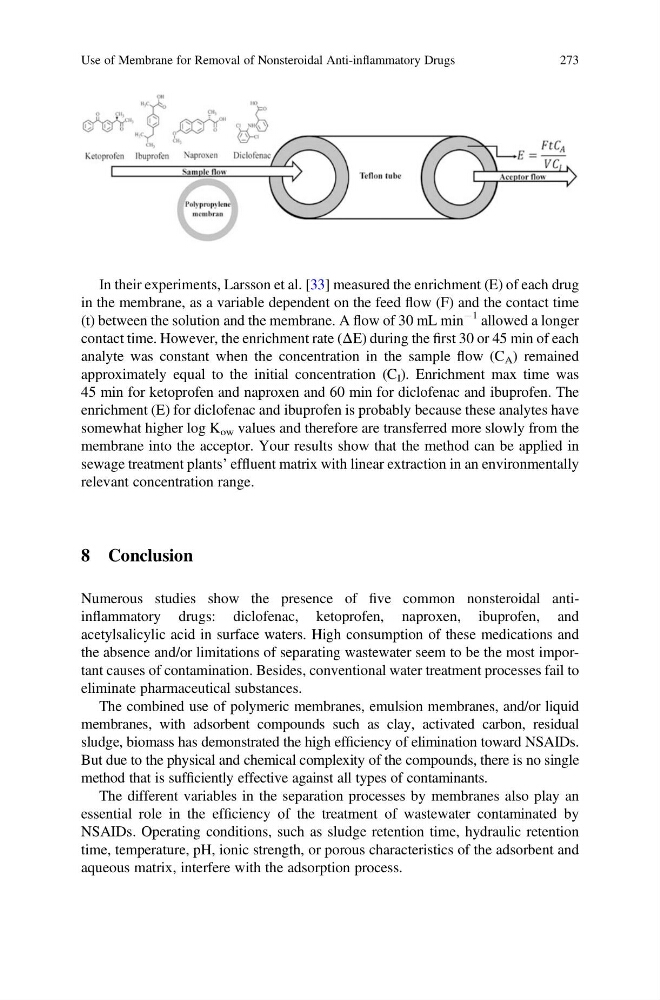
In their experiments, Larsson et al. [33] measured the enrichment (E) of each drug
in the membrane, as a variable dependent on the feed flow (F) and the contact time
(t) between the solution and the membrane. A flow of 30 mL min
À1 allowed a longer
contact time. However, the enrichment rate (ΔE) during the first 30 or 45 min of each
analyte was constant when the concentration in the sample flow (C A ) remained
approximately equal to the initial concentration (C I ). Enrichment max time was
45 min for ketoprofen and naproxen and 60 min for diclofenac and ibuprofen. The
enrichment (E) for diclofenac and ibuprofen is probably because these analytes have
somewhat higher log K ow values and therefore are transferred more slowly from the
membrane into the acceptor. Your results show that the method can be applied in
sewage treatment plants’ effluent matrix with linear extraction in an environmentally
relevant concentration range.
8 Conclusion
Numerous studies show the presence of five common nonsteroidal antiinflammatory drugs: diclofenac, ketoprofen, naproxen, ibuprofen, and
acetylsalicylic acid in surface waters. High consumption of these medications and
the absence and/or limitations of separating wastewater seem to be the most important causes of contamination. Besides, conventional water treatment processes fail to
eliminate pharmaceutical substances.
The combined use of polymeric membranes, emulsion membranes, and/or liquid
membranes, with adsorbent compounds such as clay, activated carbon, residual
sludge, biomass has demonstrated the high efficiency of elimination toward NSAIDs.
But due to the physical and chemical complexity of the compounds, there is no single
method that is sufficiently effective against all types of contaminants.
The different variables in the separation processes by membranes also play an
essential role in the efficiency of the treatment of wastewater contaminated by
NSAIDs. Operating conditions, such as sludge retention time, hydraulic retention
time, temperature, pH, ionic strength, or porous characteristics of the adsorbent and
aqueous matrix, interfere with the adsorption process.
Use of Membrane for Removal of Nonsteroidal Anti-inflammatory Drugs
273
in the membrane, as a variable dependent on the feed flow (F) and the contact time
(t) between the solution and the membrane. A flow of 30 mL min
À1 allowed a longer
contact time. However, the enrichment rate (ΔE) during the first 30 or 45 min of each
analyte was constant when the concentration in the sample flow (C A ) remained
approximately equal to the initial concentration (C I ). Enrichment max time was
45 min for ketoprofen and naproxen and 60 min for diclofenac and ibuprofen. The
enrichment (E) for diclofenac and ibuprofen is probably because these analytes have
somewhat higher log K ow values and therefore are transferred more slowly from the
membrane into the acceptor. Your results show that the method can be applied in
sewage treatment plants’ effluent matrix with linear extraction in an environmentally
relevant concentration range.
8 Conclusion
Numerous studies show the presence of five common nonsteroidal antiinflammatory drugs: diclofenac, ketoprofen, naproxen, ibuprofen, and
acetylsalicylic acid in surface waters. High consumption of these medications and
the absence and/or limitations of separating wastewater seem to be the most important causes of contamination. Besides, conventional water treatment processes fail to
eliminate pharmaceutical substances.
The combined use of polymeric membranes, emulsion membranes, and/or liquid
membranes, with adsorbent compounds such as clay, activated carbon, residual
sludge, biomass has demonstrated the high efficiency of elimination toward NSAIDs.
But due to the physical and chemical complexity of the compounds, there is no single
method that is sufficiently effective against all types of contaminants.
The different variables in the separation processes by membranes also play an
essential role in the efficiency of the treatment of wastewater contaminated by
NSAIDs. Operating conditions, such as sludge retention time, hydraulic retention
time, temperature, pH, ionic strength, or porous characteristics of the adsorbent and
aqueous matrix, interfere with the adsorption process.
Use of Membrane for Removal of Nonsteroidal Anti-inflammatory Drugs
273