

5.3 Oxidative Stress
Test systems were set up by adding industrial effluent and artificial sediment in a 3:1
ratio to 50-ml polyethylene containers equipped with constant oxygenation and
maintained under a 12-h/12-h photoperiod at room temperature. Light intensity
adjacent to the surface of the overlying water was 500 lux. The test was conducted
at a daily mean temperature (overlying water) of 23 Æ 1
C. Static systems were used,
the medium was not replaced, and no food was provided to specimens during
exposure. These systems were added with 1 g of biomass (Hyalella azteca), and
the exposure time of these organisms to such systems was 96 h. The oxidative stress
of an industrial effluent containing paracetamol was determined prior treatment and
posttreatment. Once the exposure time was over, 1 g of Hyalella azteca was
homogenized with phosphate buffer solution. The oxidative stress of the homogenized system was established through lipoperoxidation (LPX) degree by a previously reported method [51]; carbonyl proteins content (CPC) by the modified
method of Levine et al. [52]; cumene hydroperoxide (CHP) content by the method
of Jiang [53]; activity of the SOD by the method of Misra and Fridovich [54]; and
CAT by the method of Radi et al. [55]. This was conducted by triplicate. Also, the
protein content was determined [56] in order to normalize the results of the assessed
biochemical parameters.
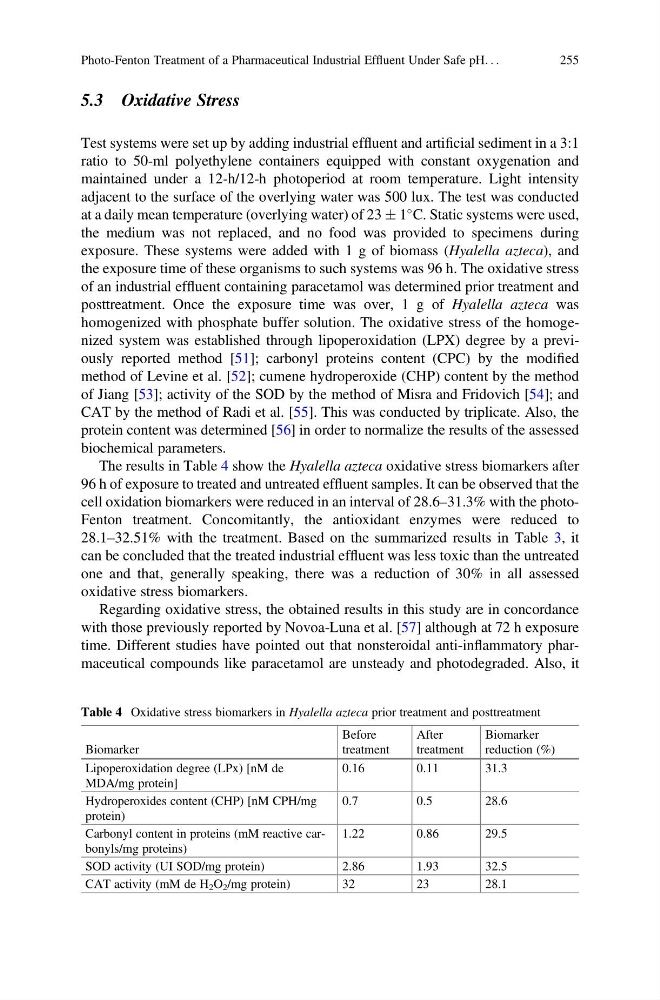
The results in Table 4 show the Hyalella azteca oxidative stress biomarkers after
96 h of exposure to treated and untreated effluent samples. It can be observed that the
cell oxidation biomarkers were reduced in an interval of 28.6–31.3% with the photoFenton treatment. Concomitantly, the antioxidant enzymes were reduced to
28.1–32.51% with the treatment. Based on the summarized results in Table 3, it
can be concluded that the treated industrial effluent was less toxic than the untreated
one and that, generally speaking, there was a reduction of 30% in all assessed
oxidative stress biomarkers.
Regarding oxidative stress, the obtained results in this study are in concordance
with those previously reported by Novoa-Luna et al. [57] although at 72 h exposure
time. Different studies have pointed out that nonsteroidal anti-inflammatory pharmaceutical compounds like paracetamol are unsteady and photodegraded. Also, it
Table 4 Oxidative stress biomarkers in Hyalella azteca prior treatment and posttreatment
Biomarker
Before
treatment
After
treatment
Biomarker
reduction (%)
Lipoperoxidation degree (LPx) [nM de
MDA/mg protein]
0.16
0.11
31.3
Hydroperoxides content (CHP) [nM CPH/mg
protein)
0.7
0.5
28.6
Carbonyl content in proteins (mM reactive carbonyls/mg proteins)
1.22
0.86
29.5
SOD activity (UI SOD/mg protein)
2.86
1.93
32.5
CAT activity (mM de H 2 O 2 /mg protein)
32
23
28.1
Photo-Fenton Treatment of a Pharmaceutical Industrial Effluent Under Safe pH. . .
255
Test systems were set up by adding industrial effluent and artificial sediment in a 3:1
ratio to 50-ml polyethylene containers equipped with constant oxygenation and
maintained under a 12-h/12-h photoperiod at room temperature. Light intensity
adjacent to the surface of the overlying water was 500 lux. The test was conducted
at a daily mean temperature (overlying water) of 23 Æ 1
C. Static systems were used,
the medium was not replaced, and no food was provided to specimens during
exposure. These systems were added with 1 g of biomass (Hyalella azteca), and
the exposure time of these organisms to such systems was 96 h. The oxidative stress
of an industrial effluent containing paracetamol was determined prior treatment and
posttreatment. Once the exposure time was over, 1 g of Hyalella azteca was
homogenized with phosphate buffer solution. The oxidative stress of the homogenized system was established through lipoperoxidation (LPX) degree by a previously reported method [51]; carbonyl proteins content (CPC) by the modified
method of Levine et al. [52]; cumene hydroperoxide (CHP) content by the method
of Jiang [53]; activity of the SOD by the method of Misra and Fridovich [54]; and
CAT by the method of Radi et al. [55]. This was conducted by triplicate. Also, the
protein content was determined [56] in order to normalize the results of the assessed
biochemical parameters.
The results in Table 4 show the Hyalella azteca oxidative stress biomarkers after
96 h of exposure to treated and untreated effluent samples. It can be observed that the
cell oxidation biomarkers were reduced in an interval of 28.6–31.3% with the photoFenton treatment. Concomitantly, the antioxidant enzymes were reduced to
28.1–32.51% with the treatment. Based on the summarized results in Table 3, it
can be concluded that the treated industrial effluent was less toxic than the untreated
one and that, generally speaking, there was a reduction of 30% in all assessed
oxidative stress biomarkers.
Regarding oxidative stress, the obtained results in this study are in concordance
with those previously reported by Novoa-Luna et al. [57] although at 72 h exposure
time. Different studies have pointed out that nonsteroidal anti-inflammatory pharmaceutical compounds like paracetamol are unsteady and photodegraded. Also, it
Table 4 Oxidative stress biomarkers in Hyalella azteca prior treatment and posttreatment
Biomarker
Before
treatment
After
treatment
Biomarker
reduction (%)
Lipoperoxidation degree (LPx) [nM de
MDA/mg protein]
0.16
0.11
31.3
Hydroperoxides content (CHP) [nM CPH/mg
protein)
0.7
0.5
28.6
Carbonyl content in proteins (mM reactive carbonyls/mg proteins)
1.22
0.86
29.5
SOD activity (UI SOD/mg protein)
2.86
1.93
32.5
CAT activity (mM de H 2 O 2 /mg protein)
32
23
28.1
Photo-Fenton Treatment of a Pharmaceutical Industrial Effluent Under Safe pH. . .
255