

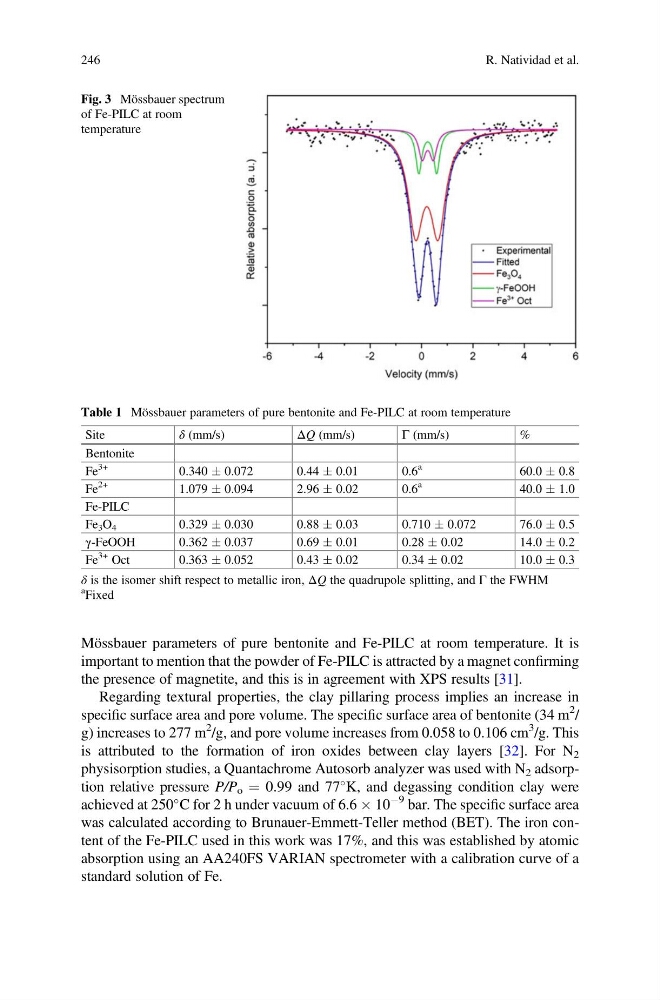
Mössbauer parameters of pure bentonite and Fe-PILC at room temperature. It is
important to mention that the powder of Fe-PILC is attracted by a magnet confirming
the presence of magnetite, and this is in agreement with XPS results [31].
Regarding textural properties, the clay pillaring process implies an increase in
specific surface area and pore volume. The specific surface area of bentonite (34 m
2 /
g) increases to 277 m
2 /g, and pore volume increases from 0.058 to 0.106 cm
3 /g. This
is attributed to the formation of iron oxides between clay layers [32]. For N 2
physisorption studies, a Quantachrome Autosorb analyzer was used with N 2 adsorption relative pressure P/P o ¼ 0.99 and 77
K, and degassing condition clay were
achieved at 250
C for 2 h under vacuum of 6.6 Â 10
À9 bar. The specific surface area
was calculated according to Brunauer-Emmett-Teller method (BET). The iron content of the Fe-PILC used in this work was 17%, and this was established by atomic
absorption using an AA240FS VARIAN spectrometer with a calibration curve of a
standard solution of Fe.
Fig. 3 Mössbauer spectrum
of Fe-PILC at room
temperature
Table 1 Mössbauer parameters of pure bentonite and Fe-PILC at room temperature
Site
δ (mm/s)
ΔQ (mm/s)
Γ (mm/s)
%
Bentonite
Fe
3+
0.340 Æ 0.072
0.44 Æ 0.01
0.6
a
60.0 Æ 0.8
Fe
2+
1.079 Æ 0.094
2.96 Æ 0.02
0.6
a
40.0 Æ 1.0
Fe-PILC
Fe 3 O 4
0.329 Æ 0.030
0.88 Æ 0.03
0.710 Æ 0.072
76.0 Æ 0.5
γ-FeOOH
0.362 Æ 0.037
0.69 Æ 0.01
0.28 Æ 0.02
14.0 Æ 0.2
Fe
3+ Oct
0.363 Æ 0.052
0.43 Æ 0.02
0.34 Æ 0.02
10.0 Æ 0.3
δ is the isomer shift respect to metallic iron, ΔQ the quadrupole splitting, and Γ the FWHM
a Fixed
246
R. Natividad et al.
important to mention that the powder of Fe-PILC is attracted by a magnet confirming
the presence of magnetite, and this is in agreement with XPS results [31].
Regarding textural properties, the clay pillaring process implies an increase in
specific surface area and pore volume. The specific surface area of bentonite (34 m
2 /
g) increases to 277 m
2 /g, and pore volume increases from 0.058 to 0.106 cm
3 /g. This
is attributed to the formation of iron oxides between clay layers [32]. For N 2
physisorption studies, a Quantachrome Autosorb analyzer was used with N 2 adsorption relative pressure P/P o ¼ 0.99 and 77
K, and degassing condition clay were
achieved at 250
C for 2 h under vacuum of 6.6 Â 10
À9 bar. The specific surface area
was calculated according to Brunauer-Emmett-Teller method (BET). The iron content of the Fe-PILC used in this work was 17%, and this was established by atomic
absorption using an AA240FS VARIAN spectrometer with a calibration curve of a
standard solution of Fe.
Fig. 3 Mössbauer spectrum
of Fe-PILC at room
temperature
Table 1 Mössbauer parameters of pure bentonite and Fe-PILC at room temperature
Site
δ (mm/s)
ΔQ (mm/s)
Γ (mm/s)
%
Bentonite
Fe
3+
0.340 Æ 0.072
0.44 Æ 0.01
0.6
a
60.0 Æ 0.8
Fe
2+
1.079 Æ 0.094
2.96 Æ 0.02
0.6
a
40.0 Æ 1.0
Fe-PILC
Fe 3 O 4
0.329 Æ 0.030
0.88 Æ 0.03
0.710 Æ 0.072
76.0 Æ 0.5
γ-FeOOH
0.362 Æ 0.037
0.69 Æ 0.01
0.28 Æ 0.02
14.0 Æ 0.2
Fe
3+ Oct
0.363 Æ 0.052
0.43 Æ 0.02
0.34 Æ 0.02
10.0 Æ 0.3
δ is the isomer shift respect to metallic iron, ΔQ the quadrupole splitting, and Γ the FWHM
a Fixed
246
R. Natividad et al.