

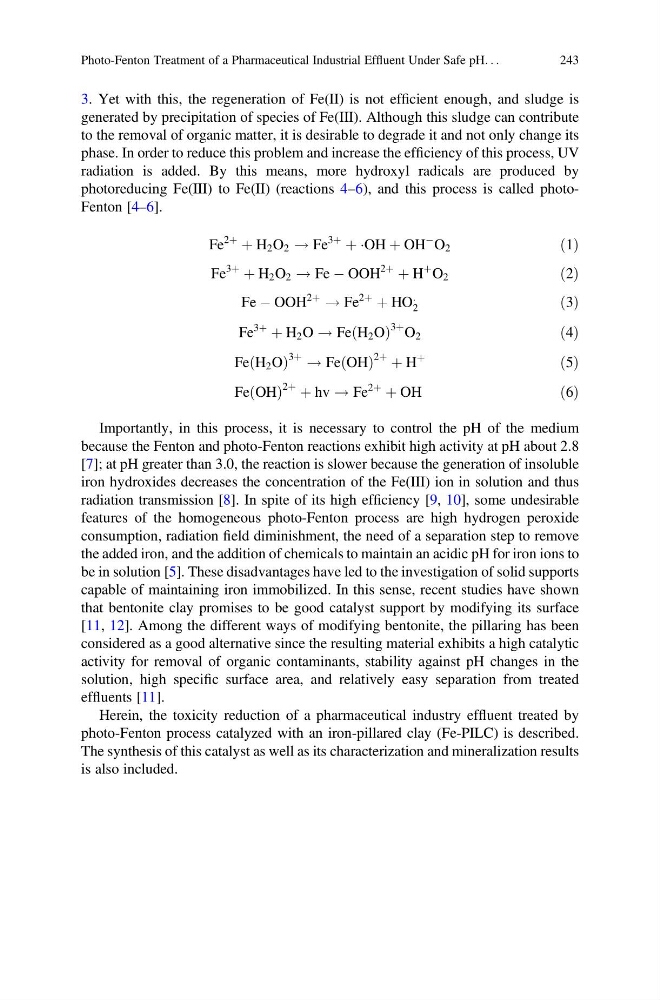
3. Yet with this, the regeneration of Fe(II) is not efficient enough, and sludge is
generated by precipitation of species of Fe(III). Although this sludge can contribute
to the removal of organic matter, it is desirable to degrade it and not only change its
phase. In order to reduce this problem and increase the efficiency of this process, UV
radiation is added. By this means, more hydroxyl radicals are produced by
photoreducing Fe(III) to Fe(II) (reactions 4–6), and this process is called photoFenton [4–6].
Fe
2þ
þ H 2 O 2 ! Fe
3þ
þ ÁOH þ OH
À O 2
ð1Þ
Fe
3þ
þ H 2 O 2 ! Fe À OOH
2þ
þ H
þ O 2
ð2Þ
Fe À OOH
2þ
! Fe
2þ
þ HO
:
2
ð3Þ
Fe
3þ
þ H 2 O ! Fe H 2 O
ð
Þ
3þ O 2
ð4Þ
Fe H 2 O
ð
Þ
3þ ! Fe OH
ð Þ
2þ þ H
þ
ð5Þ
Fe OH
ð Þ
2þ þ hv ! Fe
2þ
þ OH
ð6Þ
Importantly, in this process, it is necessary to control the pH of the medium
because the Fenton and photo-Fenton reactions exhibit high activity at pH about 2.8
[7]; at pH greater than 3.0, the reaction is slower because the generation of insoluble
iron hydroxides decreases the concentration of the Fe(III) ion in solution and thus
radiation transmission [8]. In spite of its high efficiency [9, 10], some undesirable
features of the homogeneous photo-Fenton process are high hydrogen peroxide
consumption, radiation field diminishment, the need of a separation step to remove
the added iron, and the addition of chemicals to maintain an acidic pH for iron ions to
be in solution [5]. These disadvantages have led to the investigation of solid supports
capable of maintaining iron immobilized. In this sense, recent studies have shown
that bentonite clay promises to be good catalyst support by modifying its surface
[11, 12]. Among the different ways of modifying bentonite, the pillaring has been
considered as a good alternative since the resulting material exhibits a high catalytic
activity for removal of organic contaminants, stability against pH changes in the
solution, high specific surface area, and relatively easy separation from treated
effluents [11].
Herein, the toxicity reduction of a pharmaceutical industry effluent treated by
photo-Fenton process catalyzed with an iron-pillared clay (Fe-PILC) is described.
The synthesis of this catalyst as well as its characterization and mineralization results
is also included.
Photo-Fenton Treatment of a Pharmaceutical Industrial Effluent Under Safe pH. . .
243
generated by precipitation of species of Fe(III). Although this sludge can contribute
to the removal of organic matter, it is desirable to degrade it and not only change its
phase. In order to reduce this problem and increase the efficiency of this process, UV
radiation is added. By this means, more hydroxyl radicals are produced by
photoreducing Fe(III) to Fe(II) (reactions 4–6), and this process is called photoFenton [4–6].
Fe
2þ
þ H 2 O 2 ! Fe
3þ
þ ÁOH þ OH
À O 2
ð1Þ
Fe
3þ
þ H 2 O 2 ! Fe À OOH
2þ
þ H
þ O 2
ð2Þ
Fe À OOH
2þ
! Fe
2þ
þ HO
:
2
ð3Þ
Fe
3þ
þ H 2 O ! Fe H 2 O
ð
Þ
3þ O 2
ð4Þ
Fe H 2 O
ð
Þ
3þ ! Fe OH
ð Þ
2þ þ H
þ
ð5Þ
Fe OH
ð Þ
2þ þ hv ! Fe
2þ
þ OH
ð6Þ
Importantly, in this process, it is necessary to control the pH of the medium
because the Fenton and photo-Fenton reactions exhibit high activity at pH about 2.8
[7]; at pH greater than 3.0, the reaction is slower because the generation of insoluble
iron hydroxides decreases the concentration of the Fe(III) ion in solution and thus
radiation transmission [8]. In spite of its high efficiency [9, 10], some undesirable
features of the homogeneous photo-Fenton process are high hydrogen peroxide
consumption, radiation field diminishment, the need of a separation step to remove
the added iron, and the addition of chemicals to maintain an acidic pH for iron ions to
be in solution [5]. These disadvantages have led to the investigation of solid supports
capable of maintaining iron immobilized. In this sense, recent studies have shown
that bentonite clay promises to be good catalyst support by modifying its surface
[11, 12]. Among the different ways of modifying bentonite, the pillaring has been
considered as a good alternative since the resulting material exhibits a high catalytic
activity for removal of organic contaminants, stability against pH changes in the
solution, high specific surface area, and relatively easy separation from treated
effluents [11].
Herein, the toxicity reduction of a pharmaceutical industry effluent treated by
photo-Fenton process catalyzed with an iron-pillared clay (Fe-PILC) is described.
The synthesis of this catalyst as well as its characterization and mineralization results
is also included.
Photo-Fenton Treatment of a Pharmaceutical Industrial Effluent Under Safe pH. . .
243