

2.4.1 Biological Treatment Coupled with Membrane Filtration
A complementation between membrane filtration and biological degradation of
NSAIDs in hybrid systems such as MBR coupled with NF/RO has been successfully
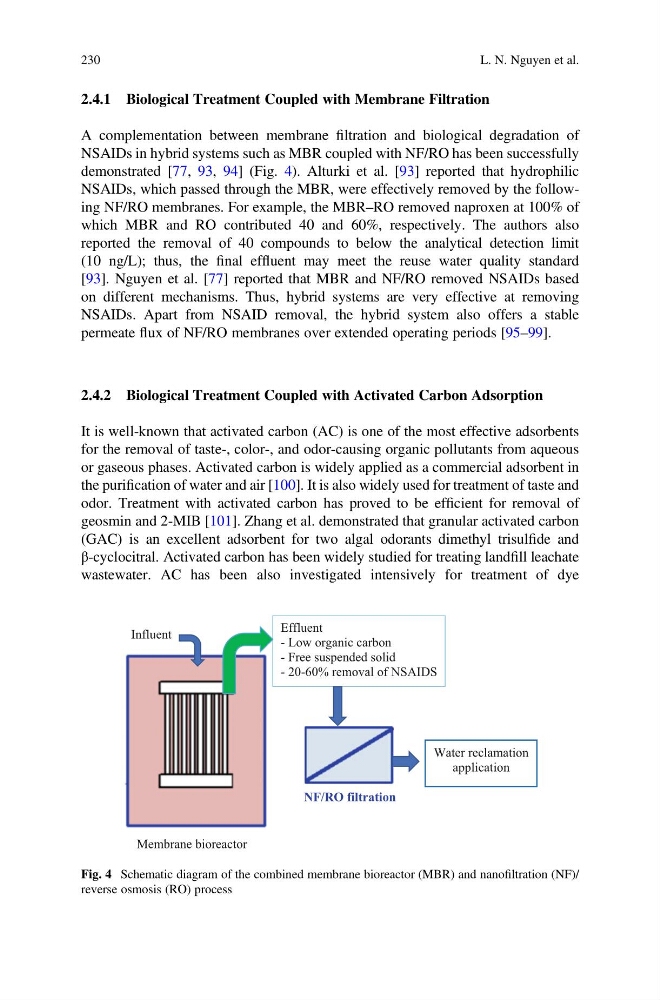
demonstrated [77, 93, 94] (Fig. 4). Alturki et al. [93] reported that hydrophilic
NSAIDs, which passed through the MBR, were effectively removed by the following NF/RO membranes. For example, the MBR–RO removed naproxen at 100% of
which MBR and RO contributed 40 and 60%, respectively. The authors also
reported the removal of 40 compounds to below the analytical detection limit
(10 ng/L); thus, the final effluent may meet the reuse water quality standard
[93]. Nguyen et al. [77] reported that MBR and NF/RO removed NSAIDs based
on different mechanisms. Thus, hybrid systems are very effective at removing
NSAIDs. Apart from NSAID removal, the hybrid system also offers a stable
permeate flux of NF/RO membranes over extended operating periods [95–99].
2.4.2 Biological Treatment Coupled with Activated Carbon Adsorption
It is well-known that activated carbon (AC) is one of the most effective adsorbents
for the removal of taste-, color-, and odor-causing organic pollutants from aqueous
or gaseous phases. Activated carbon is widely applied as a commercial adsorbent in
the purification of water and air [100]. It is also widely used for treatment of taste and
odor. Treatment with activated carbon has proved to be efficient for removal of
geosmin and 2-MIB [101]. Zhang et al. demonstrated that granular activated carbon
(GAC) is an excellent adsorbent for two algal odorants dimethyl trisulfide and
β-cyclocitral. Activated carbon has been widely studied for treating landfill leachate
wastewater. AC has been also investigated intensively for treatment of dye
Influent
Effluent
- Low organic carbon
- Free suspended solid
- 20-60% removal of NSAIDS
Water reclamation
NF/RO filtration
application
Membrane bioreactor
Fig. 4 Schematic diagram of the combined membrane bioreactor (MBR) and nanofiltration (NF)/
reverse osmosis (RO) process
230
L. N. Nguyen et al.
A complementation between membrane filtration and biological degradation of
NSAIDs in hybrid systems such as MBR coupled with NF/RO has been successfully
demonstrated [77, 93, 94] (Fig. 4). Alturki et al. [93] reported that hydrophilic
NSAIDs, which passed through the MBR, were effectively removed by the following NF/RO membranes. For example, the MBR–RO removed naproxen at 100% of
which MBR and RO contributed 40 and 60%, respectively. The authors also
reported the removal of 40 compounds to below the analytical detection limit
(10 ng/L); thus, the final effluent may meet the reuse water quality standard
[93]. Nguyen et al. [77] reported that MBR and NF/RO removed NSAIDs based
on different mechanisms. Thus, hybrid systems are very effective at removing
NSAIDs. Apart from NSAID removal, the hybrid system also offers a stable
permeate flux of NF/RO membranes over extended operating periods [95–99].
2.4.2 Biological Treatment Coupled with Activated Carbon Adsorption
It is well-known that activated carbon (AC) is one of the most effective adsorbents
for the removal of taste-, color-, and odor-causing organic pollutants from aqueous
or gaseous phases. Activated carbon is widely applied as a commercial adsorbent in
the purification of water and air [100]. It is also widely used for treatment of taste and
odor. Treatment with activated carbon has proved to be efficient for removal of
geosmin and 2-MIB [101]. Zhang et al. demonstrated that granular activated carbon
(GAC) is an excellent adsorbent for two algal odorants dimethyl trisulfide and
β-cyclocitral. Activated carbon has been widely studied for treating landfill leachate
wastewater. AC has been also investigated intensively for treatment of dye
Influent
Effluent
- Low organic carbon
- Free suspended solid
- 20-60% removal of NSAIDS
Water reclamation
NF/RO filtration
application
Membrane bioreactor
Fig. 4 Schematic diagram of the combined membrane bioreactor (MBR) and nanofiltration (NF)/
reverse osmosis (RO) process
230
L. N. Nguyen et al.