

and Nicell [33] reported 71–100% degradation of triclosan (20 μM), while the
measured laccase activity increased from 0.3 to 3 U/mL. Tran et al. [9] reported
that 2 mg/L of fungal laccase can degrade 60% of diclofenac and naproxen in the
effluent after a 3 h reaction.
Enzyme washout and inactivation are the limitation of enzyme application in
water treatment process [26, 34]. Depending on the origin of the laccase (fungal or
bacterial) and the reaction conditions, the half-life of the enzyme can vary from
minutes to days [35, 36]. The recovery of the enzyme and its reusability are key
factors for the feasibility of continuous-mode enzymatic reactors because the high
cost of the enzyme may limit their application [37]. Enzyme immobilization on a
support is one of the approaches to tackle this major limitation. Different supports,
namely, polyacrylonitrile, polystyrene, SiO 2 (celite), chitosan, and sol-gel, have
been used to immobilize laccase [29]. For example, Cabana et al. [38] immobilized
laccase on SiO 2 that degraded nonylphenol, bisphenol A, and triclosan in a packed
bed reactor. The use of membranes with pore size smaller than the molecular weight
of an enzyme is another approach to prevent enzyme washout from a continuous
flow enzymatic reactor. Enzymatic membrane reactor (EMR) allows for continuous
feeding and product withdrawal without loss of the enzyme. Depending on the EMR
design, the enzymes may be freely circulating in the retentate or immobilized onto
the membrane surface or inside its porous structure [26, 28, 39]. An example of
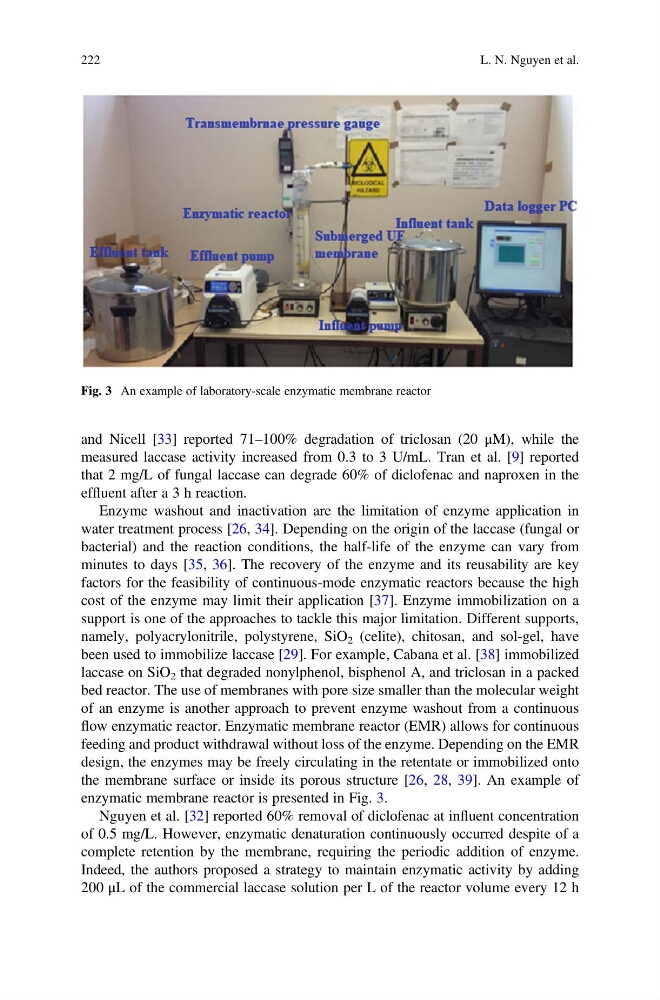
enzymatic membrane reactor is presented in Fig. 3.
Nguyen et al. [32] reported 60% removal of diclofenac at influent concentration
of 0.5 mg/L. However, enzymatic denaturation continuously occurred despite of a
complete retention by the membrane, requiring the periodic addition of enzyme.
Indeed, the authors proposed a strategy to maintain enzymatic activity by adding
200 μL of the commercial laccase solution per L of the reactor volume every 12 h
Fig. 3 An example of laboratory-scale enzymatic membrane reactor
222
L. N. Nguyen et al.
measured laccase activity increased from 0.3 to 3 U/mL. Tran et al. [9] reported
that 2 mg/L of fungal laccase can degrade 60% of diclofenac and naproxen in the
effluent after a 3 h reaction.
Enzyme washout and inactivation are the limitation of enzyme application in
water treatment process [26, 34]. Depending on the origin of the laccase (fungal or
bacterial) and the reaction conditions, the half-life of the enzyme can vary from
minutes to days [35, 36]. The recovery of the enzyme and its reusability are key
factors for the feasibility of continuous-mode enzymatic reactors because the high
cost of the enzyme may limit their application [37]. Enzyme immobilization on a
support is one of the approaches to tackle this major limitation. Different supports,
namely, polyacrylonitrile, polystyrene, SiO 2 (celite), chitosan, and sol-gel, have
been used to immobilize laccase [29]. For example, Cabana et al. [38] immobilized
laccase on SiO 2 that degraded nonylphenol, bisphenol A, and triclosan in a packed
bed reactor. The use of membranes with pore size smaller than the molecular weight
of an enzyme is another approach to prevent enzyme washout from a continuous
flow enzymatic reactor. Enzymatic membrane reactor (EMR) allows for continuous
feeding and product withdrawal without loss of the enzyme. Depending on the EMR
design, the enzymes may be freely circulating in the retentate or immobilized onto
the membrane surface or inside its porous structure [26, 28, 39]. An example of
enzymatic membrane reactor is presented in Fig. 3.
Nguyen et al. [32] reported 60% removal of diclofenac at influent concentration
of 0.5 mg/L. However, enzymatic denaturation continuously occurred despite of a
complete retention by the membrane, requiring the periodic addition of enzyme.
Indeed, the authors proposed a strategy to maintain enzymatic activity by adding
200 μL of the commercial laccase solution per L of the reactor volume every 12 h
Fig. 3 An example of laboratory-scale enzymatic membrane reactor
222
L. N. Nguyen et al.