

5 Sublethal Effects
Although acute toxicity tests are of regulatory interest to derive PNECs for posterior
risk characterization, environmentally relevant concentrations of isolated compounds are generally not likely to cause mortality in exposed organisms; thus lethal
effects are unlikely to occur in the aquatic medium [73, 82] unless in cases of
accidental spills. Thus, recent developments in risk assessment are undergoing a
shift toward the observation of effects produced at the longer term in environmentally relevant concentrations. Chronic low-level exposure has shown to be able to
induce sublethal responses that in the long term represent a hazard to natural
populations by reducing their relative fitness and competitiveness, altering behaviors
or inducing other subtle changes that make the persistence of populations difficult.
When the focus is directed toward endpoints that only describe lethality, an opportunity to capture broader exposure-related sublethal effects is neglected although
these generally precede mortality, providing a linkage between sublethal and lethal
toxicities [83]. If chronic effects are more appropriate to the questions being asked
within a risk assessment context, then alternative test endpoints must be developed
and standardized. Chronic bioassays should measure ecologically relevant endpoints
which enable effects at the population level to be predicted.
Effect evaluations based on sublethal endpoints most frequently comprise behavioral and morphological observations to evaluate chronic effects associated with
contaminant exposure. Chronic, sublethal exposure to contaminants, however, must
not be underestimated due to the lack of immediate, alarming effects, as their subtler
establishment is able to cause effects on fitness, performance, and reproduction in the
DF-IB
Concentration (mgL -1 )
0
2 0
4 0
6 0
8 0
Mortality %
0
20
40
60
80
100
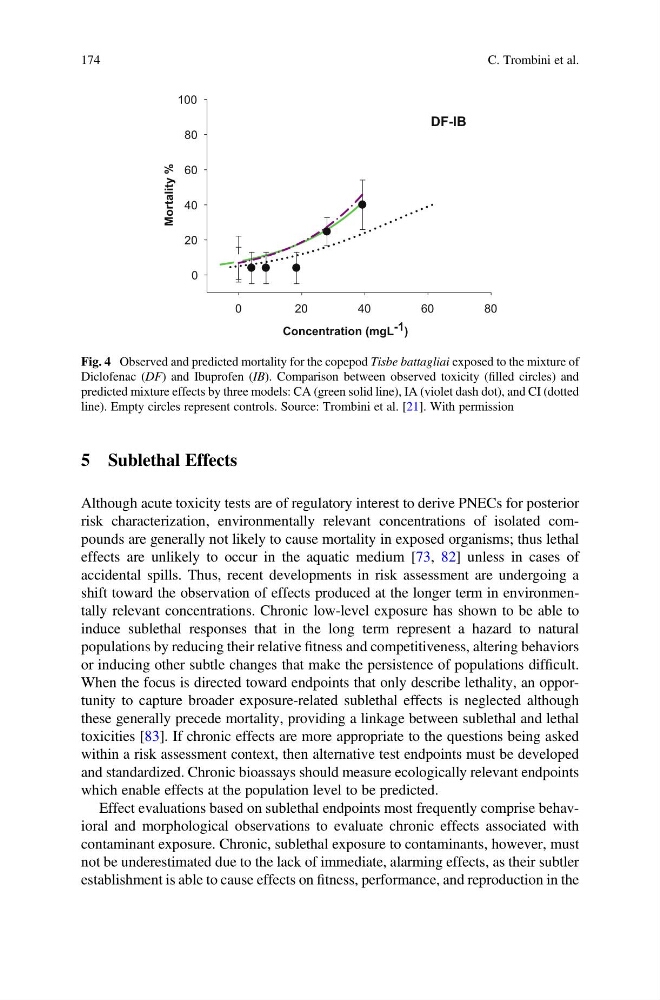
Fig. 4 Observed and predicted mortality for the copepod Tisbe battagliai exposed to the mixture of
Diclofenac (DF) and Ibuprofen (IB). Comparison between observed toxicity (filled circles) and
predicted mixture effects by three models: CA (green solid line), IA (violet dash dot), and CI (dotted
line). Empty circles represent controls. Source: Trombini et al. [21]. With permission
174
C. Trombini et al.
Although acute toxicity tests are of regulatory interest to derive PNECs for posterior
risk characterization, environmentally relevant concentrations of isolated compounds are generally not likely to cause mortality in exposed organisms; thus lethal
effects are unlikely to occur in the aquatic medium [73, 82] unless in cases of
accidental spills. Thus, recent developments in risk assessment are undergoing a
shift toward the observation of effects produced at the longer term in environmentally relevant concentrations. Chronic low-level exposure has shown to be able to
induce sublethal responses that in the long term represent a hazard to natural
populations by reducing their relative fitness and competitiveness, altering behaviors
or inducing other subtle changes that make the persistence of populations difficult.
When the focus is directed toward endpoints that only describe lethality, an opportunity to capture broader exposure-related sublethal effects is neglected although
these generally precede mortality, providing a linkage between sublethal and lethal
toxicities [83]. If chronic effects are more appropriate to the questions being asked
within a risk assessment context, then alternative test endpoints must be developed
and standardized. Chronic bioassays should measure ecologically relevant endpoints
which enable effects at the population level to be predicted.
Effect evaluations based on sublethal endpoints most frequently comprise behavioral and morphological observations to evaluate chronic effects associated with
contaminant exposure. Chronic, sublethal exposure to contaminants, however, must
not be underestimated due to the lack of immediate, alarming effects, as their subtler
establishment is able to cause effects on fitness, performance, and reproduction in the
DF-IB
Concentration (mgL -1 )
0
2 0
4 0
6 0
8 0
Mortality %
0
20
40
60
80
100
Fig. 4 Observed and predicted mortality for the copepod Tisbe battagliai exposed to the mixture of
Diclofenac (DF) and Ibuprofen (IB). Comparison between observed toxicity (filled circles) and
predicted mixture effects by three models: CA (green solid line), IA (violet dash dot), and CI (dotted
line). Empty circles represent controls. Source: Trombini et al. [21]. With permission
174
C. Trombini et al.